
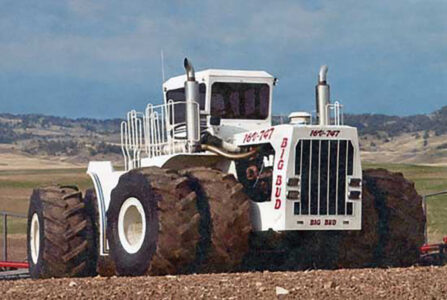

When it comes to tractors, how big is big? Western and Great Plains farmers buy the biggest tractors they can find, justifying expensive purchase prices by the rate at which their massive fields can be tilled.
Midwestern, Eastern and Southern farmers are less interested in size, instead basing their tractor size and power on specialized needs like rice, orchard or high-clearance specials. But size is subjective: do you go by weight comparison, drawbar horsepower, tire/wheel size or price?
In the beginning, large tractors had a lot less horsepower than their modern counterparts, but that just meant they traveled more slowly, pulling the same number of plow bottoms. The weight of the biggest grew over time, beginning in the 1920s at about 20,000 pounds for an internal combustion tractor (double that for steam) to as much as 50,000 pounds in the 1970s, when weight and horsepower peaked.
Originally, high horsepower numbers came via steam, but steam ratings are often confusing and not always based on “torque times speed.” The need for traction in the days before rubber tires led to steel rear wheels 7 or 8 feet in diameter, and in some cases, crawler tracks. In modern times, four-wheel drives and articulated steering became the norm.