
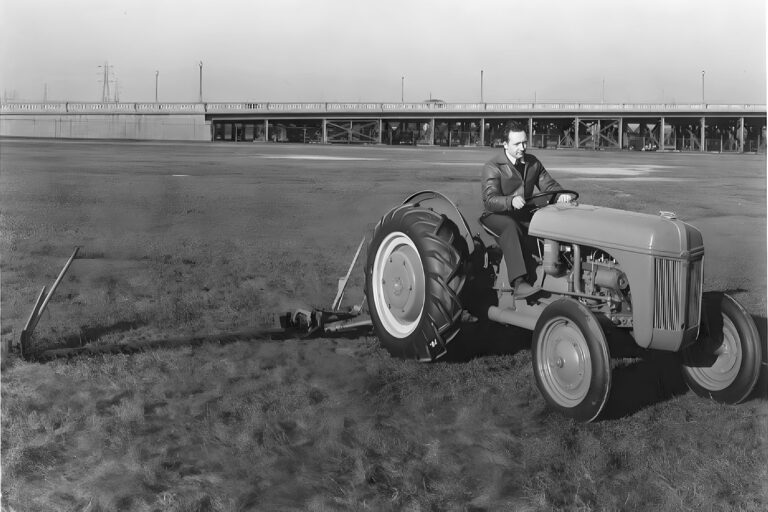
Frederick (Fred) A. Stobbe (1913-1974) was born and raised in Detroit and spent almost his entire working life there as a tractor technician and tester. Though not a farmer, Fred was present at some of the most critical moments in mid-20th-century tractor history, working for Ford, Ferguson, and Jeep.
Fred never formally recorded his story, but he kept a series of work photographs that captured those key historical moments. Each of these photographs tells a story involving some of the biggest names and events in tractor history.
Unearthing the story
When Larry Stobbe shared photos and a brief account of his late father Fred’s career on social media, one image immediately stood out: Fred driving a Willys Jeep equipped with a Newgren lift. As a Willys-Overland historian, I noticed the photo bore a factory series number, hinting at a deeper story.
Larry noted that Fred spent most of his career at Ford’s Tractor & Implement Division. This raised a compelling question: Was Ford testing the Willys Farm Jeep as a competitor, much as they did with other tractors?
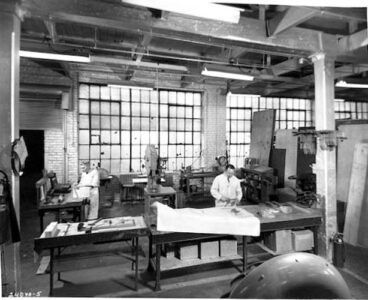
While waiting to connect with Larry, I shared the images with the Henry Ford Museum and the Ford Motor Co. Archives. Research Archivist Jamie Myler confirmed that while the archives held some of the collection, the Jeep photos and those marked “Tractor & Implement Division” were missing from their records.
By the time contact with Larry was established, it was clear that the story was more significant than initially thought. Fred Stobbe was a man who not only witnessed but also actively participated in significant moments in tractor history. Larry and I began to examine the photographs, each of which revealed a new chapter in the story.
A foot in the door with the Bellman
According to his son, Fred graduated from Dearborn High School around 1929 or 1930. He pursued independent trade and technical engineering courses while working as a bellman at The Dearborn Inn, from approximately 1930 to 1938. Ford Archivist Jamie Myler suggested that the image of the bellman and the Lincoln car was likely a staged marketing photograph.
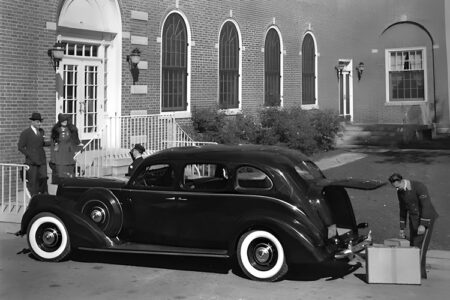
The history of the Dearborn Inn itself is significant. It was commissioned by Henry Ford, designed by Albert Kahn in the Georgian style, and officially opened in July 1931 as one of the nation’s first airport hotels, serving passengers of the adjacent Ford Airport. Although the Ford Airport closed in 1933 (the land was later used for the Ford Motor Co.’s test track), the Inn remained successful, serving visitors to the Henry Ford Museum and Greenfield Village, and Ford Motor Co. guests.
Fred’s position as a bellman placed him at the center of major events at Ford in the late 1930s. The bellman was the first point of contact for guests, allowing enterprising young men like Fred to make connections that would prove beneficial later in their careers. This seems to be precisely what happened with Fred.
Testing the 9N to start a career
Sometime between 1938 and 1941, Fred apparently crossed the street from the inn and began his career as a tractor technician at Ford Engineering. Fred’s duties included both field testing and lab work.
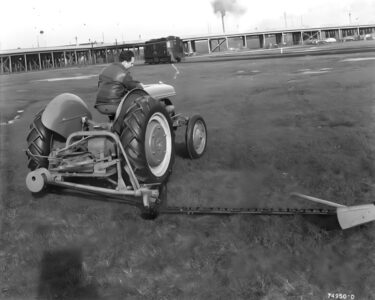
According to the Ford archives, the two photos of Fred testing the 9N with a mower were taken in February 1941. With no employment records available from that period and no family history, we can only infer on a start date. It’s possible that Fred was there at the very beginning of the 9N era.
Enter WWII and Post-War shifts
Ten months after the 9N testing pictures were taken, WWII began. It shifted the peacetime economy to full wartime status, where most production came under government control. Although production of the Ford 9N officially ceased in 1942, the assembly line continued under the new brand name, the “2N.” This designation was initially a strategic move to circumvent the Office of Price Administration’s price freezes and allow Ford to adjust pricing for the mechanically identical machine.
However, as the war intensified, the War Production Board declared materials such as copper, rubber, and chromium critical to the war effort, thereby forcing Ford to alter the 2N’s composition drastically.
Fred was drafted into service in 1943. He advanced to the rank of Sergeant with the U.S. Army Corps of Engineers, 460th Division, and toured Europe and North Africa. He was discharged in December 1945, returning home to find his job had vanished, a common experience for many veterans.
At Ford, tractor production didn’t resume after the Victory over Japan Day. Instead, Ford’s 2N underwent a rapid evolution that culminated in July 1947. The Wartime 2N tractor slowly regained electrical components and rubber tires as supply chains normalized in 1945 and 1946. To stop financial losses, Henry Ford II ended the long-standing “handshake agreement” with Harry Ferguson.
Engineers were tasked with modernizing the platform to avoid patent infringement and create a distinct identity for Ford’s new distribution arm, Dearborn Motors. The result was the Ford 8N, a machine that visually and mechanically broke from the “Ferguson era.” Its new features included a four-speed transmission for better field-speed selection, a “position control” hydraulic setting for precise implement holding, and a revised brake layout with both pedals on the right side. These changes transformed the N-series into a modern post-war icon.
A critical juncture
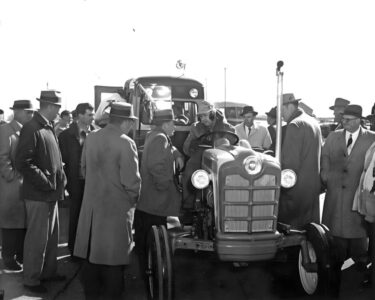
Larry doesn’t know the details of his father’s employment immediately after the war. Once again, Fred’s photo collection provides vital clues. The inscription on the back of the group photograph reads “Ferguson Education Farm, July 1946.” The stamp on the back of the photo identifies the host as the Truck-Tractor Equipment Co., the regional Ford-Ferguson distributor in Columbus, Ohio.
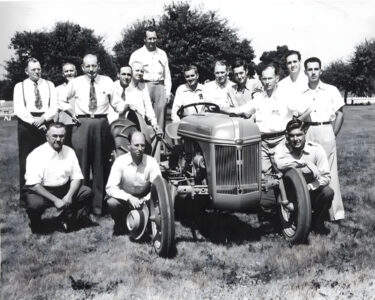
The “Ferguson Educational Farm” was a temporary demonstration site or a mobile training event, not a permanent institution. Fred, standing tall and centered in the photograph, would have been an asset to the Ferguson team. His prior testing experience with the 9N would have made him an ideal instructor for the “Ferguson System.”
This places Fred within the Ferguson organization at a critical moment. With the Ford partnership crumbling, Harry Ferguson used these events to demonstrate that the Ferguson System was a viable product and independent of the Ford tractor. He was trying to prevent his distribution network from defecting to Ford before the official split in 1947 and the introduction of his TO-20 tractor.
The Newgren Co. and Willys Jeep
My initial interest in Fred’s story stemmed from the Jeep photos, with the first thought being that Ford was testing Jeep as a competitor’s tractor. However, learning more about Fred and Ford at the time made it clear this wasn’t the case. The photographs, lacking information beyond an ID number, are easy to date. The Jeep is a CJ2a model equipped with a Newgren implement lift, which was in production from late 1946 to late 1948. I believe the photo was taken at Charles Sorensen’s CESOR Farms, the same location where the 1939 Ford 9N had been tested.
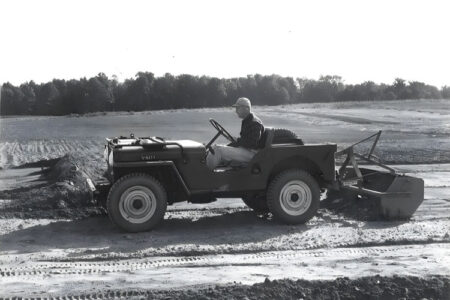
Charles Sorensen, Henry Ford’s right-hand man for 40 years, became president of Willys-Overland in 1944 and oversaw the development of the civilian Jeep. He also instructed two of his employees to form a company (Newgren Equipment) to provide hydraulic implement lifts and equipment to compete with Ford and Ferguson. Either Willys or Newgren could have employed Fred.
Newgren was purchased by the Monroe Auto Equipment Co. in 1948. Monroe, known for shock absorbers, had created its own hydraulic lift for the Jeep and assumed responsibility for marketing, testing, and distributing lifts and implements. There’s no information on Fred’s employment between 1948 and 1950. It’s possible that he continued testing the Jeep. Monroe had its own testing farms, including one near Monroe, Michigan, close to Detroit. Willys and Monroe appear to have been conducting testing at both CESOR Farms and Monroe’s farm during this period.
Aside from stills taken from promotional films from this period, Fred’s two photos are the only record of Farm Jeep testing I’ve found. These photos are important additions to Farm Jeep history.
Meanwhile, back at Ford: The NAA & T&ID
Larry believes that his father returned to Ford around 1950. Post-Ferguson, Ford needed to create an entirely new tractor line that didn’t violate the N-tractor settlement and simultaneously met market demand for higher-horsepower tractors.
The Ford NAA tractor, launched in 1953, was Ford’s first truly independent design since the pre-Ferguson era. Ford was required to incorporate proprietary hydraulic controls that didn’t infringe on Ferguson’s patents and were powered by the new 134-cubic-inch “Red Tiger” engine. Ford would’ve had a clear need for experienced tractor testers, and Fred could easily have rejoined the company during this period, remaining through the formation of the Tractor & Implement Division (T&ID).
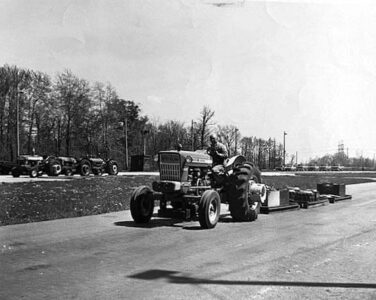
The Farm Machinery Research and Engineering Center was established in Birmingham, Michigan, in June 1955. It centralized the design process for T&ID’s new structure and formalized commitment to independent engineering. By gathering approximately 1,100 specialized personnel under one roof, Ford wanted to elevate farm-tools engineering to industrial efficiency standards. The heavy investment reflected management’s goal to seize control over product quality and innovation, correcting past issues with external partners and wartime compromises. This engineering rigor was sometimes undermined by corporate urgency.
The Select-O-Speed failure
Fred Stobbe was at the center of one of the most infamous events in Ford tractor history. Fred was one of the testers of the new Select-O-Speed transmission. Harold Brock, who’d been handpicked by Henry Ford to lead the original 9N development, was T&ID’s Chief Engineer two decades later. Brock was deeply concerned about the Select-O-Speed test results. He informed the executives that, based on the testing, the system was unreliable and not ready for mass production, and he refused to sign off on the project. In what is widely regarded as one of the worst management decisions of the 20th century, Brock was dismissed, and the tractor was put into production.
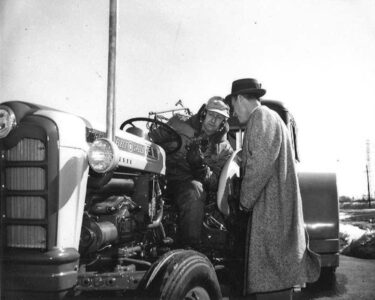
As Brock had warned, every tractor Ford sold had to be recalled and rebuilt with a redesigned system. The managers responsible for firing Brock were subsequently dismissed, and although Ford attempted to rehire him, Brock refused to return. Production of tractors was halted for 18 months while the problems identified in testing and in the field were corrected. When the recalled tractors were returned to their owners, they bore a new blue-and-light-gray paint scheme, marking a symbolic, albeit costly, organizational reset.
Beyond the millions spent on rectifying the error, Ford’s failure gave a significant market boost to competitor John Deere for years to come. The John Deere 4020, launched in 1963, was an immediate and overwhelming success. Designed by the team Brock led, the 4020 is remembered as one of the most influential and important tractors in U.S. history. Its defining competitive advantage was its transmission. The John Deere 4020 featured the “first successful full powershift transmission” (the Power Shift), which offered the same functional advantage as Ford had sought, but with proven reliability.
The Final Years: From 9N to 8000
Larry remembers that his father was laid off during Ford’s shutdown period. Fred was rehired when production resumed. The disciplined engineering approach that followed the Select-O-Speed debacle allowed Ford to successfully re-enter the high-horsepower segment by the end of the 1960s. The introduction of the Model 8000 in 1968 marked a turning point for Ford, restoring its reputation. Over the next three decades, Ford undertook strategies that would eventually eliminate its tractor production.
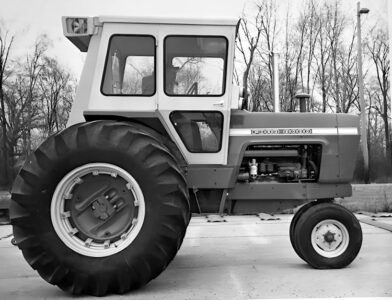
Fred’s final photographs from his career as a tractor tester demonstrate the enormous changes over three decades. He’d tested everything from the small 9N, which offered the driver no comfort, to the modern Model 8000, which featured heated and air-conditioned cabs. He witnessed technological changes, both large and small, that fundamentally shaped modern farming.
According to Larry, Fred continued his career with T&ID until a period of economically related cost-cutting in 1974, which forced him and many other “seasoned” personnel into early retirement. Fred passed away suddenly, shortly thereafter, at the age of 60.
The importance of the tester
Many people associate tractor testing with the Nebraska Tractor Test Laboratory. Fred Stobbe’s photographs, however, have provided a new understanding of the importance of manufacturers’ in-house testing programs. Each of his photos tells a compelling story of 20th-century tractor development and highlights the critical role of tractor technicians and testers, who helped shape the future of farming.
I want to thank Larry for sharing his father’s legacy. You can see more of the story and more photos by visiting www.FarmJeep.com. There, too, you’ll find all the reference materials used for this article. You can learn more about the Ford/Jeep relationship by reading my Farm Collector article titled How the Ford 9N Tractor Saved Willys-Overland. To learn more about Harry Ferguson, read the Farm Collector article Harry Ferguson: Building in Safety.
Barry Thomas and his son Evan have posted their Willys Jeep adventures since 2002. After Barry’s retirement, he turned his passion for history toward documenting the Farm Jeep story, including several articles on the Farm Jeep and its impact on the automotive industry and agriculture. Email Barry at barry@farmjeep.com.


