

In America today, it’s hard to visualize what the world was like before the Rural Electrification Act of 1936.
The REA brought electricity to all the tiny backwoods settlements. What would your house look like if electricity simply disappeared?
Cities had AC electricity many years before public funding through the REA made it possible to build costly high-power lines and sub-stations that sent power our to cities and down roadways.
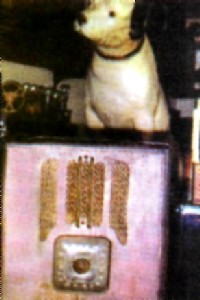
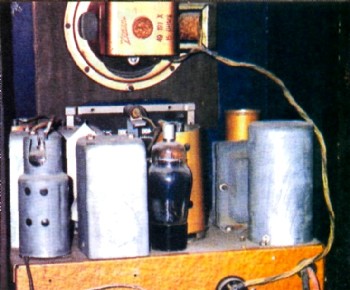
In the mid-1930s, most radio manufacturers made AC radios and “farm radios.” The battery-operated farm radios, running on DC, were designed for a rural market that hadn’t yet been touched by municipal power systems. From the cabinet front, you wouldn’t know the difference between a farm radio and an AC model in town. But while the AC model plugged into a wall outlet, the farm radio clipped onto batteries.
These 6-, 12-, and 32-volt batteries weren’t like the neat little things that we pop out of blister packs today. They were heavy jars or hard rubber containers filled with sulfuric acid (oil of vitriol) that were kept in the basement. A heavy wire, passing through a hole in the living room floor, connected the battery and the radio. The battery was often kept in the basement because the lady of the house objected to the smell, and to the burnt holes in the carpet resulting from leaks, which were frequent.
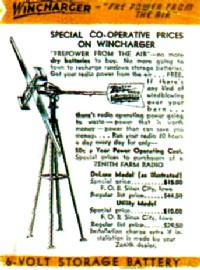
Batteries had to be recharged, but they weighed too much to be taken somewhere to have that done. Most people bought a gas-powered generator for that purpose, but some used windmill power plants. The Zenith Radio Company made a popular windmill system called the “Zenith Wincharger with ‘FrePower from the Air.'” Winchargers occasionally show up on eBay auctions.
The wind chargers gave free power and worked for a lifetime, but they weren’t the perfect solution.
“They worked well,” says David Salny, a historian and collector of antique radios. “The problem was the small windmills could only charge a 6-volt system. You couldn’t run a radio, lights and a household on a small generator. The generators would have to be huge and heavy and hard to install, with very large paddles on the windmills to get higher direct current. Small farms couldn’t afford to do that.”
Although at the time of its invention, direct current electricity was a marvel, it was in fact inefficient and difficult, if not impossible, to transport farther than a mile. Soon, though, George Westinghouse and others developed the alternate current system. Large alternators and transformer stations could generate high voltages of 13,500 volts (high pressure) with low amperage (low current) traveling down hundreds of miles of wire to individual homes and businesses. A more efficient system than DC, AC eventually spread throughout the country. But according to Salny, as recently as 30 years ago, small sections of the country continued to operate on DC electricity.
As high-power wires were installed throughout the countryside, farmers and other rural households disconnected their DC generators and hooked up to the new AC system. Because these farm generators and battery sets were so heavy, many people never bothered hauling them out of their cellars. Salny says it’s not uncommon to find an old Fairbanks-Morse gas-powered electric plant, a popular system of the day, corroding in the cellar of old or abandoned farm homes.
Zenith, Philco and Lafayette were the three most common brands of farm radios. In Lafayette’s 1935 catalog (No. 56), the copywriter raved about the Lafayette 10-tube, all-wave battery super-het farm radio series called “The Adventurer.” Lafayette, “The Largest Radio Mail Order House in the World,” sold that model for $44.75 (mantle cabinet) or $52.95 (console cabinet) with tubes included (or, for an extra $10.40, the Burgess Batteries and Eveready Air-Ceil, shipping weight 85 pounds).
If that looked like a budget buster, Lafayette also offered a scaled-down Adventurer with tubes and speaker, but less battery capacity, for $39.75, or the Lafayette 5-tube battery super-het Model B-61 with tubes and speaker, less batteries, for $22.95. It was possible to buy a chassis without speakers or cabinet, so care was required when ordering.
The number of tubes in the radio controlled the range of receiving bands. The more expensive units, with 10 tubes, covered the total tuning range of 15 to 565 meters, which took in all American broadcasting stations, police stations and calls, amateur, airport, aircraft, boating, and foreign shortwave. How remote you were and how many tubes your radio had were the limiting factors in how much entertainment you received from your radio.
Today’s high-power lines bring electricity over hundreds of miles. Very seldom does anyone even think about how that power is made, or stored. But there was a time when people had to plan ahead: “Let’s see, the wind’s not blowing, so the batteries aren’t being charged. That means we can’t use the light very long tonight, or there won’t be enough power for tomorrow morning’s kitchen light and radio.”
Nowadays, we just make sure we pick up a 4-ounce package of batteries to stick into our radio or appliance. Or, just flip a switch. FC
June S. MacArthur is a freelance writer living in Florida.


