Just as ancient man came up with the idea for the wheel, it was probably only a matter of time until someone devised the idea of squeezing loose hay into a package that could by tied, handled and transported. But until the mid-1800s, hay that was harvested for livestock was simply piled into stacks or moved into the barn for use during the winter. Moving the crop involved pitching it onto a wagon and pitching it back off at the destination.
Built into the barn
That all changed in the mid-1800s, with invention of the first mechanical hay press. Most of the earliest hay presses were stationary units built into a barn and extending two to three stories into the hayloft. Generally, a team of horses was used to raise a press weight, which was then dropped to compress the hay. Other versions used a horse- or mule-powered sweep at the bottom of the press to turn a jackscrew or a geared press.
Unlike later hay presses, these permanent models often made bales weighing as much as 300 pounds, secured by as many as five strands of wire or twine. One such press was built by P.K. Dederick’s Sons, Albany, N.Y., in 1843. Another, invented in 1843 by Samuel Hewitt, Switzerland County, Ohio, is on display at a landscape company in Lawrenceburg, Ind. Marketed as the Mormon Beater Hay Press, it was powered by a mule attached to a sweep at the bottom of the press. The mule was then led counter-clockwise to lift a 1,000-pound wooden weight to the third-floor level via a pulley.
On the second story, workers pitched loose hay into the baling compartment, where a hinged door opened to the side of the press. Once the compartment was filled with hay, the door was closed by counterweights. The attendant then pulled the trip lever, which allowed the weight to drop into the baling compartment and compress the hay. It usually took six or seven cycles to form a 300-pound bale.
The press also included a jackscrew, which pushed the baling compartment floor downward when the mule was led counter-clockwise. However, to finish the bale, the mule was led clockwise six times, which rotated the jackscrew to again bring the bottom of the bale level with the second floor. At that point, the door was opened, the bale tied and removed.
Rise of the portable press
It wasn’t long before hay presses became more mobile, going to the field and from farm to farm, much like the threshing machines of the day. Consequently, the first people to own the machines were custom operators and hay dealers who would buy a quantity of hay from a farmer, then bale it before transporting it to market. A few models, however, were sized and built for private use.
Like the larger models on the market, those required the hay to be deposited into a square chute and compressed. The difference was that these models used manpower (via a lever or crank) rather than horsepower. One such baler, on display at the Pioneer Village in Minden, Neb., was built by William Henry Penniston, Fox, Mo., in 1863. The wooden hay press was entirely hand-operated, requiring workers to fill the upright chamber with hay, pack it with a lever-operated jack-type ratchet, tie the bale with wire or cord once the chamber was full and then open the front door to eject the bale. With a coordinated effort, a crew could supposedly build up to 72 bales in one day.
The Winona (Minn.) Fence Co. also built a portable hay press for those wishing to “go it alone.” Designed as a horizontal press, the Winona Common Sense Hand Power Hay Baling Press allowed a single person to compress hay into bales by simply turning a crank.
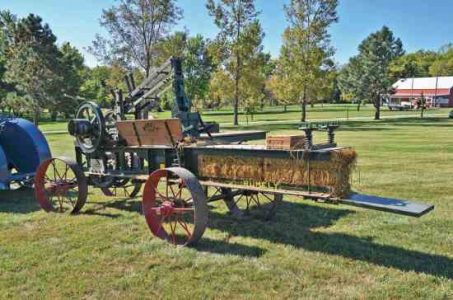
Soon, however, manufacturers developed models with a reciprocating plunger powered by a series of gears and a crankshaft, such as the one found on Whitman’s New Rebound Plunger Press marketed by Whitman Agricultural Co., St. Louis, in 1880. Manufacturers like John Deere, J.I. Case and International Harvester – along with about 30 other little-known companies that appeared during the hay press era – also put a horizontal hay press on wheels so it would be a lot more mobile. Previously, movement of even the portable-type presses required that they be tipped onto a wagon and moved from one location to another. Until the turn of the century, though, most were still powered by horses harnessed to a sweep that powered a series of gears that moved the plunger forward and backward.
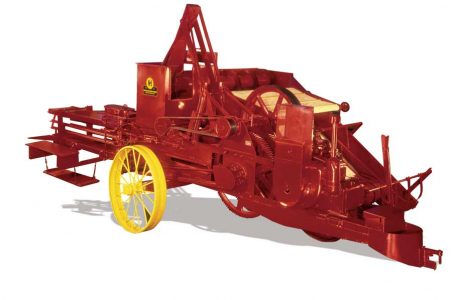
Unfortunately, there was no consistency in the market when it came to bale size. Typical sizes included 14-by-16 inches, 14-by-18 inches and 17-by-22 inches. Yet other models produced bales measuring 16-by-18 inches and 18-by-22 inches. The one constant, though, was that all of the presses were labor intensive, requiring at least five men to bale hay. One or two forked the hay into the press; two more hand-tied bales with wire and one or more stacked the finished bales. If hay was being baled out of a mow, two more men were needed to fork loose hay out of the barn.
Mechanized presses
By the early 1900s, hay presses began to follow the rest of the industrial world, meaning they were either powered by their own engine or driven by the belt pulley from a tractor or steam engine.
According to C.H. Wendel, author of Encyclopedia of American Farm Implements and Antiques, one of the early powered presses was the Burkett Motor Hay Press built by Burkett Mfg. Co., Columbus, Ohio. “This one was equipped with Burkett’s own gasoline engine, which was easily removed for other purposes,” Wendel writes, adding that Burkett was eventually acquired by the Kansas City Hay Press Co.
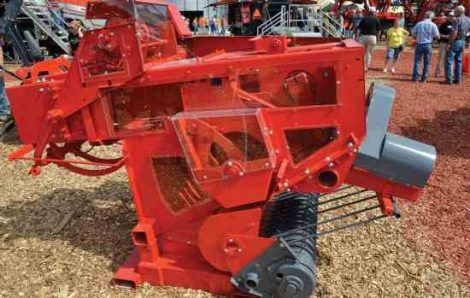
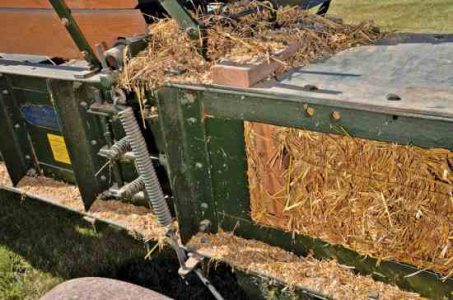
With nearly every machine, hay was pitched into a hopper by hand where a gear-powered plunger pushed it into the bale chamber. At the same time, a reciprocating plunger compressed the bale into a bale chute, just as it does on today’s balers. The difference was that once the bale in a bale press reached the desired length, a wooden block (with channels for baling wire) had to be introduced into the bale chamber to hold the bale shape and provide a means of tying the bale. Two men (one on each side of the press) passed pre-cut pieces of wire through channels in the blocks and around their side of the bale as it moved through the bale chute. Once the other end of the bale cleared the bale chamber, the other end of the wire was passed through the next block and secured.
According to Wendell, the term “hay press” remained in use well into the 1930s. The term “baler,” meanwhile, was primarily reserved for those machines that were taken to the field where they picked up hay from the windrow. That didn’t happen, though, until around 1932, when the Ann Arbor (Mich.) Agricultural Co. pioneered the “pick-up” baler that picked up windrows directly out of the field. J.I. Case also introduced a field-type pick-up baler in the early 1930s. Unfortunately, both models still required three people to operate the machine: one to drive the tractor and two to ride on seats attached to the bale chute, where they had the dusty job of feeding and tying the wires.
Birth of the self-tie baler
In 1936 a baler with a self-tie system was invented. The first attempt was made by a Davenport, Iowa, man named Innes who built a baler that automatically tied bales with binder twine using Appleby-type knotters from a John Deere grain binder. The machine was a great idea, but, unfortunately, it didn’t work well in the field.
Shortly thereafter, Pennsylvania farmer Edwin Nolt began working on his own idea for an automatic-tie, pick-up-type baler. Ironically, his quest began after he sold his threshing machine and purchased an Allis-Chalmers All-Crop combine. In his effort to salvage the straw from his new machine, he eventually traveled to Iowa to purchase an Innes baler to pick up the straw left in windrows. However, Innes never revealed that there were major flaws in the machine. When Nolt got it back to Pennsylvania, it didn’t work. Out of desperation, he built his own baler, salvaging the bale chamber from the Innes baler.
According to historians at New Holland, which eventually acquired the design, Nolt worked on his contraption through the winter of 1936-37. Additional parts borrowed from other machines included bevel gears from a Fordson tractor, knotters from a grain binder and a blower from a blacksmith’s forge to keep dust off the knotters. The rig rested on pneumatic tires and wood-spoke wheels from a Willys Knight truck. The unit had its problems, but Nolt was determined to make it work, eventually getting it to the point that it tied several hundred bales in a row. In essence, it became the world’s first commercially successful automatic field pick-up, self-tying hay baler.
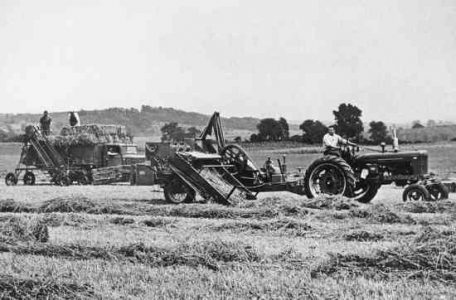
“Ironically, the design that made the Nolt baler a commercial success was discarded within the next decade,” notes a New Holland history brochure. “Instead of holding the hay under compression while the knotter tied, knotters began working so fast they were able to tie the bale even as the plunger continued to work. During the next two years, about 35 Nolt balers were built at a shop in near by Kinzers, Pa., but Nolt realized he needed more room and financial backing to produce his machine in large volume. A small group of men who had just purchased the ailing New Holland Machine Co. were interested in Nolt’s baler, and production began at the New Holland plant in late 1940.” Nolt worked in the New Holland engineering shop for the rest of his life. He died in 1992 at age 83.
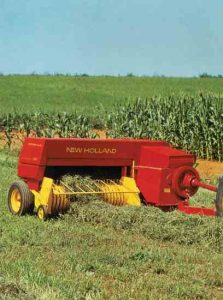
By the 1950s, the transition to baled hay was well under way with loose hay quickly becoming history. Although wire continued to be used on automatic balers for a while with the development of wire twisters in place of knotters, twine quickly took over the market, leading the small square baler into its current role today.
The industry has, in a sense, gone back to where it started. Rectangular balers have not only returned to larger sizes, but some hay producers are once again using true hay presses to compact traditional bales into even tighter packages for export. This time, though, they’re using hydraulics instead of horse power. FC
Fascinated by the inner workings of farm machinery? Read How the Bale Knotter Works to learn more, and check out a video that shows how a twine knotter on a grain binder works in our Old Iron Videos blog.
Seen a piece of farm machinery that makes you scratch your head? Tell us about it: We’re looking for more topics to cover in “How it Works.” Send your suggestions to “How it Works” at Farm Collector Editorial, 1503 S.W. 42nd St., Topeka, KS 66609; email: editor@farmcollector.com.
Tharran Gaines is the author of five books on antique tractor restoration and writes a variety of materials for AGCO Corp. He is also a contributing editor to AGCO Advantage and Massey Ferguson Farm Life magazines for AGCO. Email him at gainescomm@yahoo.com; online at Gaines Communications.