
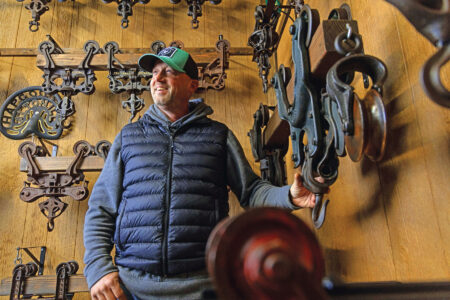
When he was a youngster, Carl Wagner enjoyed tagging along with his dad to antique tractor shows, swap meets and farm auctions. Because old wrenches were within his price range, he started buying them. Then, he graduated to cast iron seats.
“Twelve years ago, I saw an old hay fork carrier in an antique store in Ash Grove, Missouri,” he says. “I bought it for $35 with the idea of trading it for some wrenches.”
After completely disassembling and cleaning his first carrier, Carl – a lifelong resident of Lawrence County, Missouri – thought it would look even nicer with a very good paint job. Luckily, paint is his specialty. Today, he’s changed his tune. To appear in their best state, carriers should be torch-heated, doused in used motor oil, he says, and wiped down thoroughly. “If someone wants to do something else later,” he says, “this process is reversible.”
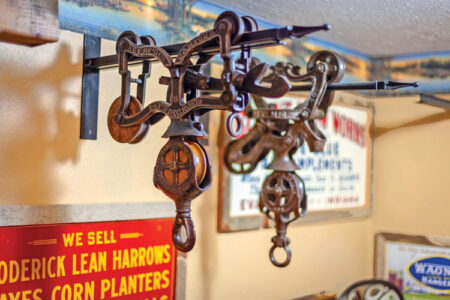
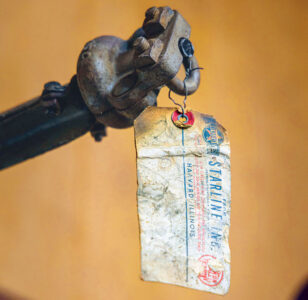
A few of Carl’s hay carriers remain in original condition with original factory paint and stencils. An original shipping tag is still wired to one. Carl’s collection includes nearly 200 pieces stretching from the 1870s to the 1950s when advanced systems made hay carriers obsolete.
That said, the Amish still use hay carriers. “They disassembled an old barn about 20 miles from here and got the lumber plus the old carrier equipment,” Carl says. “I bought the carrier later from another man at an auction. I left a note asking the barn’s owners about a particular knocker that I did not have. I continued calling until he eventually came up with it.”
Collectibles with enduring appeal
A couple of Carl’s carriers were made with beveled wheels. It was an ill-considered design, and the wheels wore out quickly. After a very short run at the factory, the beveled wheels went through redesign. Carl has heard a story about a collector who had one of the original sets predating the redesign. Protecting his investment, that collector kept the unique carrier in a safe.
Hay carriers turn up just about anywhere. “I was kicking around by an old junk pile on our farm one day,” Carl says, “and I saw just a little bit of a rusty hay carrier sticking out of the ground. I knew immediately it was a Myers.”
As he worked to clean it up, Carl and his wife, Barbara, decided that the carrier had been used by her granddad, dad and uncles to unload hay. “Even though that barn’s been gone for a long time,” Carl says, “the hay carrier has survived. It’s in original ‘as used’ condition.”
Packaged outfits offered convenience
According to the 1908 Sears, Roebuck & Co. catalog, wooden-track carrier outfits sold for $8.35 to $11.35, depending on length, or for $11.05 to $15.60 for units with double-angle steel track. The package included a double harpoon hay fork, rafter brackets, hanging hooks, floor hooks, yoke knot passing pulleys, plus correct lengths of 3/4-inch carrier rope and 3/8-inch check rope made from manila hemp.
The interior stacking outfit included one reversible hay carrier, a short-tine double hay fork, 50 feet of 1/2-inch steel cable, two eye bolts, 2 half-inch cable clamps, four-floor hooks, three steel-knot passing pulleys, 130 feet of 3/4-inch manila hay carrier rope and 55 feet of 3/8-inch manila check rope, at a total cost of $10.37.
The exterior hay stacking outfit included one cable hay carrier, 150 feet of half-inch steel cable, 2 half-inch cable clamps, two square collars for cable, two long bolts for post tops, three steel-yoke knot passing pulleys, 130 feet of 3/4-inch manila carrier rope and 65 feet of 3/8-inch manila check rope.
Active collector network keeps the past alive
Some people today believe it’s wrong to remove hay carriers from old barns. Carl sees it differently. “I believe they should be displayed and appreciated as unique pieces of early-day machinery,” he says. “I’ve swapped with collectors all across the country, and we are always comparing information about our carriers.”
At a recent estate auction, hay carrier prices were sky-high. “Sometimes there’s just a small difference in the casting that will make one carrier slightly different from another, so it becomes much more valuable because of its rarity,” he says. “I’m always interested in getting the next one, whether it’s rare or not. If I don’t have it, I want it.”
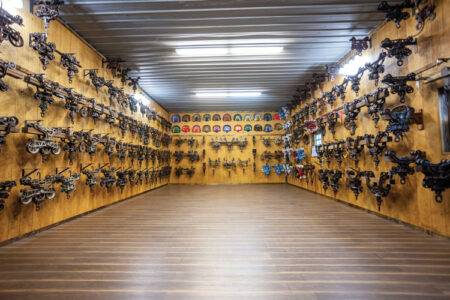
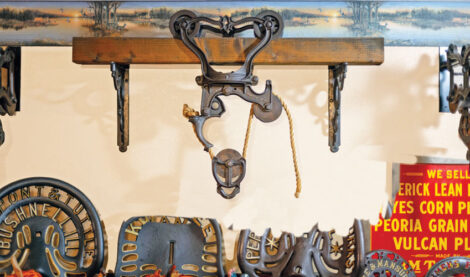
Each piece of Carl’s collection is displayed on a short length of 4×4-inch lumber, an iron rod or a rail track to show how it operated in the barn. Some of the pieces in his display were originally strung with wire cable and erected by gin poles to stack hay in the field.
As hay presses began to become available in the early 1900s, old barns were put to the test. Mows designed to hold loose hay were packed to the top with bales weighing as much as 80 pounds each. The problem was compounded by chain-link elevators that made it easier to fill every last inch of the barn loft with dense, heavy bales.
In 2009, a howling 100mph wind flattened many century-old barns across northern Greene County, Missouri. Those that were left without shingles or tin roofs gradually rotted into the weeds. The long familiar structures – and their rusting hay carrying equipment – were soon forgotten, and were finally burned down or pushed into a junk ditch. FC
For more information: Carl Wagner, (417) 366-2462.
Dan Manning was raised in a central Kansas farming community and now lives with his wife, Betty, in the Missouri Ozarks. Contact him at (417) 225-2085.
Keeping It Together
Farmer turns down offer for barn’s decades-old hay equipment.
As a 4-year-old in the summer of 1935, Mike Rookstool observed his father and a crew of workmen unload hay into a barn.
“A horse pulled on a rope that went into the barn, and that made a fork come down to pick up a bunch of hay,” Mike says. “A guy inside pulled another rope that tripped it wherever he wanted the hay to drop. I was probably more in the way than not. I’m sure it wasn’t used anymore after Dad bought a baler in 1948.
“I watched some men use a carrier rig one time after that,” he recalls. “They had a sling attached to the pulley hook, and were putting eight bales at a time into a barn near Pleasant Hope.”
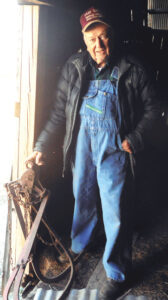
Mike’s wife, Marge, was in her early teens when she helped her dad put up hay in 1945. The barn had been built in the 1920s, and it still stands on the farm she and Mike own a few miles north of Springfield, Missouri.
“My job was driving a team of horses hitched to the hay wagon from the field to the barn,” Marge says. “The unloading equipment is still in there.”
Best as Mike knows, no one lubricated the hay carriers or pulleys. Nor does he remember the long ropes ever being treated with any kind of preservative. Apparently, it was considered too difficult and unsafe to climb to the barn’s rafters to oil or grease the equipment. There were probably a ton of wasp nests up there as well.
At his equipment sale a few years ago, Mike was offered $400 for the hay carrier and grapple fork in his barn. As he thought about all the years the devices had been in the barn, Mike turned down the offer. “It just seemed wrong to separate the equipment from the barn,” he says.
– Dan Manning


