Yesteryear farm equipment may represent nostalgia for some. For others, it may be an essential part of farming. Old Fashion Farming Day was organized as an opportunity to view the equipment along with demonstrations. The annual event is staged on the Merve Yoder farm in Shipshewana, Indiana.
Shipshewana and the surrounding communities are the third most populated Amish area of North America. Subsequently, the so-called “yesteryear” farm equipment is vital for many area farmers, and others would feel a sense of nostalgia when viewing the equipment.
Merve said, “We show our visiting friends the way we used to farm. That includes grain threshing, hay pressing, log skidding, milk separating, and corn shredding, along with reapers and binders.” Merve selects several items from his extensive collection to share during the event.
Collection Assimilation
Merve related his interest in collecting equipment from bygone days. “When I grew up and moved away from the farm, I began installing fences, known as Quality Fencing. I’ve been doing this work for over 41 years. I never had a hobby, but I kept thinking about how we used to farm. While attending a farm auction, I bought an old John Deere tractor.
“Soon after the tractor purchase, I bought a threshing machine that needed repair work. I found an Amish farmer with a field of oats and bought 20 shocks. Friends agreed to help me repair the old beater. After finishing the repairs, she was belted up, and with a few minor adjustments, the 20 shocks were threshed.
“After purchasing two pieces of equipment, I figured I had a hobby. And so, I gathered up some more antique farm equipment. That inspired me to invite some friends with their equipment from bygone days to gather for a show. That was 2004 when the Old Fashion Farming Day was launched.”
Several pieces from Merve’s collection are highlights with interesting history behind their respective manufacturers. The equipment has been restored where necessary and is fully operational.
McCormick Reaper
Cyrus McCormick is often credited for the reaper invention. McCormick’s chief rival was Obed Hussey, who patented the reaper in 1853: the Hussey Reaper. Hussey’s advanced design resulted in major improvements for the reaper.
Over several decades, Hussey and McCormick each claimed patent rights to the reaper. In 1861, the United States Patent and Trademark Office issued a ruling stating that Hussey held the original patents.
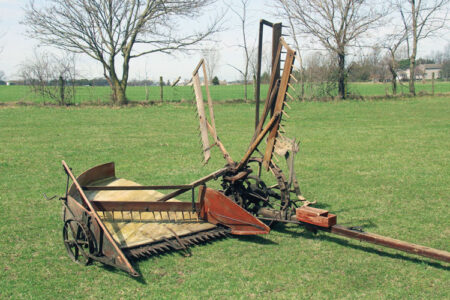
McCormick’s reaper didn’t experience mainstream acceptance and success until at least 20 years after it was patented. Hussey’s reaper utilized a sawlike cutter bar that was far more efficient than McCormick’s.
Around 1850, McCormick acquired the rights to Hussey’s cutter bar design, and a revolutionary reaper emerged. Even though McCormick is credited as the “inventor” of the mechanical reaper, it’s more accurate to say that he reinvented aspects.
Cyrus McCormick worked from his small blacksmith shop in Virginia with limited capacity. In 1847, the business was relocated to Chicago, where McCormick did all his own manufacturing. This relocation was closer to the wheat market, and the extensive rail system through Chicago proved beneficial.
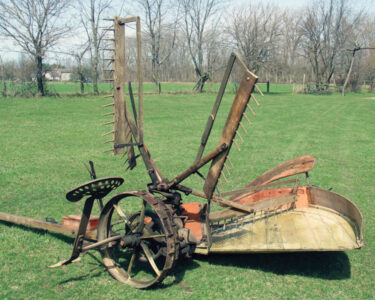
By 1868, the demand for harvesting equipment was enormous. McCormick continued to make improvements, resulting in the new model, “Advance” replacing the original “Reliable.”
The economic depression of 1893−1896 resulted in reduced sales and a changing environment for farm machine manufacturing. As a result, International Harvester was formed in 1902. It brought together five reaper companies: McCormick Harvesting Machine Co. and Deering Harvester Co. along with three smaller manufacturers. This resulted in the fourth largest corporation in the United States.
John Deere Hay Press
As with the invention of the wheel, it was only a matter of time until the idea of pressing loose hay into a package for more convenient handling was conceived. Until the mid-1800s, hay harvested for livestock was piled into stacks or stored as loose hay in the barn for winter feed.
Methods to handle hay changed with the invention of the first mechanical hay press. The earliest hay presses were stationary and often built into a barn. A horse or mule powered a sweep that turned a jackscrew or gear press to raise a weight, which was dropped to compress the hay.
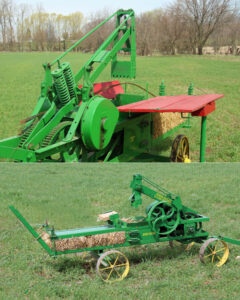
These permanent press models made bales that weighed up to 300 pounds, and they were secured with as many as five strands of wire or twine. It wasn’t long before hay presses became mobile by going to the field or from farm to farm, which required that the bales became lighter. By the early 1900s, hay presses received power from either their own engine or a belt pulley from a tractor or steam engine.
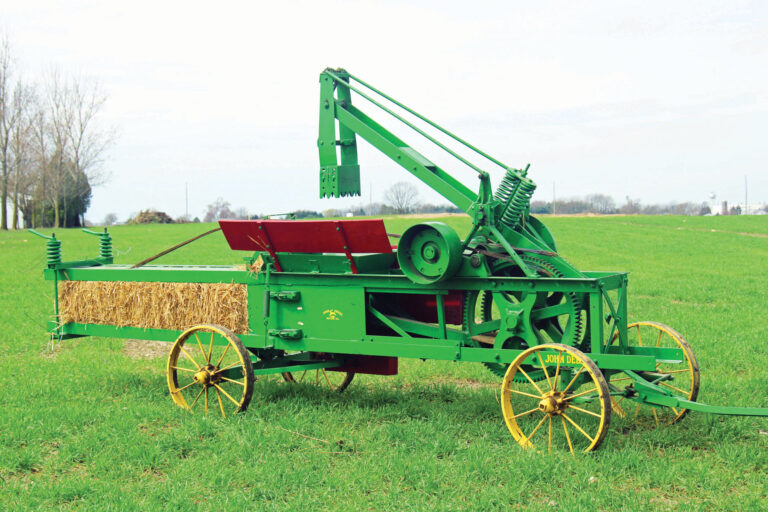
By the late 1800s, Dain Mfg. became a major player in hay equipment, including hay presses. In 1900, Dain Mfg. moved to Ottumwa, Iowa, to utilize railroads for easier shipping. As John Deere sought to expand their farm equipment manufacturing, the Dain Mfg. firm was acquired in 1918. Merve’s mobile hay press is an early Dain model.
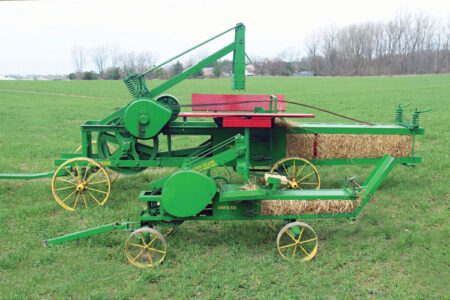
Using Dain’s early technology, John Deere revolutionized hay manufacturing equipment. The John Deere Ottumwa Works in Iowa has excelled in hay-making products, from the early press to modern round balers, mowers, and choppers.
Keystone Corn Sheller
Merve’s corn sheller and cleaner was manufactured by the Ellis-Keystone Agriculture Works. Located in Pottstown, Pennsylvania, the company also built farm implements that included the thresher and cleaner, peanut picking machine, one and two horse tread mill, circular saw, and more.
An East Coventry, Pennsylvania, farmer and inventor named James Ellis teamed up with a mechanic named Nathan Hoffman and manufactured a grain thresher in 1872. By 1875, production grew, resulting in limited space. Consequently, the business and manufacturing was relocated to Pottstown.
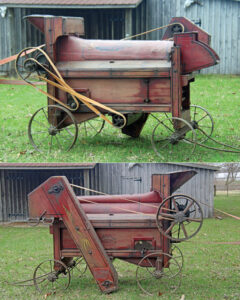
Well into the next century, combines were taking over. The company produced one but found it too expensive to retool and stayed with the thresher for a while longer. After WWII, the peanut machine became the company’s best seller.
The company underwent ownership changes and eventually became Ellis Keystone Mfg. Co. with business ending in 1975.
Flying Dutchman Hay Loader
In the world of antique farm equipment, the Moline Plow Co. gained respect for their Flying Dutchman line of products. The company traces its roots to Hendry Candee, Robert Swan, and several others who partnered to form Candee, Swan, & Co. in the 1850s. The firm first built fanning mills, hayracks, and eventually plows.
Through a partnership change, the company was renamed Moline Plow Co. in 1870. Moline Plow released its Flying Dutchman sulky plow in 1884. The Flying Dutchman brand eventually led to new designs in sulky plows around the world.
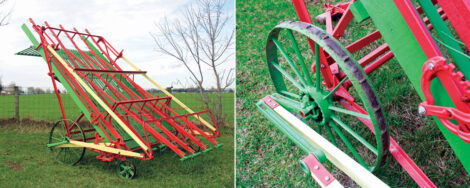
Through time, Moline Plow introduced additional farm equipment under the Flying Dutchman name. In 1919, the well-engineered hay loader entered the market. Using the loader, one man with a team of horses could load hay on a rack for transport to the barn.
The company, which became the fifth-largest farm equipment manufacturer globally by 1918, encountered financial challenges. As a result, Moline Plow Co. merged with Minneapolis Steel and Machinery Co. and Minneapolis Threshing Co., creating the Minneapolis Moline Power Implement Co. That company continued until 1974, when assets were acquired by White Motor Corp., and eventually AGCO.
Dog Treadmill
A unique item in Merve’s collection is the dog treadmill. This 19th century treadmill was developed to harness the “dog power.” The dog’s brisk walk or trot performed tasks like churning butter, separating cream, or powering washing machines and grindstones.
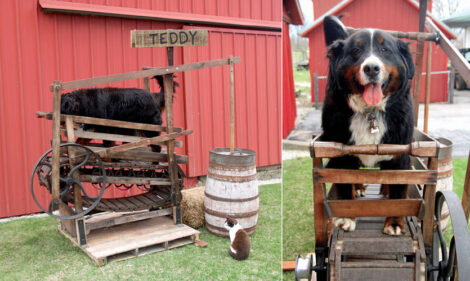
The dog would walk or trot on the inclined, segmented belt. The belt was connected to machinery via a flywheel and pitman rod to drive the required task.
Unlike their predecessors, modern dog treadmills have a different purpose. They’re designed for exercise, fitness, and health – not labor.
Shipshewana Steam & Gas Show
In 2021, the annual event was renamed Shipshewana Steam & Gas Show. Merve Yoder continues to host the show the third weekend in July. Merve noted, “The event was opened up for folks to bring their old farm tractors and equipment for demonstration. That includes plowing, sawing lumber, equipment powered by steam engines, and more.”
He continued, “I personally invite everyone to come enjoy the way we used to farm. If you’re unable to attend the event, you’re welcome to come by for a visit. Should you make a personal visit to our farm, you’ll see things you haven’t seen before. If you don’t see anything new to you, I’ll pay your travel cost to get here.”
“In conclusion, we want to give a heartfelt thanks to our Divine Creator for our many blessings. To Him be all the Glory and praise that enabled us to collect old-fashioned farm equipment,” Merve said.
For an informative chat or to arrange a visit, Merve Yoder welcomes your call during the evening at phone: 260-768-4986. FC
Freelance writer Fred Hendricks of Mansfield, Ohio, covers a vast array of interesting subjects. You may contact Fred at fwhendricks@gmail.com