
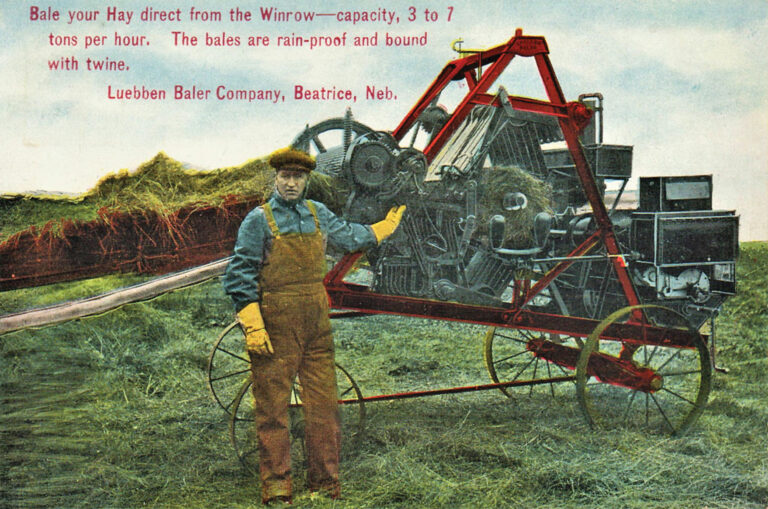
For farmers, the world of hay changed hugely in 1872 when Charles Withington invented the first successful mechanical hay baler with a knotter.
That machine was commercialized by Cyrus McCormick two years later. Because it bound hay into compact bales, it significantly improved hay transportation and storage, and doubtless many readers will remember hefting those small bales and piling them onto hayracks in their youth.
The world of hay changed hugely once more with the invention of the round baler. But who first invented the round baler – Depends on who you ask. And what you call it.
In terms of round balers, five possibilities exist: Ummo Luebben in 1910; John M. Wolf in 1928; Allis-Chalmers in 1947 with their Roto-Baler; Wesley Buchele and Virgil Haverdink in 1966; and Gary Vermeer in 1971.
Ummo Luebben
The idea for the first round baler emanated from the Luebben family of Sutton, Nebraska. According to Katy Moore in “Fame on the Luebben Farm” in Midwest Messenger, “It started with a stove and some piles of straw. In the late 1800s, when harsh winters meant low fuel supplies, Melchior and Ummo Luebben, and their father Hugo, realized that the straw bundles they used as emergency fuel in the family’s stove heater were inefficient and slow to produce by hand. They began experimenting – building machinery that would roll the hay into a round bundle, perfect for burning.”
The goal of the Luebben family’s design was to make straw logs that could be burned for fuel.
Eric Luebben of Fullerton, California, Melchior’s great-grandson said in Midwest Messenger, “They were living in a time when ideas were plentiful, inventions were very plentiful. I can fully understand being in the hayfield, stacking hay on the wagon, and thinking, ‘There’s got to be a better way.'”
Weekend said, “Ummo was the creative force behind the baler, and kept building and improving the round baler design. This original unit was a stationary machine mounted on a chassis. Material brought to the machine was fed in and rolled. Eventually, the design was improved to be used on the go, and material was fed into the machine while in motion. He applied for his patent in 1901 and was granted a patent to his ‘baling press’ design on October 18, 1910.” Ummo continued to improve his rotary baler design into the 1930s.
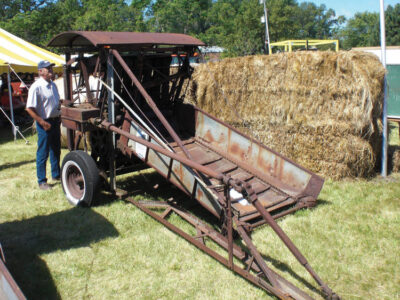
Eric said, “The really big attraction, from things I’ve read from Ummo, was because the hay was rolled, the stems were parallel to the ground and could repel water better than a bale where the ends were exposed.”
Eric said that the trio worked on their Luebben round baler for numerous years, improving on the design and producing multiple versions of the baler. Their work culminated in the birth of the world’s first round baler.
Six Luebben balers still survive today in the U.S. and Canada, some in museums, some on farms. Eric said, “I’m interested in making a Luebben baler work, and I’m trying to find a vintage tractor to pull it and satisfy my curiosity,” Eric said of his search. “I can really understand the idea of inventing or building a successful product. I feel very close to them in that way. Their work truly contributed to the quality of life for a lot of us, in the 1900s and now. It’s pretty neat.”
The late Arnold Skromme, who researched balers, said, “Luebben balers made round bales weighing about a hundred pounds each,” large round bales for the time.
John M. Wolf Baler
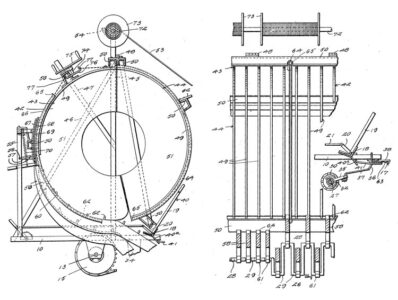
“John M. Wolf of Devils Lake, North Dakota, built the world’s first baler for large round bales,” said the late Arnold Skromme, who stumbled onto United States patent 1,691,865: Hay baling device, while doing research for a book, The History of Forage Harvesting and Patents. “That was the patent for the baler that makes those huge round bales,” said Skromme, of Moline, Illinois, who retired after working for John Deere.
Wolf’s baler, according to Skromme, was a milestone, “because it made a large round bale and tied it with wire. This patent is very important. Apparently Mr. Wolf was the first person to visualize that hay and straw could be harvested by rolling the material into a large, cylinder-shaped bale.” Balers for making small round bales were invented much earlier, in the 1860s, Skromme said.
That he was an inventor, Wolf chose to keep secret. His late niece, Genevieve Rutten of Devils Lake, said. “He lived with us, and I thought I knew him well. But I didn’t know about any patents.”
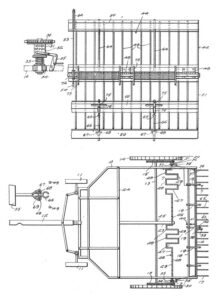
The patent papers filed on February 4, 1928 (accepted for patent November 13, 1928) make it clear the inventor was indeed John M. Wolf, Ramsey County, Devils Lake, North Dakota.
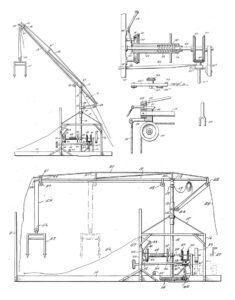
But it wasn’t finished yet. Realizing moving huge round bales weighing hundreds of pounds required another machine: a “Hay Stacker and Loader,” as described in his patent applied for January 19, 1929. The patent was allowed June 10, 1930. In his patent application no. 1,762,459, he described it: “This invention relates to…stacking hay and bales and loading the hay, … adapted either for use in the open, in a barn, or on a wagon. The general object … is to provide a very simple, readily operated and cheaply constructed loader and stacker which may be operated either by motor or by hand power … Also … to provide a (very simple) mechanism…whereby it may be controlled and the boom swung around in a circle and the bale raised or lowered as needed.”
Allis-Chalmers Roto-Baler
In 1940, the Allis-Chalmers Tractor Division Manager Harry Merritt acquired the rights to Luebben’s baler for the company to use. The engineers at Allis-Chalmers immediately got to work tweaking the Luebben design.
“Six experimental machines,” wrote John Burleson in “Making Hay in a Whole New Way” in Midwest Messenger magazine, “were built in 1941 and tested by A-C and several farmers in the Midwest. The new ‘Roto-Baler‘ worked. The next step was to convince farmers that round bales were better than rectangle ones. Round bales left more leaves on the stems, were easier to unroll and feed to cattle, and could be left outside and still protect the hay inside. The sales crew also argued that cattle liked rolled hay better because it didn’t have sharp ends to jab their mouths.
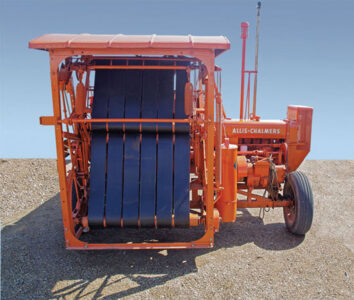
The earliest patent granted to Allis-Chalmers for their baler was in December 1945. After testing and fine-tuning the machine, another company patent was granted in April 1949, when the machine went into full production, and within three years, 23,000 Roto-Balers had been sold.
Wesley Buchele and Virgil Haverdink
When Wesley Buchele was young, according to Ames Tribune, he was a curious child. “He was often creating miniature farm equipment with his twin brother, Luther.”
Buchele said, “I was on a baling crew when I was 16, and it was 115 degrees in the shade but there was no shade. I made an oath to myself that I would eliminate those small square balers.”
FirstIgnite.com summarized, “He developed a large round baler in 1966 with his graduate student Virgil Haverdink, which allowed several times the amount of hay to be moved with a fraction of the effort. These large round balers collect the vast majority of the world’s hay today.”
Though the claim was made that Buchele’s baler was the first large round baler ever made, it is not accurate, as John M. Wolf invented one in 1928, and at least one of the Wolf balers was made.
According to Farm Show magazine, Arnold Skromme said, “Wolf’s patent indicates that the inventor must have done a great deal of testing of the machine because he goes into great detail on specific ways to handle the baler without damaging rake teeth, and how to thread wire around the bale.”
No such information exists on a baler made by Buchele.
Gary Vermeer baler
Hay & Forage magazine wrote, “Prior to the invention of the Vermeer ‘big, round baler,’ haymaking was a time-consuming, laborious job. When a local farmer told Gary Vermeer the process had him on the verge of leaving the cattle business, Gary started designing a ‘one-person hay system’ – a baler that a single person could operate and one that opened a whole new level of productivity in the field.”
Hay & Forage added, “The introduction of the Vermeer round baler in 1971 had a major influence on how hay and cattle producers harvested hay. It also started a period of seismic evolution that built on an existing heritage of continuous innovation at Vermeer, yielding scores of new tools and implements — like the ZR5-1200 self-propelled baler introduced in 2017. Subsequent innovations have touched nearly every aspect of the hay and forage industry, ranging from how it is harvested, stored and ultimately fed.”
Vermeer President and CEO Jason Andringa said, “When my grandfather successfully brought the big round baler to the market, it forever changed the landscape of hay and cattle farms around the world. From hay rings and new styles of hay barns to new attachments for tractor loaders and three-point arms, that baler became the center point of a whole new industry of hay tools. We are excited to celebrate with our team, our dealers and our customers as we reflect on my grandfather’s original invention and many of the new innovations we offer today.”
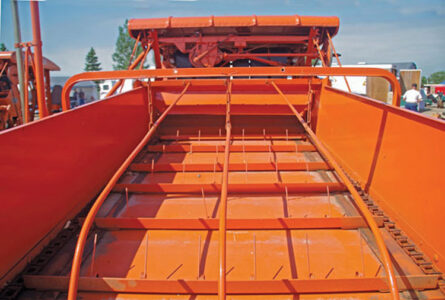
History of the First Round Baler said Gary and Vermeer engineer Arnie Mathies first chalked the baler out on the Vermeer factory floor, and it looked like a winner. A prototype was ready for field testing 45 days later.
“It didn’t work,” recalled Al Van Dyke, who worked at Vermeer. “They couldn’t get the bale to start. Then Gary got a fence post, threw it in there and the bale took right off. So then he knew he had something. So, he ordered a bunch of these long cardboard tubes. Then he figured out the fingers to catch the hay.” And the rest is history.
History added, “When they field-tested that first prototype, Gary and his team knew their round hay baler design was something big.”
And was it ever. What became known in the industry as “the big, round baler” was introduced in 1971.
“With it,” History said, “hay producers could make hay bales almost 10 times bigger than what they could with any other baler on the market,” a truly unique and massive achievement.
“Perhaps more important, it turned a process that traditionally required multiple people into a one-person job. Finally, hay producers could single-handedly put up high volumes of hay in shorter periods of time.”
Thus, it is clear that Gary Vermeer invented the first really large round bale baler, though not the first, as the Vermeer site states in an essay titled History of the First Round Baler. It was not the first. That credit goes to Ummo Luebben.
That Vermeer baler led to the invention of many other large round balers around the world. FC
Bill Vossler is a freelance writer and author of several books on antique farm tractors and toys. Contact him at Box 372, 400 Caroline Ln., Rockville, MN 56369; email: bvossler0@outlook.com.


