
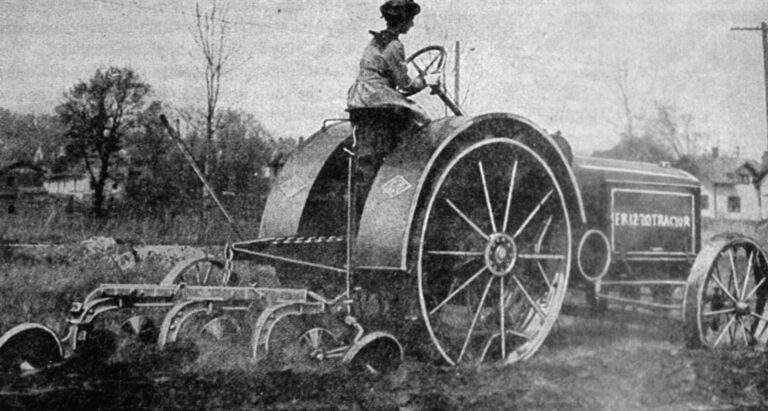
In April 1918, the Los Angeles Times reported, “600,000 men left the fields of America last year,” many to go to war in Europe, but as “Women & Tractors Must Help Solve Shortage” added, “In the east, high wages paid by munitions plants have practically stripped farms of the manpower remaining.”
That meant women, normally essential just for keeping the household running, raising children, gardening, caring for livestock, and so on, were now tasked with fieldwork.
Making matters worse, of the 1,200,000 equines U.S. farms sent overseas for WWI, Sir Evelyn Webb-Carter, Chairman of Brooke International, said, “Only 200 returned.” Brooke International was a charity dedicated to the welfare of equines.
Horses in the war zones lasted, on average, only two weeks. So procuring horses for farm work became difficult.
Farm Implements magazine in 1918 called for the tapping of a new source for getting work done on farms: more tractors, and young women driving those tractors, especially young women who weren’t from the farm.
That led to a pair of diverse and surprising methods to try to solve the problems: tractors – and urban women.
Tractors
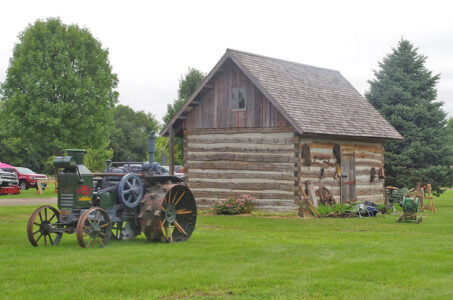
Luckily, from 1917 to 1921, according to C. H. Wendel in Encyclopedia of American Farm Tractors, 166 new tractor companies started up, adding 300 new models. Unfortunately, many were huge models, like the Rumely 30-60 Model E Oil Pull, (meaning 30hp at the drawbar and 60hp at the belt), Big 4 45-90, and Holt 70-120, and many others. All had been manufactured and designed mainly for plowing in large open fields. They had to be started manually using a hand crank in front, turning the huge flywheel on the side by hand, with a starting handle, or even climbing onto the flywheel and using their bodily weight to turn it.
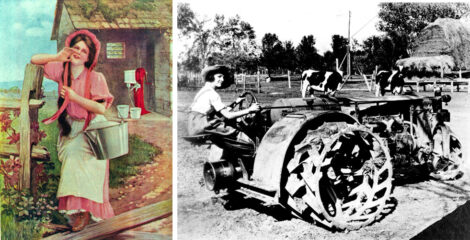
That was beyond what most women had the strength to perform. Luckily, once more, even prior to the war, farmers had been asking for smaller tractors that would provide versatility on their farms.
According to the book More Orphan Tractors, “Bull created the first small and lightweight tractor on the market in 1913. Farmers had been clamoring for smaller tractors for years when D. M. Hartsough and his son Ralph B. Hartsough, who had made tractors before, were asked by P.J. Lyon of Minneapolis to design the Bull tractor.”
According to Barton Wood Currie, writing in The Country Gentleman, “So when [the Little Bull people] got together in the tractor metropolis of Minneapolis, they decided to greatly reduce the tonnage.”
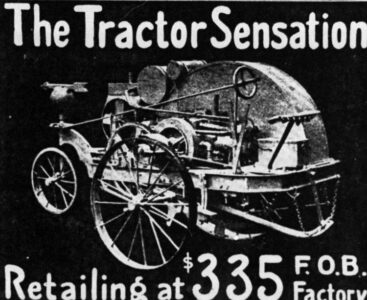
By the end of their first year of operation, Lyon and the Hartsoughs had sold more Little Bull tractors (named after its very distinguishing single bull wheel) than any other company in the tractor business, making them the leading producers of tractors in the United States. The smaller size and smaller price of $335 made it very attractive.

Unfortunately, the Little Bull wasn’t durable. Open gears on larger tractors were high above the field dust. Not so with the much-lower Little Bull, whose open gears got fouled with dust and produced mechanical failures. Most Little Bull tractors were returned.
The Minneapolis-made Corn Belt tractor was another small one, built in 1915. Farm Implements wrote in “Noteworthy Success in the Tractor Field,” “Among the noteworthy successes in the tractor field in the past year is the Corn Belt Tractor Co. of Minneapolis, which has developed a very successful small tractor.”
But, for some reason, the company went out of business within a year.
The most successful small tractor was the Fordson, which followed Henry Ford’s methodology of making a good product cheaply. Ford’s tractor was small enough for women to start, and run.
Other tractors also worked well for women. Miss Ruth S. Hardin of Albion, New York, writes, “I am the proud owner of a Moline tractor and have readied 30 acres of land for sowing in 40 hours’ time. I have never called a man from his work to assist me with this tractor in any way.”
Urban Women
When some women’s groups – like gardening clubs, suffrage societies, civic groups, and the YWCA – realized more farm workers were needed to produce the nation’s food, they decided to send urban women out onto farms.
In December 1917, the Women’s Land Army of America (WLAA), 20,000 urban women strong, decided they wanted to work on farms to help stabilize the food supply.
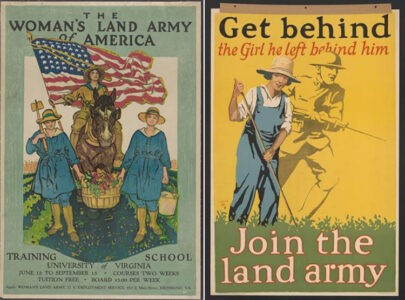
Members of the WLAA primarily consisted of college students, teachers, secretaries, and those with seasonal jobs or occupations, which allowed summer vacation. Also, various colleges established Women’s Agricultural Camps, such as Barnard College in Bedford, New York; Minot, North Dakota Teachers’ College, which hosted “tractorette” courses, specialized training for women tractor drivers; Michigan State College of Agriculture and Applied Science, which offered a 25-day intensive course in various agricultural skills, including operating machinery, like tractors. And there were others.
Peter E. Palmquist wrote in Rendezvous, “Most of these women had never before worked on a farm, but they were soon plowing fields, driving tractors, planting and harvesting.”
Well, not exactly.
S. P. Johnson, who wrote about these “farmerettes,” said, “The newspapers have been publishing stories about the refusal of Nebraska women to have college girls come out from the East to work on the farms. One woman said the refusal wasn’t jealousy. She suggested that if the girls do come they be set to washing dishes and doing indoor work, permitting the experienced Western women to do the farm work – if women must take the place of men.”
After farm wives had the opportunities to drive tractors while their husbands and workers were absent, they realized how much work the machines saved, and there was no going back.
Magazine articles and advertisements of the time showcased women operating tractors, and some manufacturers even noted that their female operators were as skilled as their male counterparts.
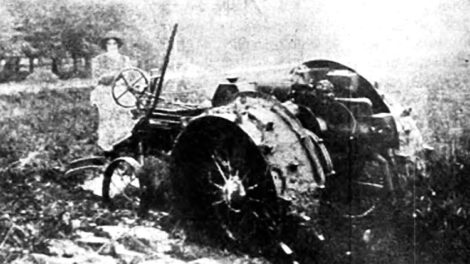
In an article titled “Girl Tractor Operator is a Hit at Davis” in a demonstration at the University of California farm at Davis, S. P. Johnson said, “The thousands of farmers and their wives who attended the tractor and farm implement demonstration, saw a college girl driving a tractor and beating the men by plowing her stunt better and quicker than they.”
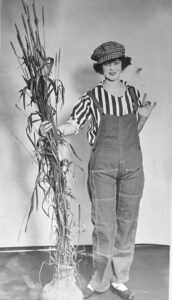
He added, “She was suitably dressed for the work in a blouse and bloomer costume made of denim. The bloomers were gathered at the ankles and met the thigh-top shoes.”
The urban women who worked on the farms, Palmquist wrote, “were paid wages equal to male farm laborers and were protected by an eight-hour workday. For many, the farmerettes were shocking at first (wearing pants!) but farmers began to rely upon the women workers.”
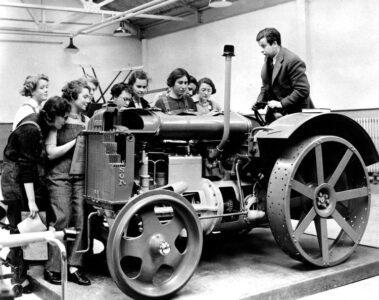
Chandler Hansen wrote in “Heroines on the Homefront: The Women’s Land Army” that “Farmerettes came from various backgrounds, but a great many were college-aged women working during their summer breaks, or others who would have had more time and the funds to pay for training. Members needed to be at least eighteen years old and deemed fit enough for agricultural work. While uniforms varied, many farmerettes wore a blue or khaki-colored smock which made them recognizable.”
“Farmerettes,” Hansen added, “were placed on individual farms or worked in more community agricultural settings. While many farmers were skeptical or resistant to having women work their lands, the farmerettes were able to show themselves capable workers helping perform a variety of tasks from tilling fields to harvesting fruit crops to working with livestock and more.”
Eventually, the WLAA women worked in 42 states during WWI and shortly after, until men returned from overseas.
At that point, cheaper tractors introduced in the 1920s helped launch an agricultural revolution, allowing more farmers to afford one. In the 1920s, women played an increasingly visible role in agriculture and were active participants, including operating tractors.
World War II
Following the Great Depression and the outbreak of WWII, the labor issues that occurred on farms during WWI were repeated. By July of 1942, two million U.S. men from farms went to war and six million by 1945, meaning work was again shuttled onto farm women.
Hansen wrote, “In the 1942 growing season, there were calls for women and children to pitch in with farm work, and many non-farm women did. Groups like universities and the Young Women’s Christian Organization (YWCA), and individual citizens helped recruit, train, and deploy women to help in emergency farm work.” Thus the WLA “was officially reestablished in 1943,” this time backed by the U.S. government.
“For women that enrolled” Hansen wrote, “trainings were available in many topics like dairying, livestock husbandry, poultry husbandry, gardening, and more. While these trainings existed, most women learned farm skills ‘on-the-job.'”
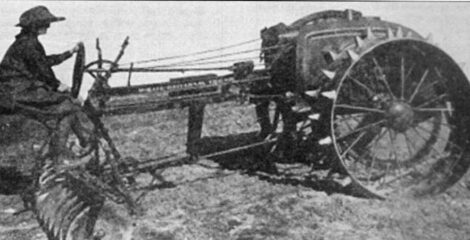
All kinds of urban women joined the WLA. “Some harvested orchards or milked cows, while others were trucking wheat and corn from fields, picking cotton, or pulling vegetables during harvest time,” Hansen added.
Many WLA women felt their work supported the war effort, as well as being an exciting experience. Leslie Tresham, an Iowa WLA worker, wrote, “Tired? Of course, I get tired, but so does that boy in the foxhole. That boy, whose place I’m trying so hard to fill.”
Another woman found her WLA work much more personal. In a New York Times article, she said, “My fiancé was killed in this war and I feel that perhaps that I, by helping to produce the food so vitally needed by our soldiers, can in part make up for the loss of at least one fighting man.”
Hansen wrote, “On the coasts, urban women often traveled in units going from farm to farm while living in camps or on the farms where they worked, doing orchard and field work. Meanwhile, in the Midwest, women in rural towns would take buses, often given names like ‘the Housewives’ Special,’ to local farms to work for the day and then return home to take care of their own homes. WLA members also helped farm wives with basic home tasks like cooking, cleaning, and child care so experienced farm wives could operate machines and perform other farm duties.”
But not everybody was excited, Hansen said. Some farmers didn’t want women working on their farms, especially in the Midwest where agriculture was more dependent on machinery. Farmers were hesitant to let women, who had never used farm machinery before, to operate it.”
But by the end of the war, many farmers felt differently. Hansen added, “One Midwest farmer said at the war’s conclusion, ‘I will say that they were eminently successful and helped me get the job done…They drove tractors for me on side rake, pick-up baler, rotary hoe, and trucks to pick up hay in the field…The boys in the armed forces should know the remarkable work done by these women and farmers’ wives.'”
The WLA lasted until the end of the war in 1945. As Hansen added, “Throughout the WWII years, approximately 1.5 million women served in the Women’s Land Army in various capacities. Their efforts helped produce record output of crops like corn and wheat in 1944 and provided food for the nation and soldiers worldwide.”
And proved that women were as capable to run farm machinery, and farms, as men were. That more than continues yet today. FC
Bill Vossler is a freelance writer and author of several books on antique farm tractors and toys. Contact him at Box 372, 400 Caroline Ln., Rockville, MN 56369; email: wdvossler@outlook.com.


