
This story of a German-born lad tells how hard work, faith in God, tragedy, family togetherness, and vision sent this young boy to his American future, and how his dream of driving a John Deere played a big role in his life.
“Schnell kindern, schnell”
“Quickly children, quickly into the bunker, the bombers are coming.”
The loud rumbling sounds of B17’s, B29’s, and B52’s were already overhead. Bombers were on their way from England to the industrial Ruhr, the heart of Germany’s war production of weapons, military equipment, and ammunition.
These bombing raids had been occurring almost daily, 500 to over 1000 missions at a time. The bunker was about 12 feet by 15 feet, big enough for the parents, three boys, four sisters, grandparents, and sometimes the neighbors on the other side of the road. “Obviously there was no heat, we sat on wood stumps, and the only light was from a candle or two. Only when the rumbling stopped could we go outside, or go back to bed, or go perform farm work with our hogs, dairy cattle, sheep and geese.”
The family lived 6 kilometers north of Ahaus, an important rail center, and sometimes the bombs would cause the house to shake and the windows to rattle. Unexploded bombs and other ordnance were often found in our farmyard and fields.
A bit of family history
Heinrich was eight years old on VE Day on May 8, 1945, when WWII came to an end in Europe. Fortunately, he was born on a farm in northwest Germany, in the State of Westfalen, near a little town called Graes, (population 100), only a couple of miles from the border with Holland, across from the town of Enschede, in Holland.
The first written record of Herickhoff family history is 1406, when ancestors were feudal tenants (agricultural slaves) to landowners. In 1679, an ambitious ancestor acquired the “heim platz”, the home place and his freedom from slavery for two bushels of wheat, and the land has remained in family possession to this day.
World War II was the latest in wars involving the Herickhoff home place. The armies of Frederick the Great, and later Napolean from 1804 to 1815 marched through Graes. During WWI, Uncle Heinrich Engelbert Herickhoff was drafted and lost his life on the Russian front in 1916.
Another uncle, Bernhardt, emigrated to the U.S. in 1930 and would send letters with pictures of family and funny-looking tractors called John Deere’s with narrow fronts and steel wheels all around. Then in 1933, Adolf Hitler came to power, seeking retaliation for Germany’s humiliation and financial penalties from WWI.
Knowing the history of war across the farm, Heinrich’s father, Clemens August Herickhoff, built the concrete and steel bunker, hoping to protect his family. Survival was the highest priority, and no one cared about John Deere machinery – besides, there was no fuel available.
War on the streets of Graes
In 1940, the German army advanced on its way to Holland, Belgium, and France, past our farm, helping themselves to foodstuffs. However, in the next years until VE Day, the German army retreated and the American and British armies advanced past the farm. Numerous soldiers stopped for water, food, and sometimes shelter, hiding from captors. It was scary.
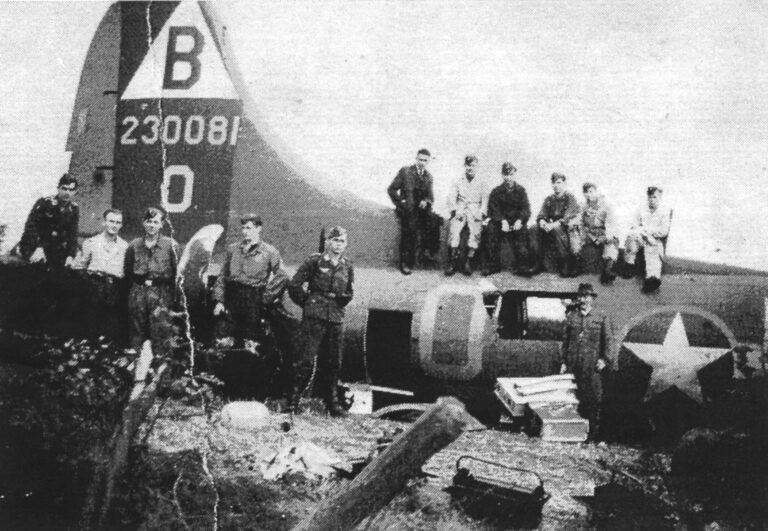
Of the planes in a massive bombing run, not all made it back to England. On August 12, 1943, an American B17 received heavy flak and made an emergency landing just a mile or so from the farm. The entire crew of 11 men survived, even though injured, and were quickly captured by the Gestapo and held as prisoners of war in various stalags (POW prisons). Among neighbors, there was talk of hiding the crew, but no one dared, because if caught, all would have been arrested and shot.
VE Day and life after the war – helping everyone
VE Day, May 8, 1945 was met with rejoicing and relief. But, it seemed there was the constant threat and fear of more war. The Russian Cold War, plus the associated food and material shortages, were important factors in later convincing Heinrich’s parents that going to America was a good option for their sons.
After Germany’s surrender, it was tough being in the countryside. Starvation was everywhere, with many town folks walking to farms, begging to work in exchange for food for themselves and their families. At night, people would steal potatoes or beets or grain from the fields. Heinrich’s mother and the neighbor women would daily fill a large soup kettle with water, vegetables, potatoes, meat scraps, and grains, feeding many adults and children. Heinrich’s father would make blutwurst, a blood sausage made with fats, meat scraps from cooking and butchering, plus lots of ground wheat and rye. He also prepared and baked a black bread, called rogen brot (rye bread) made with a high percentage of rye flour. It was highly caloric and was eaten with hot bacon fat as a spread.
American aid makes a big difference
Gradually, things got better as American aid and the Marshall plan helped Germany get back on its feet. Even in recovery, there were no luxuries, not even small ones, and every Pfennig and Mark was saved.
In 1946, Heinrich’s family received their first letter in over 5 years from Uncle Ben in the U.S. He sent a family picture and a black-and-white photo of his new John Deere A with a three-bottom plow. This time with rubber tires! But he didn’t explain how this mystery tractor worked – there were no John Deere’s in Germany.
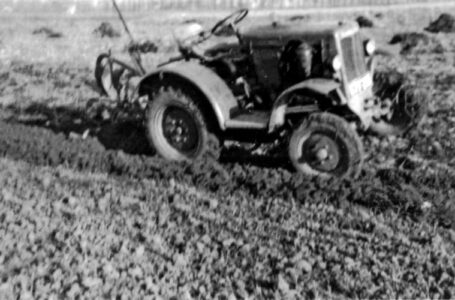
Then, in early 1950, a huge farming event occurred. Heinrich’s Dad had saved enough money to purchase the family’s first tractor, a one cylinder, 15hp Schlueter diesel, manufactured in Munich, Germany. It could pull a one-bottom plow, and it sure beat handling a plow behind a team of horses. The Schlueter sounded somewhat like a two-cylinder John Deere and scared the horses if they were nearby.
Also in early 1950, a big surprise and important life-event occurred for this now 14-year-old boy. Uncle Ben Herickhoff and his wife, Aunt Anna, would be visiting from their home farm in Belgrade, Minnesota, USA. It was Uncle’s first trip back to Germany since he emigrated in 1930. The visit brings with it life changing events.
How soon can I get to America?
“Uncle Ben, tell us about America, tell us about your farm, and how does that John Deere tractor work?” Heinrich listened to every word and his mind was made up – ”Mom and Dad, I want to go to America.” Their reply was clear, “Yes, but first of all, you must be 16 years or older, must be sponsored by an American family, and there is a mountain of paperwork – and, your older brother Josef has to go along – you’re just too young!”
Heinrich had listened to Uncle Ben’s story of how he came to America in 1930. He and Aunt Anna started with nothing, worked through the great depression, and now had a very nice farm with big John Deere tractors and modern machinery. “But Uncle Ben, why did they name the tractors after a wild animal?” A short explanation took care of that!
It actually took more than two years to process the documents in the U.S. Consulate in Hamburg, Germany. On September 19, 1953, Heinrich and Josef received notice to report for physicals and their Dad, booked travel on the ship Olympia, berthed at Bremerhaven in North Germany, departing on November 16, 1953.
Leaving home, and our family
“Time flew as we prepared, and on the departure date, we got up extra early. How were Josef and I going to say Good Bye to our brother, four sisters, and how could we say good bye to our Mother? We weren’t supposed to cry!
“We packed everything into and on top of our Volkswagen and arrived at Bremerhaven late evening. The next morning was check-in, and we all toured the 600 ft. ship.”
Soon all visitors had to leave the ship, to enable the Olympia to leave at low tide, so it could sail under some bridges. As the Olympia slowly moved out, a band played a song of “Good Bye to My Homeland.” Dad stood on the pier and waved a white handkerchief until we couldn’t see him anymore. “To this day, I can’t describe how much it hurt.”
The Olympia arrived in New York on Thanksgiving Day but the immigration offices were closed. “We had sailed past the Statue of Liberty, and received our first lesson in American History”
Everything is strange
“At disembarking, all passengers were directed to go to a huge building with letters A-Z according to our last names, where we met the Traveler’s Aid people. They were a big help, especially since we didn’t speak a word of English. They helped us get on the right train from New York to Chicago, and then to Minneapolis – all big, new strange cities. Finally, after 12 days of travel, the last leg of the trip was the train to Paynesville, Minnesota, a small town about 25 miles from our Uncle’s farm. We arrived about midnight and Uncle Ben and Aunt Anna were there to greet us! At last, we were safe, and at our new home, even our younger cousins spoke German. Aunt Anna served us a midnight lunch with cake and ice cream, and then we collapsed in bed.”
Our American journey begins
“We couldn’t wait for morning to come but we hadn’t anticipated the 20 below zero Minnesota cold. Even so, we went right to Uncle Ben’s machine shed where I put my hands on his 1951 John Deere R with a 5-14 plow. In the same shed he had a John Deere A, a John Deere B, and a John Deere 45 combine, along with other John Deere implements. My thoughts moved from our farm in Germany with 60 acres, 15 cows, and the little Schlueter tractor to this 400 acre farm with 100 purebred Holsteins, a DeLaval 4 stall milking parlor, and all that John Deere machinery.”
“Soon I was 18 years of age and registered with the U.S. Military Draft Board. In 1957, I was inducted into the U.S. Army with basic training in Fort Chaffey in Arkansas, followed by orders to report to Artillery assignment at Schofield Barracks on Oahu in Hawaii. After two years, I was honorably discharged and came back to Uncle Ben’s farm and worked with my cousins, Jim and Charley Herickhoff, and even learned to play baseball, American football, and basketball.
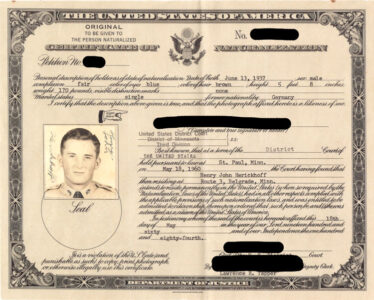
“I took steps toward becoming a U.S. citizen – a proud moment in my memory. That’s when I Americanized my name to Henry John. In 1960, I received my Certification of Naturalization, which proved that I came to the U.S. legally and granted me citizenship in the U.S.! It also caused me to consider where my future was going so I moved to Minneapolis and learned welding, plumbing, heating, and irrigation work”.
Family and farming
“During that time I met and married the love of my life, Vicky, who grew up near Sauk Rapids, MN. We have been blessed with two wonderful daughters, Michelle and Emily, and two great sons, Darrin and Andy. Vicky and I purchased a 200 acre farm near West Union, Minnesota, and specialized in growing and selling organic crops, which produced a nice financial margin but was incredibly time consuming from a record-keeping standpoint. I also milked a herd of Holstein cows. The farm became debt-free and our children all graduated from high school and colleges. All are successful in various businesses. This is a particular source of pride for Vicky and myself, as I only had an 8th grade education in Germany.
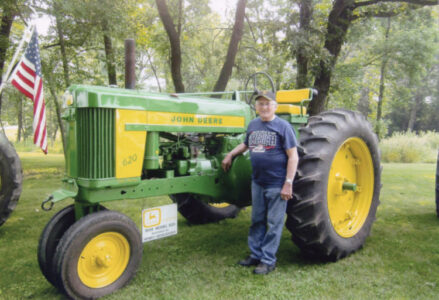
“My farm was operated economically – no new equipment. I purchased used John Deere tractors which I repaired until they ran like new. I purchased a John Deere 820 and a 720 at good prices, actually more than I needed, but my field work went quickly. On a lark, I bought a non-running junky 1937 John Deere B, because that was my birth year in Germany. Today it runs like a top. These experiences caused me to get the bug, the John Deere restoration bug. Also, I was then in my 70’s and my sons encouraged me to retire from farming, and to collect, restore, and show a series of John Deere’s. I already had the two big ones, and soon I bought a John Deere 620, which my cousin Jim Herickhoff says is the most beautiful tractor John Deere ever produced.
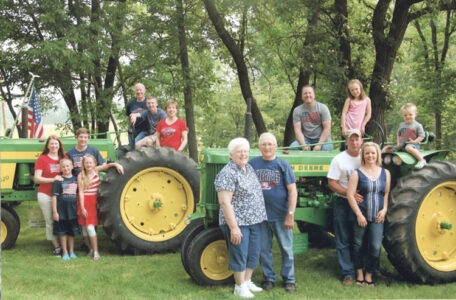
“Not long thereafter, I traded my John Deere 60 for a John Deere 520. My son Andy had just returned from serving in the war in Iraq, got the restoration bug, and with Darrin helped in their spare time not only to restore, but also to locate tractors with ‘good bones.’ They found a John Deere 420 in Kermitage, Arkansas, and a John Deere 320 in South Carolina and after Christmas Day drove to pick them up. Upon returning home, incredibly, within a few hours two men stopped by stating they heard that I had added to my ‘two-banger’ collection. Now my 20 Series is complete!
“My entire group of restored John Deere tractors has become the big attraction at the 4th of July parade in West Union, Minnesota. All seven tractors, led by the John Deere 820, receive lots of cheers and attention. Many spectators come by after the parade to see these beautiful tractors up close, pay their compliments, and enjoy a big smile. Many just want to sit in the seat and remember!”
Some wisdom and perspective
Restoring one tractor is a big job, but seven by one guy has to be a labor of love. “As my wife Vicky has become famous stating to visitors, “Old tractors are like wives, if it’s not yours, don’t touch it.” We laugh, but we also enjoy seeing the results of my labor, and greatly enjoy the camaraderie developed with parts suppliers and many farmers. Over the years a constant stream of visitors have come by to see, talk, and just admire, often saying, “How the hell did you do it all?”
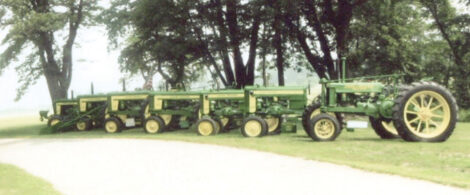
“My love for restored John Deere’s has been extended back to my German family. In 2009 I sent two John Deere 50’s to my nephew, Franz-Josef Blommel in Graes. He promptly restored them and has become a popular item in area parades. The American antiques with two cylinder engines and narrow fronts is a real curiosity. Every year, several newspapers highlight the John Deere’s and tell the story of emigration to America, building a farming career using John Deere equipment, and then tieing in with today’s lineup of John Deere equipment in Germany.
“Today in my spare time, even though I’m 87 years young, I recently rebuilt a 1947 Farmall M owned by my son-in-law, who received it in non-running status from his Grand Dad. Today, the M is retired back on their North Dakota farm. After 60 years, it’s only job is to look pretty, go to parades, and give friends rides.
“So that’s my story, a long distance from bombs, starvation and fear. The memories of WWII and my youth will never leave me. Most importantly, I am thankful to God for all the blessings my family and I have received, and to all who have helped me in this wonderful Country. A big ‘Thank You’ goes to John Deere for helping deliver the fruits of our earth to so many people.”


