
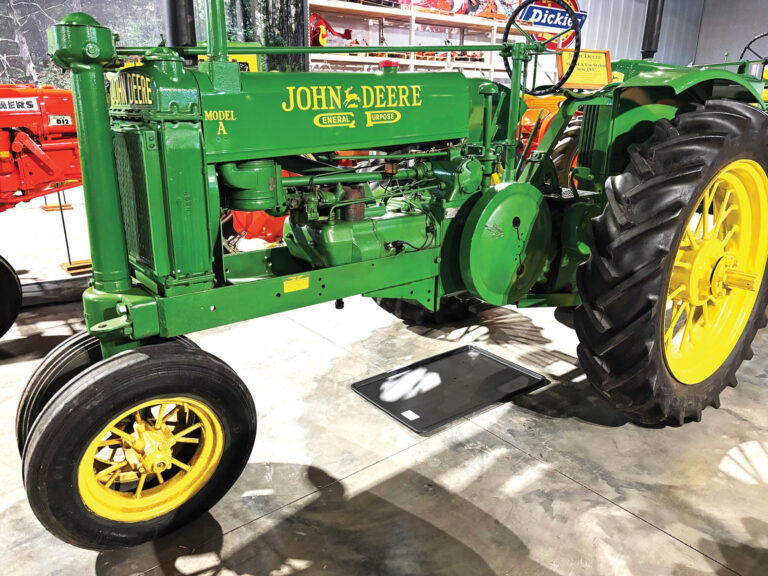
Determining the all-time favorite tractor among American farmers is not an easy task, as opinions vary and there is no single answer. John Froelich, from Marquette, Iowa, is credited with inventing the gasoline tractor in 1892, producing a one-cylinder machine capable of moving both forward and backward. In 1924, the Farmall tractor emerged, able to pull a two-bottom plow and cultivate corn, earning high praise. The John Deere Model A was designed to compete with the Farmall H, which sold 390,000 units between 1939 and 1954.
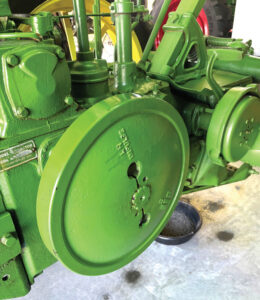
Older tractor models were often slow, heavy, underpowered, and physically demanding to operate, leaving farmers exhausted after a day’s work. The transition from steam to gasoline engines marked a significant advancement. During the early 1930s, farmers faced economic hardship: the price of wheat plummeted from $1.38 per bushel in 1929 to just 38 cents in 1932. Horses were no longer efficient for the increasing demands of farm work, as farmers needed to manage larger acreages in less time.
John Deere’s response: Engineering for farmers
John Deere, initially known for its plows, had previously released the Waterloo Boy tractor in 1918 and the Model D in 1923. However, the Model D was too wide and lacked the agility required for row crop farming. Farmers needed a tractor that was fuel-efficient and easy to maintain with basic tools. In response, Deere engineers spent two years developing an entirely new tractor, focusing on practicality and farmer feedback rather than showroom appeal. In 1934, Deere produced only 100 of these new tractors, sending them to fields for real-world testing.
Features of the Model A
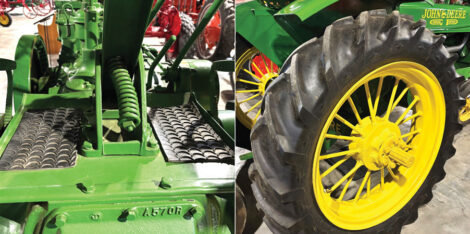
The early John Deere Model A tractors featured four forward speeds and one reverse, accompanied by a straightforward, well-written operator’s manual often kept in the toolbox. The large steering wheel provided mechanical advantage, making turns easier, while a spring-loaded seat improved operator comfort.
The Model A could pull a two-bottom plow in tough soil and three in lighter conditions. Replacement parts were readily available to farmers. Sporting the iconic green paint and yellow wheels, the Model A was a reliable workhorse for two decades. Its design included a high hood and narrow frame. The tractor was powered by a 25hp, horizontally mounted, two-cylinder engine with a 5.5-inch bore and 6.5-inch stroke. For those unfamiliar with engine terminology, bore refers to the diameter of the cylinder where the piston moves, and stroke is the distance the piston travels.
Performance and innovations
Early models delivered approximately 19 horsepower on the drawbar and 25 horsepower on the belt. The nickname “Johnny Popper” was inspired by the distinctive popping sound of its engine. The Model A featured a revolutionary four-speed transmission and a hand clutch, allowing operation while standing. Early tractors ran on kerosene, which was less expensive than gasoline.
The radiator on the earliest models was exposed at the front, earning the name “early-style.” In 1938, Deere introduced full tin work covering the radiator and gas tank, and a curved, rounded grill improved airflow for cooling. These “late-style” tractors had a modern look. Originally equipped with steel lug wheels, rubber tires became available later, along with fenders to protect the driver from dirt and dust.
Key developments over time
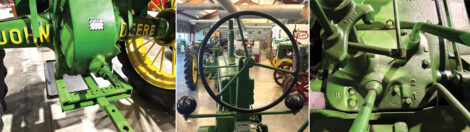
In 1941, the engine size increased from 309 to 321 cubic inches, raising horsepower from 25 to 31. That same year, the transmission was upgraded from four to six speeds, with advertised horsepower of 34 on the drawbar and 38 on the belt pulley. An electric starter was added in 1938, along with an ignition key, eliminating the need to manually spin the flywheel. The battery was relocated under the seat, and the Model A became known for its fuel efficiency, often running for a full day on a single tank.
Model variants and versatility
The Model A had two main variants. The row crop model was the most popular, featuring a narrow, nimble design and “V” configured front wheels, ideal for planting, cultivating, and harvesting. With individual brake pedals for each rear wheel, the tractor was highly maneuverable, reputed to “turn on a dime.” Its price was $2,400.
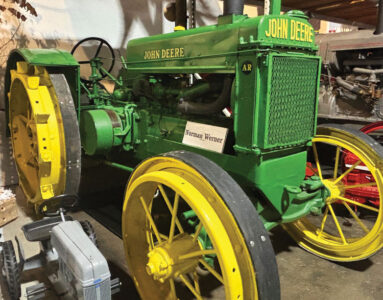
The John Deere AR was the standard-tread version, with “R” standing for “Regular.” Designed for general farm work rather than row crops, it featured a fixed rear axle and wider stance for stability, especially in plowing and belt work on flat land. Introduced in 1936, the AR remained in production with updates until 1953, becoming one of Deere’s most enduring models.
Other variants included the Model AO for orchard work, featuring smooth shielding for navigating under trees without snagging branches; the AI for industrial applications; and the AW for wide front axle configurations.
Additional features and overseas use
Deere added hydraulic systems and lights, allowing farmers to operate in the dark. A rear light included both a red bulb for road use and a white bulb for working. Later models featured a single shift lever instead of separate hi-lo gear shifters.
The Model A was also exported overseas. During WWII, copper shortages led Deere to use steel for radiators, and they implemented pressure-cooling systems. Modified Model A tractors were used for runway maintenance on airfields and even saw armored versions resembling small tanks.
Advancements in comfort and technology
In 1947, Deere introduced the Roll-O-Matic, or “knee action,” suspension for the front wheels, providing a smoother ride over bumps and obstacles. The familiar pan seat eventually was replaced with a cushioned armchair design. During the Korean War, copper was again scarce, so steel radiators were paired with water pumps, replacing the earlier convection cooling systems.
Later models switched from magneto ignition to point-type ignition with a distributor, which meant the addition of an ignition key. These late models also featured gauges for water temperature, ammeter, and oil pressure.
Production, popularity, and legacy
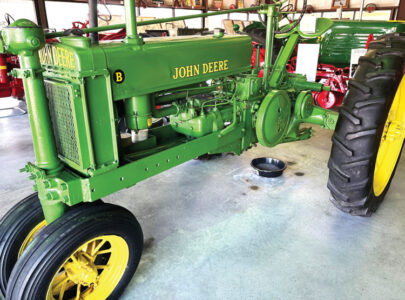
John Deere produced 320,000 Model A tractors, rivaling the Farmall H in popularity. The Model A complemented Deere’s wide range of farm implements and helped establish the company’s reputation among American farmers. Additionally, Deere made over 40,000 Model B tractors from 1935 to 1952. The Model B was a scaled-down version of the Model A with 30 percent less power, and only capable of handling two-bottom plows compared to the A’s three. Collectors often prefer the Model A for its distinctive, huskier “pop-pop-pop” engine sound. The Model B had a sticker price of $1,900.
The John Deere Model A remains a favorite among tractor collectors, with thousands restored to working conditions. Its reliability, versatility, and efficiency made it popular among farmers, and today it stands as an icon of vintage farming equipment.
To view a notable collection of John Deere Model A tractors, visit the American Tractor Museum in Perryville, Missouri, which recently doubled in size and features models like the 1936 AR, the 1937 unstyled, and the 1949 styled A.
Larry and Ann Scheckel, retired teachers, reside in Tomah, Wisconsin. Larry is the author of several books, including Seneca Seasons: A Farm Boy Remembers and Murder in Wisconsin: The Clara Olson Case. He can be contacted at 1113 Parkview Dr., Tomah, WI 54660, by phone at (608) 372-3362, by email at lscheckel@charter.net


