
Decades ago, exhausted woodsmen, farmers, and explorers trudging across snow-covered terrain looked down at their awkward snowshoes and inhaled winter’s crisp sub-zero air. Although hardy and physically fit men and women, they voiced a wish that someone, somewhere would create a practical means to track over, through, or even under the “white stuff.” Manufacturers heeded their calls, pondered the get-rich possibilities, and jumped in with promises of mechanical marvels.
“We feel that machines exist which can travel over snow and prairie at rates cheaper than ox, camel, horse, or mule transport either on or off roads,” said a London, England, sales representative on March 14, 1921. “Anywhere that a dog team can go, we can go at several times the speed.”
The enterprising Brit didn’t know that Maine lumberman Ira Peavey had already patented a steam-powered contrivance with unique screw-like “landing gear” in 1907. His prototype formation of parts worked well on hard-packed snow but couldn’t grip soft surfaces and cold-hardened metal drawbars fractured. A year earlier, siblings Charles E. Burch and Frederick R. Burch entered the arena with a peculiar machine press reports claimed resembled a steam-heated streetcar for “making trips to the trackless wastes of Alaska.”
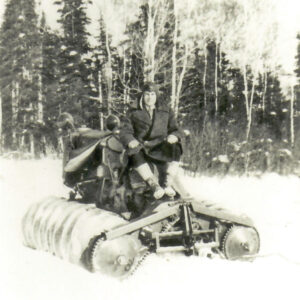
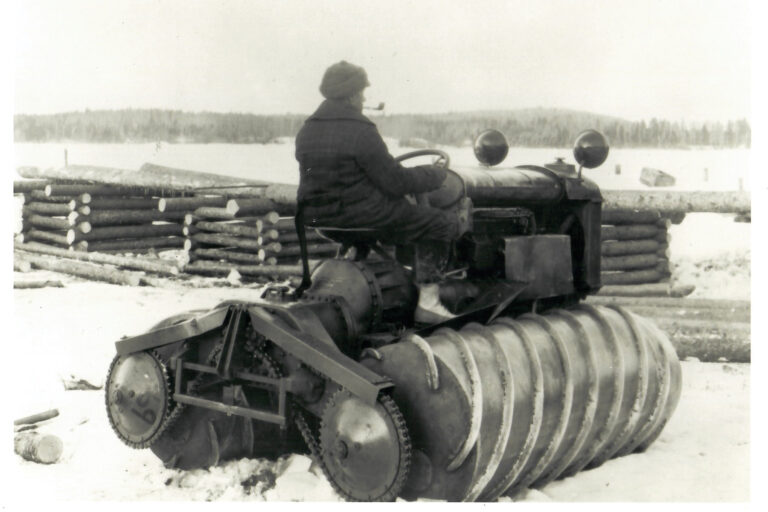
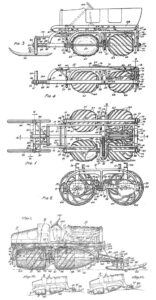
The endeavor fizzled out and nothing more was heard of the machinery until May 28, 1917, when Frederick Burch accepted final Patent No. 1,228,093. Arctic explorer U.S. Army Major H. H. Armstead lent his name, cold weather expertise, and financial support to the “Armstead Snow Tractor.” Designed with a four-cylinder Liberty engine and weighing 5,500 pounds, four rotary drives with tapered cylinders made up a package of pulleys, supporting members, sprockets and channel iron cross beams. To steer, each drum received power from a separate clutch. Snowshoes would become obsolete.
On April 16, 1917, United States entry into WWI placed the program on hold until improvements led to a further patent in October 1922. The Ford Co. later converted Fordson tractors into a similar screw-propelled vehicle. An Evans Film Company clip demonstrated the vehicle’s promising potential. One observer claimed the brothers’ brainchild mounted a 29-degree slope and pushed roads in 8-foot depths of snow. A public test took place for Collins Lumber Co. at Pine Lake, Wisconsin, 196 miles southeast of Duluth.
“The Snow Motor was given a preliminary trial yesterday at Pine Lake and astounded old-time woodsmen with its ability to plunge through snow two or three feet deep hauling a load of logs,” exclaimed the February 9, 1921, Ironwood (Michigan) Daily Globe. “Without a doubt, the invention will revolutionize winter transportation in the Snow Belt.”
Other press described the contraption as an ordinary automobile with wheels replaced by four large drums modified to hold augur-like gripping flanges. Guided by ski runners attached to steering gear, the three-speed gadget dragged an 84-ton load on four chained logging sleighs. The same week, drivers chugged away with nine sleighs and 400 cheering passengers. In Oregon, a stage line used a pair of Armsteads on passenger service and a Time issue claimed Canada’s Royal Northwest Mounted Police would turn in their horses and become chauffeurs “to the deep regret of cinema people.” The future looked positive except for the horses.
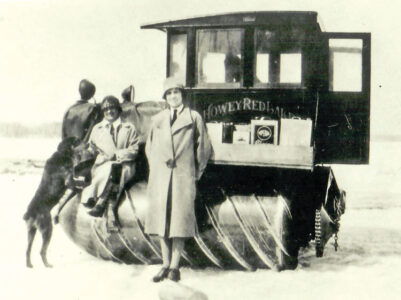
Marketing counselor and former Oklahoma senator Robert L. Owen reached out to the wigged British lords of the skeptical Hudson’s Bay Co. (HBC). The possibility of replacing four-legged power sparked the fur-trading organization’s interest. At one point, the affluent masters of the north considered manufacturing snow tractors under license but the tea-drinkers agreed to an unwelcome decision. Hordes of snow tractors flogging into wilderness never came to pass.
The HBC pointed out that expensive winter-only equipment rusting on remote shorelines could never be economically viable. Slush as deep as 18 inches might clog screw drives and slamming through low-latitude coniferous forests would soon wear them out. Establishing parts depots at seasonal trading posts consumed profits rolling in from beaver hides, fox pelts and seal meat. The fact that hired help didn’t need to feed staked-out unemployed husky dogs at great cost never crossed their minds.
The opportunity to prove the practicality of snow dogs, snow tractors, tin dogs – or whatever the current epithet for the clanky invaders might be – arrived. Explorer Sir George Hubert Wilkins decided to search the Arctic Ocean north of Alaska for undiscovered lands. He reasoned that the theoretical “Point of Relative Inaccessibility” could be accessed by airplanes, and created the 1926 Detroit Arctic Expedition with two Fokker ski-planes. Besides supplies, such as spare mittens and mukluks for personnel, aviation gasoline, kerosene, and glycerin (part of a solution for the radiator) would be needed to sustain the aircraft. Sir Wilkins believed modernistic marvels could conquer distance, ice, and snow.
Alaska Railroad freight cars delivered three snow dogs from Seward, where they’d been off-loaded after shipping from the south. On February 10, 1926, two land-bound vehicles with enclosed cabins departed Nenana, 60 miles south of Barrow. One machine stood in reserve while the 10-sleigh caravan planned to creep along the ice-covered Tenana River to the confluence of the Yukon River, then push north 520 miles for Barrow. Minneapolis Morning Tribune told tales of wolf-faced Alaskan sled dogs watching patiently for the competition to fail. After 12 days of chuffing, grinding, and rocking, the snow tractors covered only 65 miles.
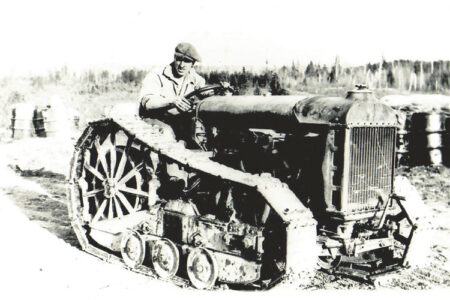
“The tractor screws couldn’t get adequate traction in Interior Alaska’s dry powder snow and their engines were troublesome in the region’s sub-zero temperature,” said the Fairbanks Daily News-Miner. “While the tractors worked well on relatively level ground, they had some trouble going over obstructions on rough ground.”
Metal castings snapped while traveling as many as 16 hours per day, and engines consumed fuel at unpredicted astronomical rates. Expedition members realized that overcoming the formidable Brooks Range of mountains or crossing the pond-laced North Slope were out of the picture. Train commander Malcolm Smith lost 16 pounds in two weeks and, “showed bodily signs of a desperate fight on behalf of the mechanical malamutes.”
The dogs watched and so did newspaper subscribers throughout the continent. Had the illiterate canines been taught to read, they would’ve pranced and partied around their kennels. “Alaska ‘Mushers’ Grin As Ice Defeats ‘New-Fangled’ Snow Tractor” announced the February 27, 1926 Daily Oklahoman. Exasperated, Sir Wilkins threw in the towel. In spite of snow blindness, near-starvation, and so-called adaptability of snow tractors to winter, the first Detroit Arctic Expedition ceased to exist.
“We didn’t accomplish much but we enjoyed the experience,” pilot Maj. Thomas Grant Lanphier said. “The mushers did not enjoy themselves, since they ran short of food and killed 53 of their 68 dogs to feed the others.”
Sir Wilkins remained in camp to supervise dismantling and shipping of his airplanes. Snow Tractors never again plunged toward the mythical point of relative accessibility. The renowned explorer returned with Stinson aircraft instead of Fokkers, and went on to prove the possibility of Arctic air travel with American pilot Carl Ben Eielson. He found no new lands.
The Armstead/Burch design didn’t prosper. One critic claimed the device lacked “no capacity to accommodate itself.” In certain snow types, it appeared adequate but designers didn’t consider texture and temperatures. Lacking grip powders and the hard ice below made for poor steerage and constant collisions with frozen rock-hard trees shattered components. Fuel consumption skyrocketed when sloshing through slush underneath snow layers. More detrimental, promotors misjudged potential customers.
“Your impression that dog teams are used for transport is quite wrong. They are only used in wintertime by hunters, trappers, and mail carriers as a means of getting from place to place,” HBC Fur Trade Commissioner A. Brabant had explained. “The loads they carry are negligible. The real transport work is done in summer by means of steamers, barges, canoes, etc.”
Although the Burch brothers and Armstrong promoted strongly in the U.S., they did not actually ‘research’ their competition, American or foreign. The Lombard Traction Engine Co. of Waterville, Maine, had been in business since 1900, and Holt Manufacturing invented the caterpillar tread before WWI. Britain’s Roadless Traction sold continuous track vehicles in 1922. None ventured into screw propulsion.
With more studies of track types and refined metals, the Armstead Snow Tractor might have turned woodsmen, farmers, and explorers into contented campers. At least the Ford Motor Co. benefited from publicity, and herds of huskies went back to work. At one point, 26 of the hard-working creatures were hitched to one sleigh with four men on snowshoes breaking trail beside them. They reached the limits of exhaustion within minutes.
Remnants of a few examples of the tractors survive. At least two sets of the strange undercarriage exist in Canada’s communities of Hunta, 387 miles north of Toronto, Ontario, and Fort Smith, Northwest Territories, 274 miles north of Edmonton, Alberta. Another exhibit in the Heidrick Ag History Museum at Woodland, California, attracts visitors who gape at the strange augur-like helical flange undercarriage.
However, the Fountainhead Antique Auto Museum in Fairbanks, Alaska, preserves the world’s only functioning example of a 1926 version called the Fordson “Snow Devil.” FC


