
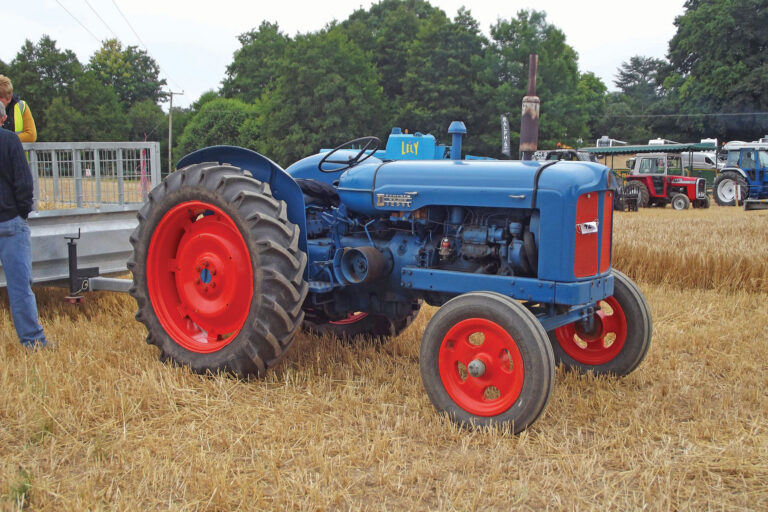
The Fordson Major was first introduced to the public at the Royal Smithfield Show in 1951, and after that exciting unveiling, the “Major” went on to become one of Britain’s most popular tractors during the 1950s and ’60s.
London’s Royal Smithfield Show is an institution in itself, and a whole article could be written about its history, but I’m just going to give a brief description of the event here, so that you can appreciate the long tradition of this show and understand what an important part of our agricultural and industrial heritage it’s been.
The first ever Smithfield Show was held in 1799 in London and it initially focused on livestock breeds. Before long, the Royal Smithfield Show became the most important stock show in the world, not only demonstrating the best of British farm animals, but also encouraging breeders and farmers to produce premium animals, early maturing livestock, good breeders, and the finest fatstock. By the 1860s, the Royal Smithfield Show was also showcasing machinery, which included everything and anything that was useful, new, or innovative in the world of agricultural equipment. It’s said that almost 135,000 visitors attended the 1862 show, which, in a time when transportation was limited, was a vast number of people.
Alongside the livestock breeds, horse-drawn farm implements and barn machinery were also shown, with prizes being awarded to producers with the best new designs. These awards were a sure way to put a company and its products on the map, and were highly regarded and much sought after. In 1920, tractors began appearing at the Royal Smithfield, with producers using the show as a way of introduce their newest models to the public at this highly prestigious event.
Let’s step back in time to visit that show in 1951 where the Fordson Major E1A was unveiled. The Royal Smithfield Shows were traditionally held in December, so it’s a cold day, but the place is heaving with people, all well-dressed in their 1940s and ’50s clothing, complete with hats and caps, happily wandering through the stalls and the trade stands. Many different tractor manufacturers displaying their new machines at the show this year, companies such as David Brown and Massey-Harris with their red tractors. Alongside there’s the Ferguson stand, proudly exhibiting its gray tractors and matching implements. Then we come to the Nuffield trade stand, with its array of bright orange tractors. These tractors all look impressive of course, but we’ve seen these colors before.
Then, we walk up to the Fordson stand, and gasp at the sight of Fordson’s new, bright-blue tractor. It’s not just that this tractor is a different color to anything Fordson has produced in the past; it’s also in a shape that’s completely new. This, the long-awaited next step from Fordson, is certainly eye-catching. Most of Ford’s rivals are producing red or grey tractors, so this sky-blue paintwork is a whole new look. Not only was the paintwork striking, but the styling and the tinwork of the Fordson Major E1A gave the tractor a modern appearance completely different from Fordson’s earlier tractors.
Fordson’s earlier tractors – the Fordson F, the Fordson N, and the Fordson E27N – were extremely popular, reliable, well-respected tractors, but they all had the same archaic appearance. Fordson tractors “evolved” from the 1917 Model F, but there’d been no obvious differences in appearance from one model to the next, and the basic shape of these earlier tractors had remained the same. The rather outdated appearance of the earlier Fordson tractors was largely due to WWII. Wartime shortages had forced Fordson to put tractor production on the back burner, and no revolutionary new designs had materialized.
All that changed in 1951 when Fordson introduced its new modern-looking tractor, the E1A. It seems funny to say this now, but in its day, the long-awaited Fordson Major E1A was considered a big tractor. Well, let me be more specific – it was a big tractor to British folks – perhaps it wouldn’t have seemed quite so large to you chaps in the U.S.
Ford and the Dagenham Factory
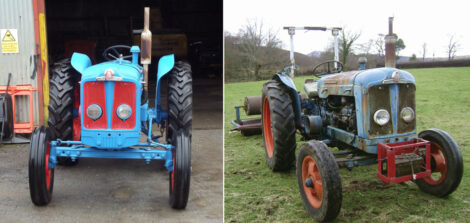
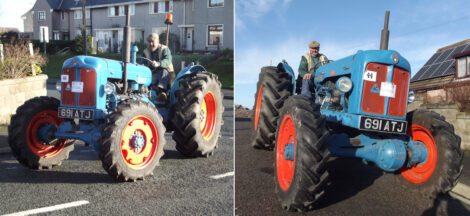
The Fordson E1A was built in Ford’s Dagenham factory in England. It was a robust-looking tractor, available with either a Ford 3.3-liter 4-cylinder gasoline engine, a 3.3-liter 4-cylinder all fuel engine, or with a 3.6-liter 4-cylinder diesel engine. The tractor was claimed to provide 30hp at the drawbar and 35hp at the PTO, though when tested, the horsepower rating turned out to be slightly higher than initially claimed. The tractor came with modern-styled sleek, rounded tinwork, with that unmistakable blue livery, officially known as Empire Blue.
Ford’s Dagenham factory has a history that dates back to May 1929, when Edsel Ford ceremonially cut the first turf on the new construction site that was to become Ford’s Dagenham factory. The site wasn’t far from the River Thames, on the east side of London. In 1931, this factory opened and became Britain’s and Europe’s largest vehicle production site. The first vehicle to roll off the production line was a Ford AA truck. The Dagenham factory went on to produce many of Britain’s most iconic cars, trucks, and tractors. It’s thought that over 72 years the Dagenham factory produced some 11 million cars, trucks, and tractors.
Of course, Ford’s history in the U.K. goes a lot further back than the Dagenham factory and the Fordson E1A. Ford was said to have sent three of his Model A cars over to the U.K. back in 1903, and then in 1910, the first Ford dealership was opened in Southampton, England. In 1911, Ford opened an assembly plant in Trafford Park, Manchester, using the site of an old tram factory. This was the first-ever Ford factory outside of North America.
In 1917, another plant was opened, this time in Cork, Ireland. Initially, this purpose-built site was used solely for manufacturing tractors for Ford’s new company – Fordson – but from 1921, cars were also built there.
Both the Ford and Fordson names grew in popularity, and the decision was made to open a larger site with access to a deep water port; and this is when the site at Dagenham was selected. The name “Dagenham” became synonymous with vehicle production, much like the name Detroit has in the U.S.
The Fordson Name
When Henry Ford first built a tractor, it was naturally referred to as the Ford tractor, but it was soon found that a Minneapolis company, a group which included a man called Carl B. Ford, had already named their company the Ford Tractor Co., so Henry Ford had to think of another name for his tractor range. Carl B. Ford’s company’s tractor line didn’t prove successful, but it still made good business sense for Ford to think of another name for his tractor in any case, Ford no doubt felt that it was wise to keep tractor production separate from car production.
Ford decided to manufacture his tractor in Cork, Ireland, a place from which the Ford family had emigrated. It’s said that as telegraph communications went back and forth across the Atlantic, the telegraph operators began to shorten the name Henry Ford & Son to “Fordson.” It turned out that Henry Ford quite liked the name. As well as getting around the issue of using the Ford name for a tractor, the name “Fordson” also suggested that the company belonged to Ford’s son – given that Ford was keen to involve his son Edsel in the tractor business, this was perfect.
From 1928 on, all production of Fordson tractors was transferred from the U.S. to Britain. It’s thought that the main reason for this was that Ford wanted the factory space in Detroit to be dedicated to producing his new Model A automobile.
A British Legacy
All Fordson tractors have had a huge impact on British agriculture and industry, and the Fordson Major tractor was no exception. The Fordson Major became an extremely popular tractor with farmers during the 1950s and ’60s, and it’s so well-known here that many people refer to it simply as “the Major,” a name which gives the tractor a certain gravitas, and makes us think of words such as reliable, capable, and dependable – which was exactly what the Fordson Major was.
In the early 1950s, the Fordson Major was considered quite a powerful tractor, with the diesel versions proving by far the most popular. Diesel tractors were economical to run here in the U.K., and while some diesel tractors had a reputation for being difficult to start, the Major had a good reputation in this respect, and it soon became known as a good, reliable workhorse.
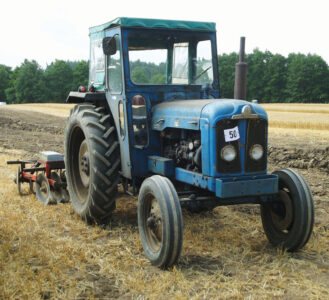
In order to widen their range, Fordson also produced the Power Major in 1958 and then finally the Super Major in 1960. While the Power Major and Super Major boasted increases in power and specifications, visually, the look remained much the same as the Fordson Major E1A. These days we refer to them all quite simply as “Majors.”
Strange Adaptations
The Fordson Major can appear in other, less recognizable, guises, for it was altered aftermarket many different times to suit a variety of specialist applications. The tractor was an ideal donor for modification; it was strongly built, simple in design, and relatively affordable, and what’s more, the base (the skid unit) was easily accessible. It’s said that the Fordson Major has undergone more conversions than any other tractor. Whether that’s true or not, I’m not sure, but there certainly exists a vast array of variations and derivatives, and previously unseen conversions seem to keep popping up all the time.
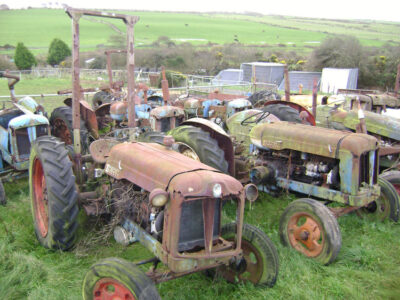
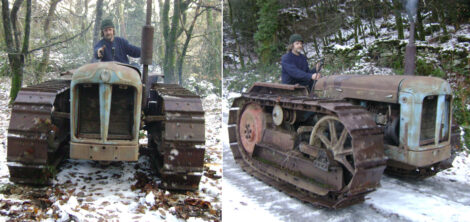
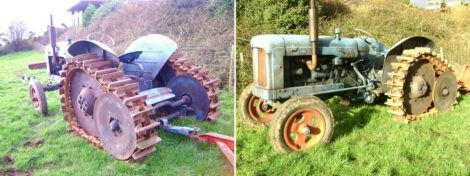
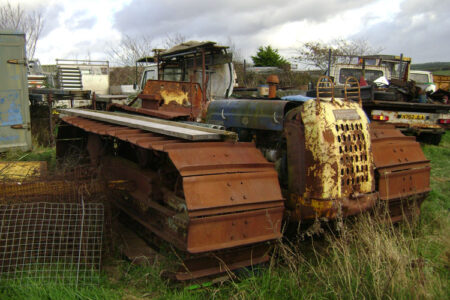
People have always modified tractors at home to suit their own needs, but many companies and manufacturers have also used the Fordson Major to produce their own specialist machines to sell to a more niche market. Companies like Roadless, County, Doe, Chaseside, JCB, Matbro, Muir Hill, and Bray have all taken Majors, or at least their skid units, and have adapted them for their own purposes. For instance, Roadless Traction Ltd. converted Fordson Majors to run on tracks and halftracks, and created a very popular 4-wheel drive conversion.
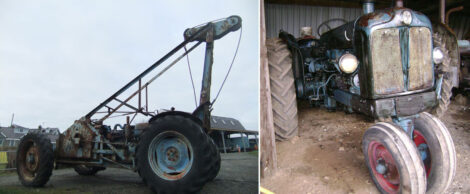
“Roadless” Fordson Major conversions were popular with those in the timber industry and were often fitted with high-capacity winches and cage cabs. Some of these tractors still work in the forests today because, for the small-time operator, the outlay for a modern-day equivalent would be out of the question. In any case, these old machines are far easier to mend at home than the modern equivalent. The fact that these Roadless Fordson Majors are something a bit different makes them quite sought after amongst those enthusiasts who like a classic tractor that’s also tough and workmanlike in appearance.
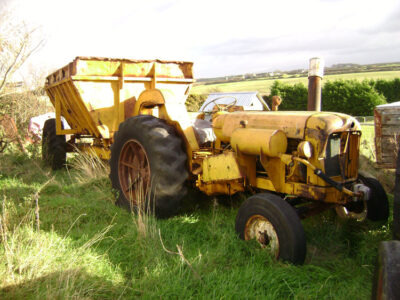
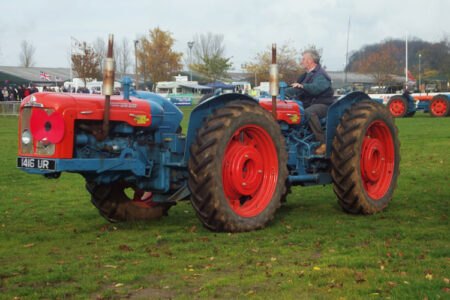
Another collectible workhorse is the Fordson Major County conversion built in the 1950s, where the tractor sits on four equal-sized wheels. But probably the strangest Fordson Major derivative is the “Doe” conversion, sometimes called the Doe Triple D or the Doe Dual Drive. This tractor was built by Ernest Doe & Sons during the 1950s and ’60s and was a unique piece of tractor engineering. At its most basic, the Doe Triple D is a dual-engine tractor made by joining two Fordson Major tractors together to produce a more powerful machine than anything available on the market at the time. Anyone who has read my previous article on British shows will recall that I focused on a Doe Triple D tractor, which was exhibited at the 2025 Shrewsbury Steam Fair.
As you can tell by now, we do see all sorts of unusual tractors that have been created using Fordson Majors here in the U.K. Some of these conversions were made in quite small numbers, and this rarity factor means they command high prices when they come up for sale today. However, the standard Fordson Major tractors models – including the Fordson Major E1A, the Fordson Super Major and the Fordson Power Major – are still relatively affordable collectible tractors.
Ford stopped producing the Fordson Major in 1964, and the Fordson name ceased at this point too, as from then on, Ford’s tractors were simply badged as “Ford.” The end of the Fordson Major was the end of an era, but what a legacy this final Fordson has left behind! As well as the standard Fordson Major tractors that were so popular with farmers, and which are still a regular sight in shows, ploughing competitions, and parades, there are also some extremely interesting Fordson conversions to be seen. These include: Fordson Majors fitted with high-powered engines, spiced-up to create a big bad load of smoke and power at tractor pulling events; Majors on tracks; high clearance Majors; Majors with bulldozer blades; and then there are the 4-wheel drive Majors sporting high capacity winches, with their tinwork dented from a life of timber extraction.
I’ve seen Majors in all states of repair and color–from rusty to black to yellow or pink. Of course, there are still the much-cherished, much polished showpieces that look just like that shiny bright blue Fordson Major that was unveiled at the Royal Smithfield Show back in 1951.
Josephine Roberts lives on an old-fashioned smallholding in Snowdonia, North Wales, and has a passion for all things vintage. Email her at josiewales2021@aol.com


