
Growing up Amish, Matt Schwartz had limited time around farm tractors, but it was a latent interest. After completing his Amish schooling, Matt helped on the family’s farm in Bremen, Indiana. When he came of age, he began working in northern Indiana’s RV industry. “Dad had a sideline business building wooden wheels for farm and circus wagons. Having helped in his shop shifted my RV employment to construction work and that evolved into starting my own business, B&M Builders,” he says.
Although Matt had limited experience with tractor mechanics, he desired further skills. “We relied on draft horses for our fieldwork. I well remember Dad’s tractors that provided stationary power. They consisted of McCormick, Oliver and New Holland tractors. I often rode on the tractors with Dad. At about age 10, I started driving tractors alone. The related mechanical work created a desire to learn more as I grew older,” Matt says.
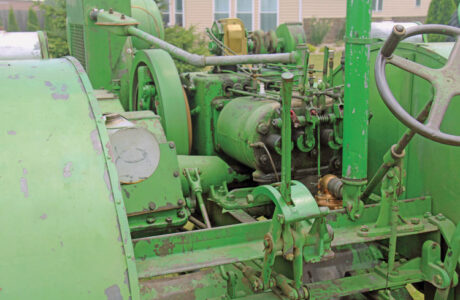
Although the tractors at home were well suited for their purpose, Matt was intrigued with the green and yellow tractors. “For some reason, I favored John Deere tractors. I found the 2-cylinder concept to be fascinating along with their unique putt-putt sound,” Matt says.
An unexpected gift
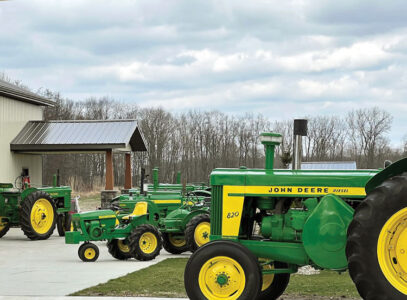
Matt and his son, Brenton, were made aware of a need that resulted in a surprise gesture. “We learned about a neighbor whose collection of antique John Deere tractors needed oil and filter changes. Brenton and I decided to make those changes for him. There was no expected compensation. We just wanted to be helpful. The neighbor insisted on paying us, but we declined.” Matt continues, “Shortly after we provided the assistance, he offered the 12 tractors to us as a gift. We could not believe such generosity. We accepted his gift with appreciation in September 2021. The 12 tractors range from an early Model D to three in the three-numbered series. Unfortunately, we had no storage for the tractors. I own a construction business, so we got busy and built a shed.”
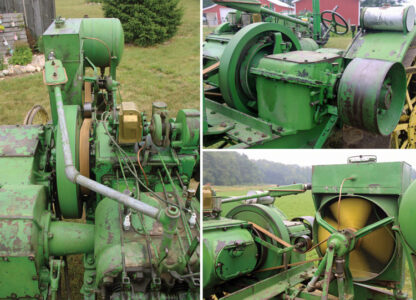
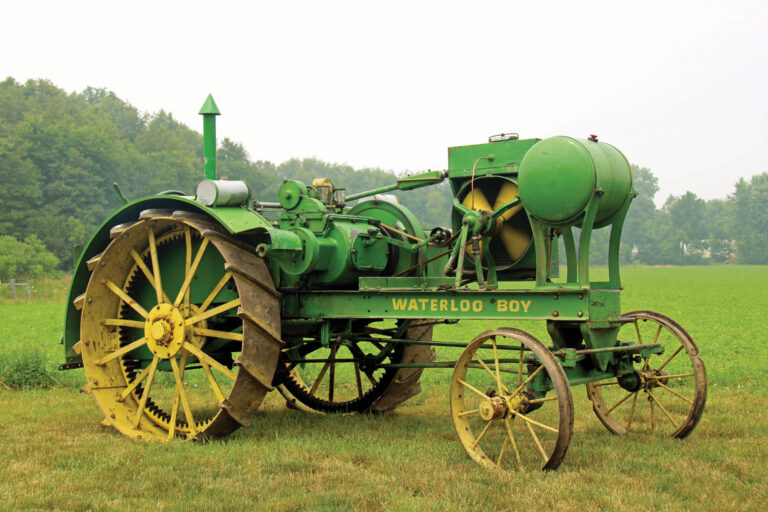
When you own an early collection of John Deere tractors that leads to further interest. “With those antique tractors, I was drawn to the forerunner of the John Deere tractor line, a Waterloo Boy. I started looking in the Green Magazine listings. After a couple searches, there it was in North Dakota. I contacted the seller, and we agreed on the price. We became owners of a Model N Waterloo Boy in November 2021.” Matt adds, “Arrangements were made to meet the seller about halfway for pickup. The tractor was in its original condition. The only restoration requirement was rebuilding the carburetor.”
History of the Waterloo Boy
John Froelich, an enterprising engineer, and a group of Iowa businessmen started Waterloo Gasoline Traction Engine Co. in 1893. The company’s attempt at building a tractor in 1892 was unsuccessful.
In 1895, the company was sold and renamed the Waterloo Gasoline Engine Co. The new ownership stopped tractor production and focused on the manufacture of plain gasoline engines. Hence the production of hit-and-miss engines.
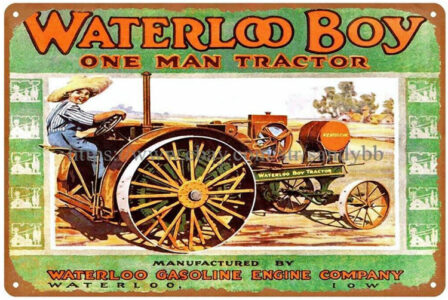
Following several years of research and development, the company began manufacturing tractors in 1911. However, none sold well until 1913, when the Waterloo Boy was introduced with a 2-cylinder engine. By 1914, the firm introduced the Waterloo Boy Model R. This tractor model proved successful, with more than 8,000 sold before it was discontinued in 1923. A subsequent Model N introduced in 1916 was also successful.
During this same time period, Deere & Co. started experimenting with its own tractor. In 1912, an experimental prototype was developed but never put into production.
In 1914, Deere purchased a hay machinery company from Joseph Dain, Sr. Dain was then charged with developing a tractor that could be sold for $700. An all-wheel-drive tractor was introduced in 1917. One hundred Dain-designed tractors were manufactured, but sales were sluggish.
Deere purchases Waterloo
Shortly after the decision was made to build Dain’s tractor, Deere purchased the Waterloo Gasoline Engine Co. With this acquisition, the company became known as the Deere Tractor Co. The tractor made by Waterloo was far more acceptable and could be produced for half the cost of Dain’s tractor. Subsequently, Dain’s tractor design was scrapped.
Tractors produced by the newly named company were sold with the Waterloo name until 1923. When the Model D was introduced in 1923, it was sold under the John Deere nameplate.
Over time, the company built more sophisticated versions of the 2-cylinder tractor using its iconic name. The 2-cylinder engine was eventually replaced with multi-cylinder engines that provided greater horsepower for larger farming operations. Today, the company is commonly known as John Deere.
Collecting roots
The Schwartz family’s collecting interest evolved from an early age. “As a youngster, I had a couple farm toys. They consisted of an International tractor and a John Deere self-propelled combine. They were tucked away in safekeeping until they were turned over to the boys. Brenton has taken the lead in expanding the collection, with a focus on John Deere,” Matt says.
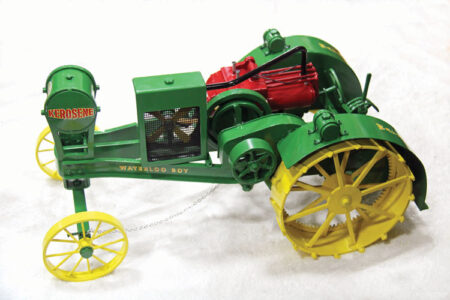
Brenton’s interest has been supported by his loving grandfather, Gerald Yoder. Gerald graciously takes his grandsons to local farm toy shows. He is also a collector and modeler of tractors. His most recent accomplishment is a precision scratch-built 1/8-scale Waterloo Boy that he offers for sale. “Brenton hopes to have one of those in his collection,” Matt says.
Brenton’s collection of nearly three dozen models is displayed in his exclusive attic “man cave.” “It is available for viewing by family and special friends. Hopefully, he will bring it out for public viewing someday,” Matt says.
Red Gem acquisition
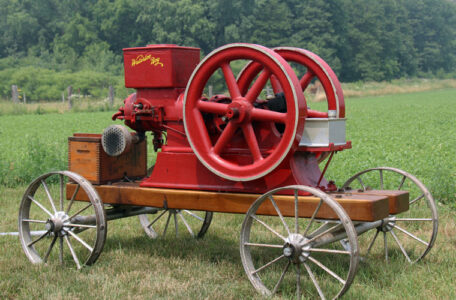
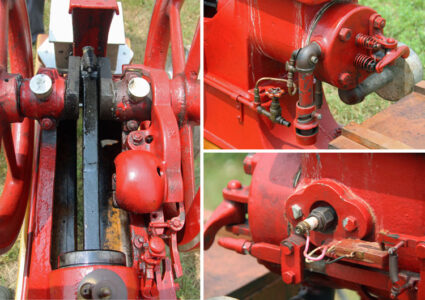
With a fascination for the Waterloo Boy, the hit-and-miss version caught Matt’s attention. “I learned about a Waterloo Boy hit-and-miss engine that became available. The red engine was in good running condition. I was able to acquire the 6hp portable engine mounted on a stand with wheels,” he says.
John Froelich started his company in 1893, building stationary Waterloo Boy engines. However, references for those early engines are not available. “It appears as though our hit-and-miss engine was built in either 1914 or 1915. The Red Gem is a nice complement to our Model N tractor,” Matt says.
The next adventure
The Schwartz family displays their tractor collection at the Rentown Old Fashion Days. “This annual event brings the Indiana communities of Nappanee and Bremen together with lots of excitement,” Matt says.
When asked about his future pursuits, Matt replies, “The John Deere Model D was the first tractor to carry the John Deere name. And it had the longest manufacturing period of any model, 1923 to 1953. Within the Model D, there were two different flywheel versions; one had spokes and the other was the closed style. We’ve learned that a limited number of Model D tractors had the spoke flywheel. This rare version became known as the Spoker D. So that’s our next adventure, locating a John Deere Spoker D tractor for our collection.”
Regarding fulfillment resulting from farm tractor collecting, Matt reflects, “The John Deere tractors are a pleasure to work around. More importantly, it provides quality time to be with my son, Brenton, who also enjoys tractors. The collection preserves farm tractor history.” FC
Freelance writer Fred Hendricks of Mansfield, Ohio, covers a vast array of subjects relating to agriculture. You may email Fred at fwhendricks@gmail.com.


