
I decided this time to share a bit of what I’ve been doing lately, and, in order to do that, it’s probably best that I explain my situation first.
I’m self-employed, which for me means that I earn my money by doing a variety of different types of work. I assist an elderly lady, and I garden for those who can no longer manage their own gardens. I also work one day per week in a eucalyptus plantation and one day per week in a native wildflower nursery. In my evenings, I write about the things I care about: nature, local history, and, of course, old machinery. It’s great to have all these different “jobs” because no day is the same, and there’s plenty of variety.
When it comes to my outdoor work, I’ve noticed that it’s a bizarre, never-ending battle of trying to nurture one type of plant, whilst simultaneously trying to annihilate another type of plant. For example, the elderly lady for whom I’m a private carer is passionate about her garden, and part of my work is maintaining this pretty little plot which lies out to the rear of her property and has views that are nothing short of heavenly. It’s a dream job, really, as she’s a sweet, easygoing lady, and to work on this garden is really quite an honor.
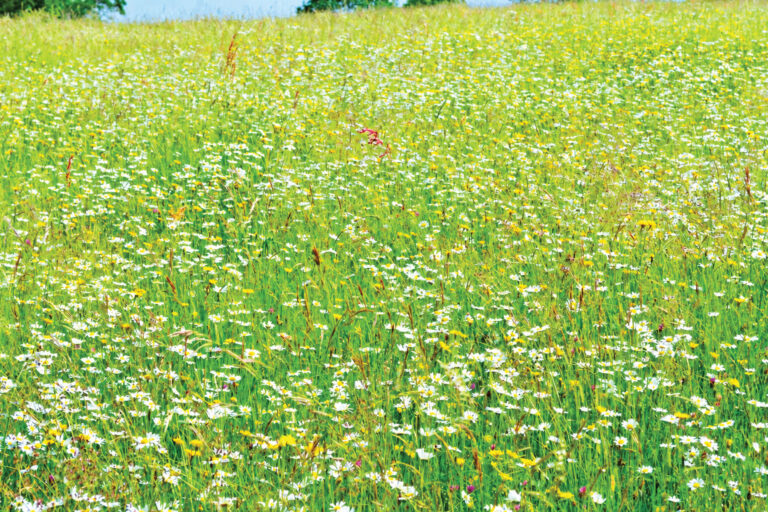
Much of my work involves weeding a long border, and I’m often removing native “weeds” such as prunella vulgaris. This low-lying plant is better known as “self-heal.” It’s a member of the mint family and native to much of the Northern Hemisphere. Self-heal, has a long history as a medicinal herb used to treat wounds, sore throats, and fevers. While some people consider it a weed, we grow self-heal in the wildflower nursery, and it sells in quite large numbers. The reason this plant has a commercial value is largely because people are beginning to care about native wildflowers, so much so that plans have been set up to give this, and hundreds of other native plants, a place to grow. One might reasonably ask why our government would want to spend money giving “weeds” a place to grow?
Well, since the 1950s, over half of the U.K.’s native flowers have been in decline, and this is a cause for concern for many reasons. Our native flowers have evolved alongside the insects that are essential for pollinating our crops and improving crop yields. These insects rely on our wildflower nectar for food, so it’s a circle that shouldn’t be broken. Members of the bee family that get most of the credit for pollination, but, in truth, over 1,500 different creatures help pollinate our crops, and while these creatures might seem insignificant, they’re a vital part of our ecosystem, and are thus crucial to agriculture, too. We are not attempting to preserve wildflowers just because they look pretty; it’s also because they’re the beginning of a food chain and are of vital importance if we wish to continue to pollinate our crops.
As a nation, we Brits have gardened and farmed relentlessly over the last century and, along the way, wildflowers have been one of the main casualties of these endeavors, resulting in a huge decline in their numbers. On the bright side, some sensible government solutions arrived; these ideas included using more native plants for municipal planting schemes, and encouraging farmers to allow strips of wildflower areas to exist alongside their cultivated areas.
My favorite plan, however, is the one the Welsh government came up with: to use road verges as safe havens for wildflowers. The nursery that I work in sells native plants and seeds for use on our roadside verges, and the results are spectacular. Now, driving along the main road through the Conwy Valley, I can see the fruits of my labors – oxeye daisies, cowslips, knapweed, and self-heal, along with others too numerous to mention. As well as looking nice for passers-by, these plants also feed our important pollinators, and another plus is that these verges now require minimum maintenance, and are only cut once or twice a year. The native wildflowers pay their way, it seems, and I like that kind of joined-up thinking.
Maintaining the Balance
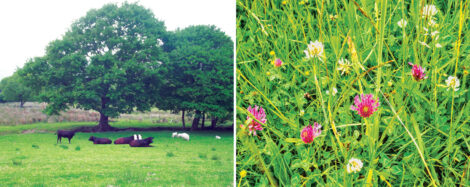
In my own hayfield, I try to encourage beneficial wild plants by minimizing the use of chemicals and not overgrazing with one species of livestock. For a period, I had a field that could be deemed the perfect balance of native grasses, clovers, and a few other plants beneficial to grazing livestock, such as ribwort plantain, black medic, and yarrow. This mix made nice hay for horses and sheep, and I began to think that I was some kind of leading authority on balancing both the needs of the livestock and the needs of the pollinating insects.
Then, one day, I noticed I had a new arrival in the hayfield – a yellow flower that I recognized with dismay as being rhinanthus minor, also known as “yellow rattle.” In no time, there were vast patches of this native plant, and there was soon less and less grass. This isn’t surprising because yellow rattle is semi-parasitic to grass – it attaches itself to the roots of grass, and takes its nutrients, reducing the vigour and eventually discouraging grasses altogether. For a few years now, I’ve been harvesting yellow rattle seed from my hayfield to sell to my boss at the wild flower nursery, hoping (in vain, as it turned out) that this would reduce the numbers of this wild little yellow-flowered plant in my hayfield. My boss loved the yellow rattle because it’s a great plant to sow on the roadside verges as it keeps the dominant grasses at bay, and it’s low-lying, so it doesn’t require mowing.
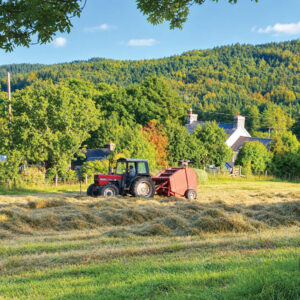
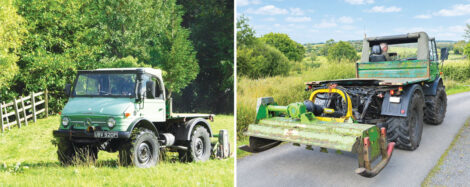
This year, however, I’ve had to admit defeat. There was just too much yellow rattle, and hand collecting the seed was proving futile. I called in the big guns and asked my brother Bob to “top” the field with his Unimog before the yellow rattle set seed. This, of course, meant cutting my hay crop just as it was beginning to grow, which was rather hard to watch.
But, so far, the plan has worked. The yellow rattle didn’t get to flower and set seed. It’s vanished now, and, given that it’s an annual plant, this should mean much less of it next year. Fingers crossed. Many would say, “Why don’t you just spray the pesky plant with some kind of weedkiller?” It’s certainly crossed my mind, but I’m an old-fashioned sort of person; I like to do things the simple way, and I like to show respect for all of the insects that pollinate our crops and that act as food for all of our beautiful birds. My brother Will (who is a farmer) rolls his eyes when I talk like that, but he agrees with me that, if nothing else, it’s a whole lot cheaper to get Bob to cut the yellow rattle with his Unimog and Topper than it is to get someone in to spray the field with some hideous chemical. So, for different reasons, we’re in agreement, and I’m still hoping to get a late hay crop, weather permitting.
Old-Style Work and Play
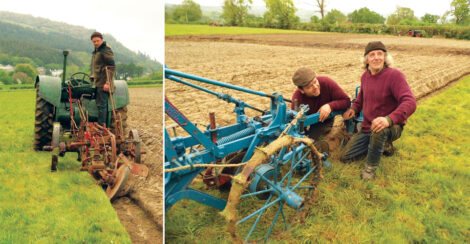
Some of the best times in life happen outdoors, and when you have a big family that won’t all fit into one house, getting together outdoors is the best solution. My older brother Will, the farmer, owns a meadow on the valley floor, and this year he decided to plow and re-seed it. He got his son Fig on board with the idea, and asked him if he wanted to plow the meadow with one of his vintage tractors. As a working mechanic with a family of his own, Fig doesn’t have a lot of spare time, so he came up with a cunning plan. He decided to invite his vintage tractor friends and relations over to the field for a kind of “plowing party,” with the idea being that if each person brought a tractor and a plow, they could all have the whole field turned over in no time. As the plowing day dawned, I decided to take a look at this unofficial gathering, so I set off down the lane in my old Jeep, with my son in the passenger seat holding my camera.
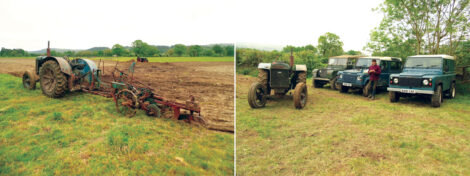
We drove into the field and saw six old tractors at work, and another two tractors parked up at the headland.
“Where’s Uncle Will?” asked my son.
“There He Is!”
I pointed to a man standing in the middle of the field, rubbing his chin and looking as if he was wondering if this was a good idea after all. In all directions, old tractors chugged by, each one plowing its own strip.
“A man outstanding in his field,” I said, laughing at my own joke, but my son just groaned.
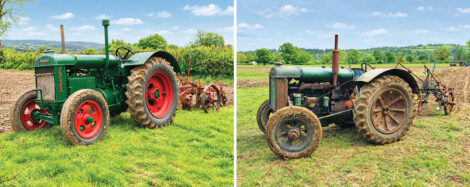
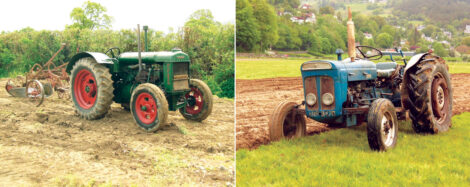
There were three Fordson Model N tractors plowing with trailer plows: Fig drove one, my brother Pete drove another, with Pete’s son Matthew driving the third. It was a lovely sight, especially for my family, as we all have a bit of a soft spot for Fordson Model N tractors. Our late father owned one, as did many farmers, because the Model N was the popular tractor of the period, and many of us who come from farming families will have fond memories of a father or grandfather who used to own a Fordson Model N.
I want to say that these little tractors hark back to a simpler time, but thinking about it, they actually hark back to a harder time – a time during WWII when we were cripplingly poor, lacking in resources, and these little tractors plowed day and night to keep people fed. U-boats in the waters surrounding the U.K. meant that imports of food could no longer be relied upon. Instead, we relied on small, old-fashioned tractors to plow and cultivate our land and to power threshing machines day and night, farming like we had never farmed before. The Fordson Model N is thought of as the tractor that kept Britain fed during those hard times, so it’s not only my family that has a fondness for Fordsons; the whole nation loves these tractors.
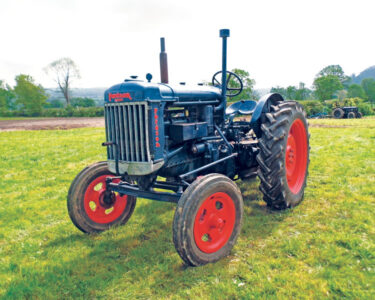
The Fordson Model N, which was built to replace the earlier Model F, had a long production run, lasting 16 years. By the end of WWII, the little British-built model N was a seriously outdated tractor, and was replaced in 1945 by the E27N. Whilst looking similar to the Model N, the E27N stands on longer legs and, for that reason, it’s a striking-looking tractor. There happened to be a fine example of a Fordson E27N on the field. It was parked up, and as I photographed it in this beautiful landscape, I felt a little wave of sadness. It was that moment of realization, the moment I’m sure others have experienced, too, that feeling of regret when we remember that we as a nation no longer make beautiful, durable, functional machines like this handsome old tractor, and I feel that’s a real pity.
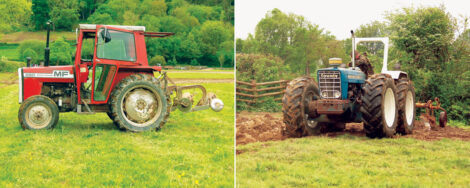
Over at the far end of the field were some slightly more “modern” tractors: a Massey Ferguson 135, a Massey Ferguson 550, a Fordson Super Dexta, and a four-wheel drive County tractor, all driven by friends of Fig and Will. Every so often, someone would pause to ask for advice, or to give a friend a go at plowing, which is something that you can’t do in an organized plowing competition. My brother Pete has enjoyed success in local plowing competitions in the past, competing with his Fordson Model N and trailer plow, but he mostly enjoys the freedom of being able to plow as he pleases, to give friends a go, and not worrying about points.
Around about midday, a car arrived on the field. It was Fig’s wife and children, bringing with them a giant spread of food, which they laid out onto a trailer. One by one, the men noticed that there was food on offer. One by one, the tractors came to a halt, and the drivers walked over to the trailer to enjoy their ploughman’s lunch. With the three Fordson Model N tractors parked up in the background, it could’ve been a scene from eight decades ago. Sometimes, there’s little better in life than getting together with your people in the great outdoors.
Josephine Roberts lives on an old-fashioned smallholding in Snowdonia, North Wales, and has a passion for all things vintage. Email her at josiewales2021@aol.com


