
Author’s Note: In the December/January 2026 issue of Farm Collector, readers became acquainted with Heinrich (Henry) Herickhoff and his adolescent years during World War II, on a farm near the little town of Graes in northwest Germany. We read how the struggles with nearby warfare and hunger helped shape his drive to go to America. After that article, Farm Collector readers called many times asking specific questions, and in general, “please tell us more.”
The anxiety and deep fear the family experienced as the WWII progressed around them sparked questions from readers that became emotional at times.
Here Heinrich tells in-depth information on “how it really was” living in a WWII war zone. The December/January issue provided a broad understanding of his childhood prior to immigrating to the U.S. Here I have included some other interesting personal items.
What was it like in the bunker during the bombing?
Really scary! Much of the bombing occurred at night. We almost dreaded nightfall because we didn’t know where the planes would drop their bombs. If the Americans bombed the Ahaus rail center six miles away, the ground shook and dust would come up from the floor. My dad had put straw and old boards on the floor to minimize the dust and help keep our feet warm. We always hoped the planes were going to the Ruhr, more than 100 miles away.
If the bombing mission was to destroy the tank factory in Gelsenkirchen, about 50 miles away, the planes came lower to increase their accuracy, but still keep away from anti-aircraft gunning. Obviously, the engine rumbling was louder. The young children would cry, “Mommy, I’m scared, when is it going to stop? Why do they drop bombs?” Usually the answer was, “God will protect us, let us pray the Rosary.”
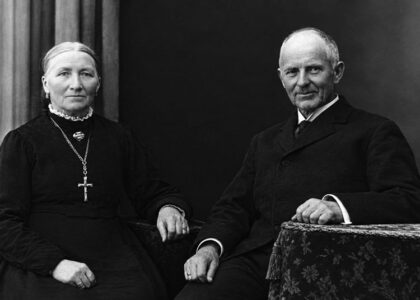
Grandma or Grandpa would lead the prayers, their hands shaking with fear as they held the rosaries. Most often we were wrapped in coats and our home-made blankets because we’d quickly come from the house, slipped into our wooden shoes, and run to the bunker. During winter, we huddled together to keep warm. My mother would often have prepared some water, bread, and meat in a container because we didn’t know how long we would be there. However, priority was to get the younger children to safety in the bunker.
Older kids had to help and be responsible for themselves – there was no “messing around.” We had no idea how long the bombing runs would last, usually a couple of hours or so – but they seemed to come in waves, and there could be several waves – we just didn’t know, so we were always on edge. At times of bravado, my brother Josef and I would sneak outside and count the bombers until Mom or Dad realized where we were and chased us into the bunker!
Life inside the bunker
The bunker was built about 50 feet from the house, so that if the house was damaged or destroyed, the 5-by-7 meter structure might still stand. The concrete walls and ceiling were about 8 to 10 inches thick, had a support post in the middle, and it felt cold and damp. There was no stove, and toilet facilities were outside. Candles made from tallow provided a bit of light. The door was about 3 inches thick, hand-sawn of oak from our forest. There were no windows, and we sat on stumps and homemade chairs and planks, seating 18 to 20 family members and sometimes neighbors. The bunker was built among mature trees in our backyard to conceal its location. After the war, the bunker was used to store and preserve potatoes after the harvest because the cement walls kept the temperature fairly even, and the heavy door could be locked.
Were any of your farm buildings bombed?
Fortunately, no bombs exploded in our farmyard, although several were dropped on our land but didn’t explode. Daytime bombing occurred toward the end of the war, as Germany’s air defenses had been severely weakened. In daytime, it was easier for pilots to see the targeted munitions manufacturing plants, and thus there were fewer bombs dropped in our area since we were agricultural. The Ahaus rail center six miles away was an important target, since rail was used to send military supplies and rations from the Ruhr through Holland to the German front farther west.
After the war, bombs were found while working the soil and Dad would notify the closest American military base. They would pick up the bomb, take it to a designated open area some miles away and detonate it. Not everyone was lucky. A neighbor, Hermann Helmert, was pulling an implement with horses and struck a buried bomb, which exploded and severely injured him and his horses. They were never the same.
A new and unusual weapon
Towards the end of the war, we saw a few “planes without wings” flying north toward England. They made engine sounds we’d never heard before while flying fairly low over our area. They were aiming much higher, and seemed to be much faster than regular airplanes. No one knew where the launch location was – certainly a secret. After the war, we learned they were V-1 and V-2 rockets, part of Germany’s “wonder weapons” program, also called vengeance weapons. These rockets were a huge advancement and Hitler saw them as the weapons that would defeat the Allies.
Did you find other ordinance around the farm or neighborhood?
Yes, mostly along the railroad track where we had pasture for the cows. Sometimes a German plane would encounter a British or American plane in a midair fight and lots of ordnance would land in the field. With all the field handwork required for grain or beet harvest, we frequently picked up projectiles and unfired bullets. The field along the railroad was dangerous because American or British planes would strafe anyone it appeared might be working to repair the tracks. When working that field, one person would handle the horses, and another would keep watch for planes. Horses never got used to low-flying planes – they went wild and it took some time to get them settled down again.
What if someone got sick or injured?
Frankly, you did the best you could. There were no medicines available to the public, as everything went to support the German war effort. We relied on home remedies handed down from earlier generations, and prayed a lot.
Did you go to school during the war, or when bombing was occurring?

Yes. I was in the 1st, 2nd, and 3rd grades during the war. Attendance was spotty if bombing or fighting was occurring anywhere near Graes. We were instructed to duck under desks or tables, or run to the two big bunkers in the schoolyard. Usually, we didn’t worry because we thought the Americans wouldn’t bomb a school or church. Also, Graes was not an important military target, being just a little farming town. Mom and Dad made the decision whether we’d attend school on any given day. On the school walls, pictures of Adolf Hitler had replaced all religious pictures or symbols, and prayers were forbidden, and we had to salute his picture daily. Importantly, every student had to know the date of Adolf Hitler’s birthday, April 20, 1889, which the Nazi Party declared a national holiday. Severe corporal punishment occurred if you didn’t know it.
Many school days were spent in the bunker, classes were all mixed up, and, as a result, it was declared that right after the war, all Graes students had to repeat the 1944 to 1945 school year subjects.
German prisoners returning to Graes
Despite being a small town of 100 or so, dozens of men in Graes and the surrounding agricultural area were drafted into the German military, mostly army infantry. In the closing months before D-Day, nearly all had been captured and placed in POW camps. A total of 425,000 German prisoners lived in 175 main camps and 511 branch camps across the United States, in almost every State, but mostly in the South. They were the lucky ones, and included my four cousins and an uncle. Those not so lucky were captured by the Russians and sent into forced labor within Russia.
After D-Day, the return of POWs held by Americans and British occurred within a few months, especially those recently captured and held in camps in Europe. Not so with Russian-held prisoners. Some were never heard from again, and others returned to Graes as much as three years later.
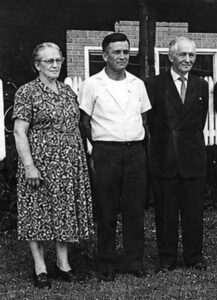
Their stories are similar. They were placed under guard, mostly in Russian factories, working 15 or more hours per day, receiving barely subsistence rations, and sleeping on floors. When finally released, and if they had survived, they were put on a freight train going toward Germany and dropped off someplace near the border. Often they walked many miles to get home to Graes, begging for food along the way, and they were unrecognizable to Graes residents when they finally arrived home. Henry’s cousin and a neighbor were among them.
They were unshaven, dressed in rags and often no shoes, and had lost large amounts of weight, some weighing in the range of 110 to 130 pounds. Georg’s story is typical. He walked to his house and knocked on the door. His wife answered but didn’t recognize him until he spoke as forcefully as his emaciated body would allow, “Maria, I am Georg – I’m back from Russia.” This and other tear-filled reunions caused community rejoicing, and also raised the questions, “Where is my missing son, or my husband”. As a result, intense hatred for their Russian captors grew among the entire community.
Did the general populace get much information about the war?
All newspaper content was controlled throughout the war by the Nazi party. Each day, the Nazis would send “news” to the four or five “legal and approved” newspapers, and all would print the same stories. History has shown the stories to be severely distorted. However, the American and British Air Force had a program where they prepared leaflets, often cleverly addressed to the “Deutsche frau” (the German woman or wife), then to the men of Germany, and sometimes to the general population, encouraging them and providing info about the intentions of the Allies.
Leaflets of the War
Here is a sample of two leaflets that were dropped by the Allies in Germany during WWII, with included translations.
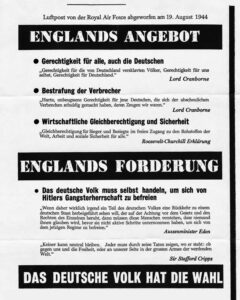
ENGLANDS ANGEBOT – England’s Offer
1st Point: Justice for all, also the Germans. Justice for those from Germany’s enslaved people. Justice for ourselves, justice for Germany.
2nd Point: Punish the criminals. Tough unshakeable justice for every one that committed dreadful acts, guiltily performed.
3rd Point: Business-like, immediate entitlements and security. Work and social security for all.
ENGLANDS FORDERUNG – England’s Request
1st Point: The German people must handle this by themselves, to free themselves from Hitler’s gangsters. This will be a series of active steps. No one can stay neutral. Every person must determine where he stands, for what gives freedom, or, more time with large armies in the world.
DAS DEUTSCHE VOLK HAT DIE WAHL – The German people have the choice.
Second Leaflet
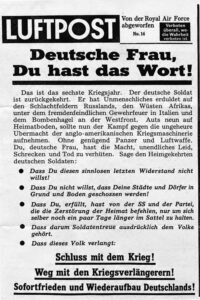
By Airmail – German Woman, You Have the Final Word.
This is the 6th year of the war. The German soldier is on retreat. They have suffered unmentionable in Russia, West Africa, against Allies in Italy. He should not need to fight against the Anglo-Americans without enough tanks and aircraft. You, dear German woman, have the authority, and the unending sorrow and the horror of death in your family. Tell the German soldier when he comes home:
1st: That you know he didn’t support this last senseless resistance fighting.
2nd: That you know he didn’t want to destroy your country and towns, shooting them into the ground.
3rd: That you have enough of the SS and their party, and the destruction of homeland, just to stay in power for a few more days.
4th: That you as soldiers have listened exclusively to the people of Germany.
5th: That the people have wanted for a long time:
Put an End to the War!
Away with the Longer War!
Immediately Bring Freedom and Rebuilding in Germany!
Just some unusual or interesting happenings
Toward the end of war, on Easter Sunday morning, we were walking to church after having milked the cows and fed all the livestock. From a mile or so away we could see the road was full of Army vehicles as far as we could see, all driving on the main road through town, about 300 feet from the church. The trucks, jeeps, and troops were going east after the retreating German army. These American and English troops had come through Holland, and it took several days for that military traffic to lighten up –that’s how many there were.
As to the church service, more people were interested in the military, it seemed, and the constant noise from the vehicles made it difficult to hear or understand. I think the priest cut the Mass short.
One day, near the end of the war, five German soldiers came to the farm asking for food. They’d become disconnected from their unit and, realizing the war was almost over, they were looking to surrender to American soldiers. They said they hadn’t eaten much for days. My mother took some raw eggs from a basket and, before she could prepare them, they each just grabbed an egg, cracked it and sucked out the contents. Then Mother gave them some additional soup and bread. They were very grateful.
Right after VE day on May 8, 1945, a solitary German soldier had come out of hiding to our farm but didn’t know the war was over, and just asked for some food. Of course, my parents fed him and told him about the surrender. He fell to his knees, crying. He thanked my parents profusely, and offered to work in return. He helped for several hours and received more food. Then he asked leave to walk to his home because he had had no contact with family for almost three years.
Food availability after the war
Literally everyone was on starvation rations. Farmers in particular shared much of their food with people from the towns. Nonetheless, we had to prevent them from stealing grain, potatoes, or livestock during the night. One night we lost 10 of our white geese. Mom had planned to pluck their feathers for pillows or blankets for our beds, and their eggs were valuable. She traded some goods with a neighbor for 10 goose eggs, which she put under some hens to hatch. All our rabbits were stolen. We frequently ate rabbits as our meat source as this allowed us to sell all our pigs or beef cattle. There was a strict government program to distribute food among the populace. All hogs, chickens, and cattle were registered and reported to a government worker when ready for slaughter. The meats were then parceled out to families based on the number in the family, and the farmer was paid by the government.
The clothing worn by some of the begging people was nothing more than rags. Mom and Dad literally gave away much of our clothing, even though we didn’t have a lot, explaining how badly it was needed by starving families. In later years, I’ve marveled at how generous my parents were.
Why did your brother Josef go back to Germany?
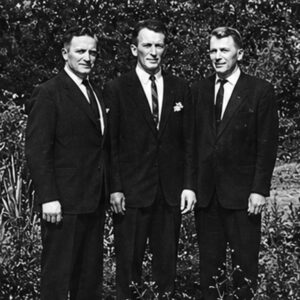
Joe loved the U.S.A. and the relatives in Minnesota, and made many friends. In fact, he’d purchased a 160-acre farm near Elrosa along with a tractor and some equipment, thinking he’d become a citizen.
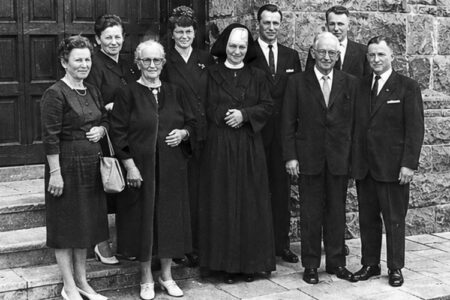
But, to understand his decision to return, we need to understand the culture and family life in rural Germany. On a German farm, the oldest surviving son has particular obligations and is the heir to the farm. In return, his parents can live on the farm and are supported there for the rest of their lives. This occurs generation after generation, and explains how the Herickhoff “home place” has remained in the family over five centuries, as mentioned in the December/January issue. Josef was the oldest son of Clements August and Katharina Herickhoff, and I’m the second son. After five years in the U.S. and being in frequent communication with his parents as they were advancing in age, it was clear they were becoming unable to fully care for the heimplatz, the home place. Thus Josef sold his U.S. farm and informed everyone in the family he was returning to Germany to fulfill his obligations.
Today, the family farm is operated by his son, Josef Herickhoff, Jr., with expanded dairying operations.
If you couldn’t speak much English, how did you meet Vicky, since she didn’t speak any German?
Let’s put it this way, love has a way of happening! I first met her at a St. Cloud, Minnesota, dance hall, but had limited conversation because of my broken English. Then about two years later, I went to a dance at the New Munich, Minnesota, ballroom, and there I saw her sitting in a booth! She remembered my amateur attempts to speak English. We danced, and soon I knew her phone number and other important information. Love blossomed, and we were married in July 1968!
Why did you choose to restore John Deere tractors instead of other brands?
When I first came to the U.S., Uncle Ben mostly had John Deeres but he also had a small Ford, an old Farmall F20, and a Minneapolis Moline Avery. I also saw some other brands on neighboring farms. When I started my farming operation, I decided the John Deeres were best for me. So, during the cold Minnesota winters, after I performed all maintenance on equipment preparing for spring, I simply decided to fix up my tractors to make them look like new. I was hooked! Completing my first restoration of the John Deere 820 was a real “high.” I couldn’t wait to start on the 720. I just admired how nice they looked!
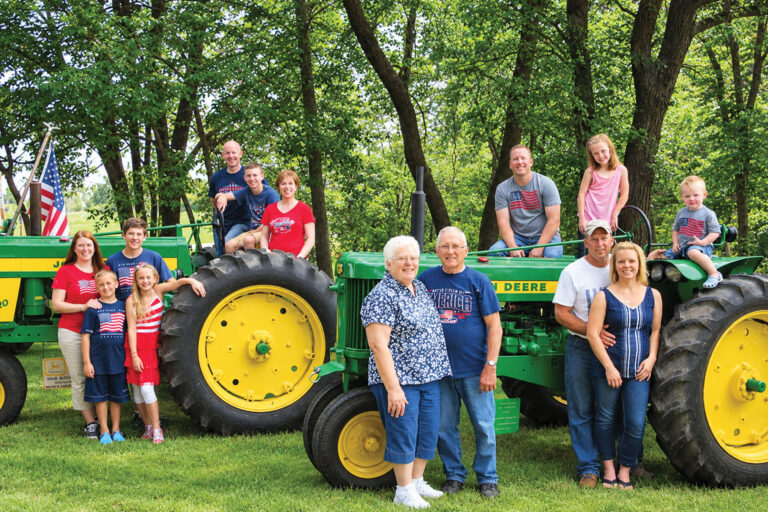
Then, my neighbors would come by to admire these nice looking tractors, and they came back, bringing their friends to see them. I developed wonderful new friends. Soon I got the reputation as being the best restorer in the Sauk Centre area. In addition to then restoring the complete John Deere 20 series (more photos in the original article), I also restored an English Ford and my son-in-law’s 1948 Farmall M tractor. It gave me lots of satisfaction, and I had a wonderful time working on the tractors with my sons when they had spare time. Today, my objective is to make other people happy when they come to the 4th of July parade in West Union, Minnesota. My seven antique John Deeres bring out cheers and smiles, and after the parade is over, many come to look, talk, ask questions, and touch and feel tractors like they drove growing up, or while farming. What more can I ask for?!
Life in the U.S.A. is great!


