Collecting vintage farm tractors and equipment remains a popular hobby. Tim Putt joined that collector craze, but soon changed course as he explained, “Through our marriage, Betty and I have strong connections to John Deere equipment. As a result, our farm is named Putt-Putt Farms. This led to becoming devout collectors with 11 two-cylinder John Deere tractors. After restoring a couple, our hobby/business took a different direction.
“As early as I can remember I wanted to farm. This led to looking through my dad’s farm magazines. After the restoration of a couple two-cylinders, I began collecting farm equipment advertisements. This included both newsprint and four-color glossy ads. The glossy ads provided material to produce jigsaw puzzles and farm equipment publications for our newfound business.
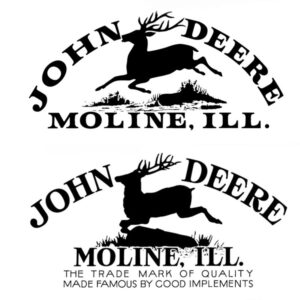
“However, the hobby continued through the collection of advertisements published on newsprint. The use of newsprint was the primary form of communication in the late 1800s and early 1900s. The pictures and graphics were usually hand-drawn. Because of their uniqueness, the early newsprint advertising created a new collection interest,” he added.
To locate the old printed material, Tim scoured antique malls and flea markets, and attended estate sales searching for vintage newsprint material. Once publications were located, countless hours were required to search for the vintage ads. As a result, Tim has a vast collection of old ads, regardless of equipment brand.
Let’s look at a number of newsprint John Deere and related advertisements, after a brief history of farm equipment advertising.
Farm Equipment Advertising History
Entrepreneurs selling products designed to improve farming practices and increase yields were anxious to get their brands in front of rural customers. As a result, historic farm equipment advertising covered a wide range of promotional materials used by manufacturers. The advertising found its way into newspapers, magazines, catalogs, company promo pieces, posters, and more.
Following advertising through time provides a glimpse into the evolution of farming practices. As farming became more sophisticated, ads highlighted technological advancements. For example, ads focused on the first gasoline tractor that propelled itself forward or backward when John Froelich developed the machine in 1892.
Marketing strategies were also revealed by manufacturing companies. Early advertisements often focused on the benefits of replacing horses with mechanically powered tractors and equipment. For instance, International Harvester marketed the company’s Farmall tractor of 1923 as a way to replace draft animals.
Advertising is often touted as the management of demand stimulation. Consequently, manufacturers would build strong brand identities through consistent advertising and pictures.
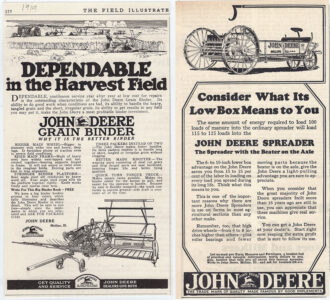
Vintage farm equipment advertising pieces are appreciated for their historical value and ability to evoke a sense of simpler times. The value of vintage farm equipment ads depends on factors such as age, rarity, condition, and the manufacturer. Tim Putt has taken great care to preserve his nostalgic newsprint advertisements. His ads published in this article share a glimpse into the past, including both equipment and farming practices.
A Blacksmith’s Vision
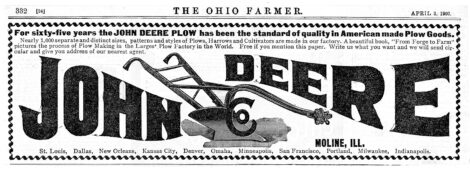
This advertisement, which was too large to reproduce, reflects on John Deere’s development of the plow from his blacksmith shop back in 1837. It went on to tout the company’s commitment to quality engineering and manufacturing. The copy relates that farmers were skeptical about Deere’s efforts to perfect his new-fangled plow that claimed to work under all soil conditions.
They saw him coming and going between the shop and field every day. “He’ll never do it,” said one. “Besides the old plows work fine in timberland. And there is plenty of timberland to be cleared off in this country.”
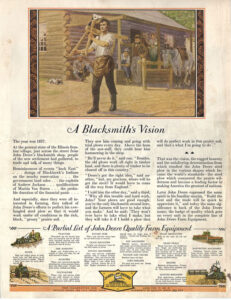
“Deere’s got the right idea,” said another. “But my gracious where will he get the steel? It would have to come all the way from England.”
That vision, rugged honesty and determination resulted in the John Deere steel plow, which became the world’s standard. The steel plow helped conquer the prairie and became a leading factor in the development of the U.S.
Later John Deere expressed the same spirit in his familiar maxim, “Build the best and the trade will be quick to appreciate it.” And today, the same significance is behind the John Deere name, the badge of quality that goes on every unit in the complete line of John Deere Farm Equipment.
John Deere Plows
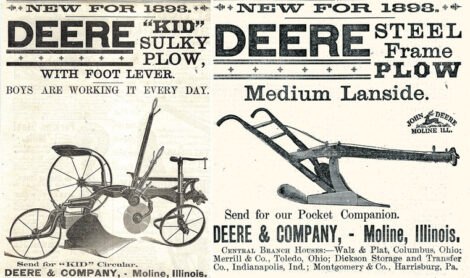
John Deere’s early plows were made in various styles with a range of bottoms, and horses or oxen drafted them. Advertisements promoted two different styles of plows introduced in 1893. They included the single-bottom, steel frame version known as the “Medium Lanside” plow. The second was the “Kid” sulky plow with foot lever. The single-bottom plow was promoted for its ease of operation, as Deere claimed boys worked with it every day.
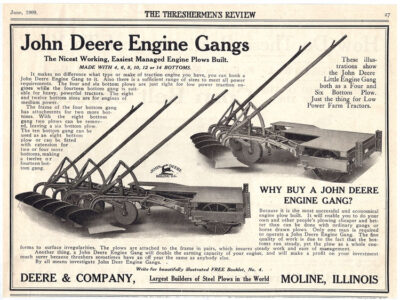
A 1909 advertisement that appeared in The Threshermens Review promoted the John Deere “Engine Gangs.” The plow was available in 4, 6, 8, 10, 12, or 14 bottoms. The ad copy claimed that it made no difference what type or make of traction engine you have, you can hook a John Deer Gang to it.
They Called It a Tractor
In a vintage advertisement taken from The Tractor Field Book, the featured tractor picture was from the Album of American Agriculture.
The copy states that during the summer of 1892, in the shade of a village store in northern Iowa, John Froelich built the first gasoline tractor that propelled itself either forward or backward. In building the cumbersome contraption called a tractor, neither he nor his helper could imagine it would revolutionize American agriculture.
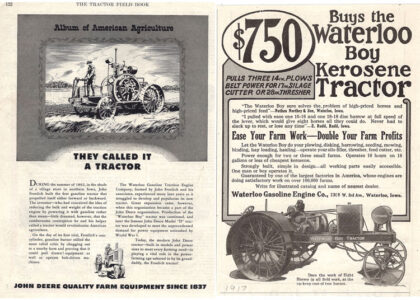
The Waterloo Gasoline Traction Engine Co. formed by John Froelich and his associates experienced many lean years as it struggled to develop and popularize its new tractor. Great expansion came, however, when the company became part of the John Deere organization. Deere continued production of the Waterloo Boy tractor and later developed the famous John Deere Model D tractor.
The ad copy concluded by saying, “The modern John Deere tractor – built in models and power sized to meet every farming need – is playing a vital role in the power-farming age ushered in by its granddaddy, the Froelich Tractor.”
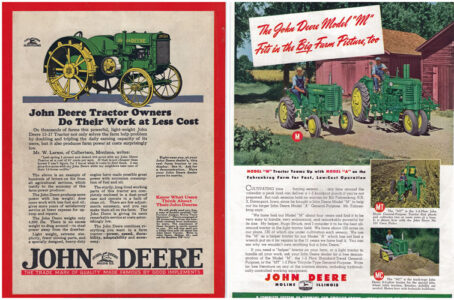
Note the 1917 Waterloo Gasoline Engine Co. advertisement. The headline promoted the cost of a Waterloo Boy kerosene tractor for $750. The ad copy says that the Waterloo Boy solves the problems of high-priced horses along with their high-priced feed. It went on to state, “Ease Your Farm Work – Double Your Farm Profit.”
Deere Affiliations
John Deere had numerous affiliations with other farm machinery companies. The relationship with Dain Mfg. Co. began in 1895 and concluded in Deere’s acquisition of Dain in 1911.
While owned by Deere, Dain Mfg. maintained a separate identity and manufacturing facility in Ottumwa, Iowa. This firm specialized in equipment for handling hay, as seen in the accompanying advertisement.
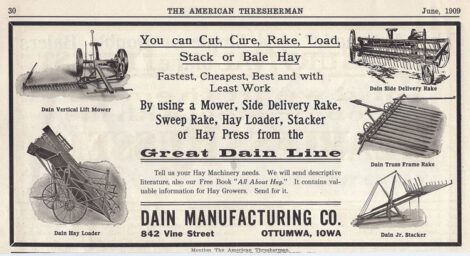
Joseph Dain became a vice president and a board member at John Deere and was tasked with designing and developing the first John Deere tractor. The experimental Dain tractor was short-lived as Deere ultimately purchased the Waterloo Gasoline Engine Co. to manufacture and promote its tractor.
Automobile Affiliation
An advertisement that could be misleading is the one for 1907 Type B Deere-Clark automobile. John Deere, through Charles Deere, had a brief but notable affiliation with automobile manufacturing.
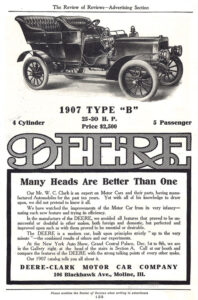
This venture, known as the Deere-Clark Motor Car Co., produced automobiles between 1906 and 1907. Although Deere & Co. was not directly involved, Charles Deere, son of John Deere, personally invested in the project by providing funds. The accompanying advertisement shows the above named Deere-Clark Type B automobile.
Tim Putt’s Collection
These advertisements from Tim’s collection are a mere glimpse of his total collection. Tim noted, “I continue to have interest in collecting vintage advertisements. It’s a great way to look back at early farm equipment and appreciate the progress made with the equipment we farm with today.
“Through this hobby, Betty and I have developed wonderful contacts with other collectors. As a result, many friendships have developed.”
If you’d like to learn more about the Putt Putt’s unique collection, Tim welcomes your contact by phone at 419.681.2755 or by email at timandbettyputt@gmail.com.
Freelance writer Fred Hendricks of Mansfield, Ohio, covers a vast array of interesting subjects. You may contact Fred at fwhendricks@gmail.com