
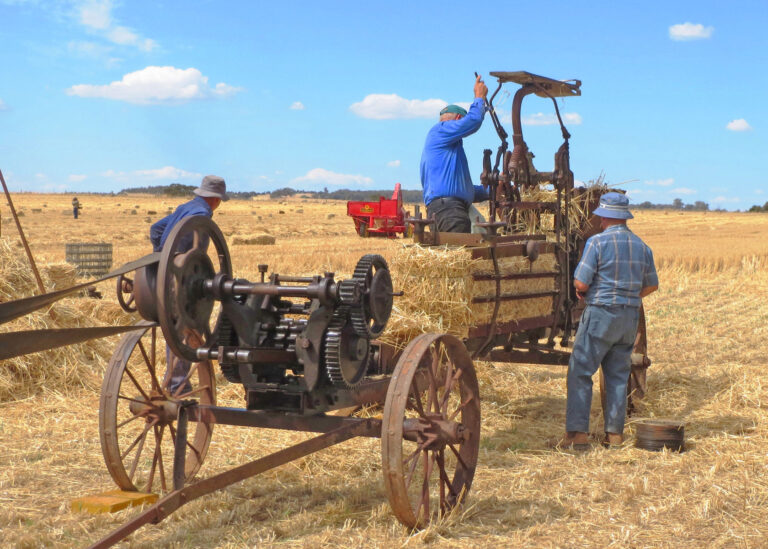
As the 1890s made their way into the 20th century and beyond, farm machinery manufacturers had to market their machines and tools to thousands of farmers who owned no source of farm power except for that provided by horses, donkeys, and mules.
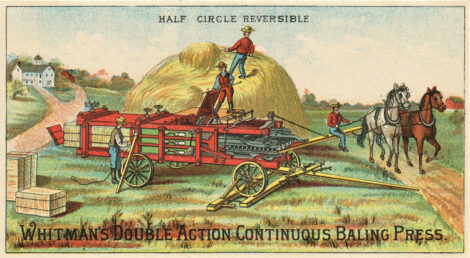
As baled hay was becoming increasingly important, machines had to be devised that could utilize the power of the farm beasts, to produce it. The first horse-powered horizontal hay presses relied upon horses traveling in half-circles in one direction then turning to retrace their steps in the other. These “Half-Circle” or “Reversible Lever” presses were the forerunners of the “Full Circle” presses, which followed soon after (Photo 1).
Some innovative hay press manufacturers even harnessed the power produced by large, remote horse powers to power their presses. Using two or three universal joints, they connected the drive rods directly to the end of the flywheel shaft of the press (Photo 2).
Others used a separate gearbox for connection to the drive rods so that a belt pulley could be used to transfer the power to the press.
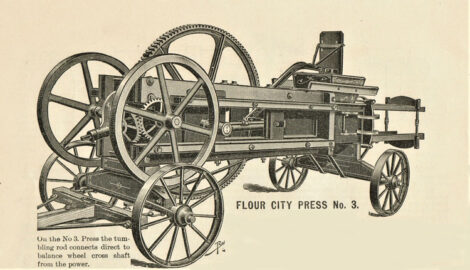
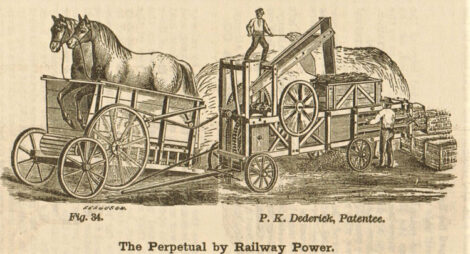
A couple of manufacturers fitted bevel gears to the end of the drive rods so that these could mesh directly with complementary gears fitted onto the main drive shaft of the baler (Photo 3). Use was made by several manufacturers, of treadmills, “Railways” as they were often called (hence “Railway Presses”) to convert the movement of the driving animals to circular motion of either pulleys or drive rods (“tumble rods” as they were called) to then drive the hay presses via belts or direct coupling.
Perhaps the most inventive of all the horse-powered presses was the pull-power press. It was designed towards the end of the 19th century to reduce the weight of horse presses and to make them easier to operate. When fitted with toggle joints on the plunger drive, they became easier still. International Harvester was probably the first company to use toggle joints on the plunger drive mechanism. Their first toggle-jointed presses were released in 1907.
Pull-power presses removed the jerky recoil associated with the returning plunger of many early push-power presses. Peculiarly, they delivered the bales in the middle of the outfit, not far from where the horses traveled during their circumnavigation of the power works at their end of the machine.
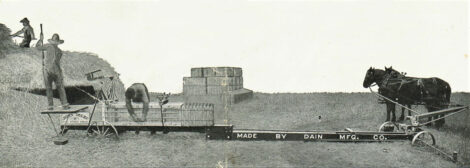
Apparently, the horses were unfazed by this. It also meant that the stack from which the hay was being fed into the baler, was at the far end, a considerable distance from the horses. This was cited in advertising as a significant advantage to the threaders and tyers because it reduced the amount of dust around them as they worked (Photo 4).
Marvin Mead may have been the first to patent a pull-power hay press. The Mead Hay Press Co. of Pueblo, Colorado, marketed his patented machine of 1895 until at least 1915.
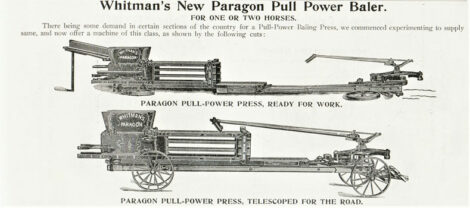
Including International Harvester, at least seven other companies manufactured pull-power presses in the United States between 1900 and 1944. Three of the seven, the well-known hay press companies, The Ann Arbor Machine Co., Swayne Robinson & Co. and the Whitman Agricultural Co., appeared unconvinced about the relative merit of pull-power presses. They each carried only the one model, the introduction of which was late and the retention of which was for only a short while (Photo 5).
Generally, pull-power hay presses yielded either two or three power strokes for each circuit of the animals operating them. The “Big 4” baler of the De Loach Mill Mfg. Co. was an exception, providing four power strokes from each lap.
When International Harvester/McCormick Deering was formed in 1902, neither McCormick nor Deering brought a hay press to the enterprise. The new company produced its first balers in 1904; pull-power machines for one or for two, horses. Each model delivered two power strokes for each lap of the horse(s). International Harvester’s one-horse press was offered with a 14 x 18 inch chamber only. It had a forty year production run with the only significant change being the incorporation of a force multiplying toggle joint to the plunger drive. The original decals and the green & red livery went through several changes but, being cosmetic only, they had no bearing on the performance of the machine; perhaps they influenced sales though!
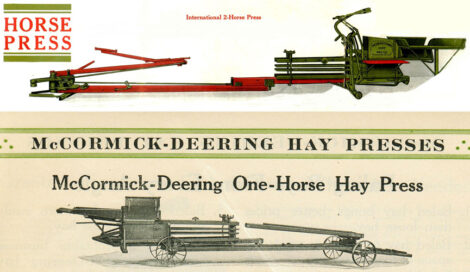
The two-horse baler was available with a choice of three bale chamber sizes: 14×18, 16×18 and 17×22 in inches. The press was produced until 1941. The addition of a condenser & self-feeder option was available from 1910 (Photo 6).
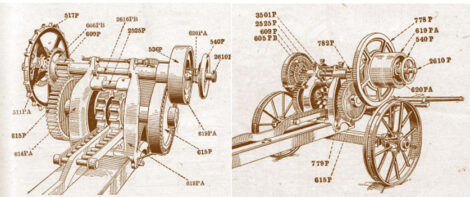
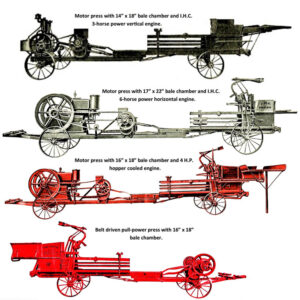
The company went on to become specialists in pull-power balers. Between 1909 and 1918 their range included several models that were engine driven. The engines drove ingenious power-jack devices, which pulled the compressing plungers in from the back of the machines (Photos 7 and 8).
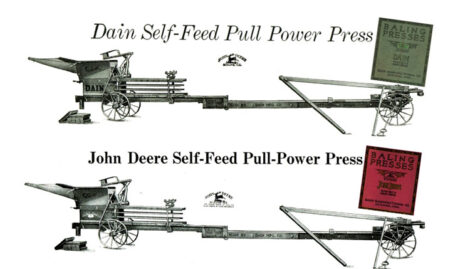
Dain Manufacturing of Ottumwa, Iowa released their two-horse pull-power hay press two years before International Harvester had launched theirs. The machines were extraordinarily similar in function and appearance. An important difference was the installation of an air-cushion, rather than a spring, on the “horse-power,” to absorb the shock of the “back-stroke” of the returning plunger. Dain followed up in 1908 with a one-horse model. This remained in production until 1938. The two-horse press was discontinued in 1935. The one-horse press used a 14×18 bale chamber. Three chamber sizes were offered for the two-horse machine: 14×18, 16×18, and slightly unusually, 18×22. A self-feeder became available for the two-horse baler in 1910.
The significance of the Dain machines is that John Deere gained special marketing arrangements over them from 1905. These arrangements led to John Deere buying out the company in 1911. An equivalent range of John Deere-Dain balers ensued, with the hyphenated name lasting long after John Deere’s complete takeover of the company (Photo 9).
Both International Harvester and Dain Manufacturing were mindful of the need to make the path for the horses as trouble-free as possible. To this end, the power transmission rods from the horse-power end to the plunger end of the balers was set-up to be as low and unobtrusive as possible. The machines telescoped-in for transport. Upon reaching the baling site, it was first necessary to telescope the machines out again then either partially bury the wheels into the ground or take them off altogether. A special jack was offered to facilitate this. With the wheels partially buried or removed, the beam protecting the power transmission rod sat on the ground. Consequently, there was little for the horses to step over.
I don’t know of any pull-power presses built by Swayne Robinson, De Loach, Ann Arbor, Whitman’s or Mead that have survived but I guess there are some, hopefully in the care of collectors and museums rather than in hedge rows. There are definitely many survivors amongst the International Harvester models and a good few Dain/John Deere-Dain/John Deere that have made it to the present as well. Some are being demonstrated at shows and fairs; a boon to fostering interest in these, the most unusual of balers.


