
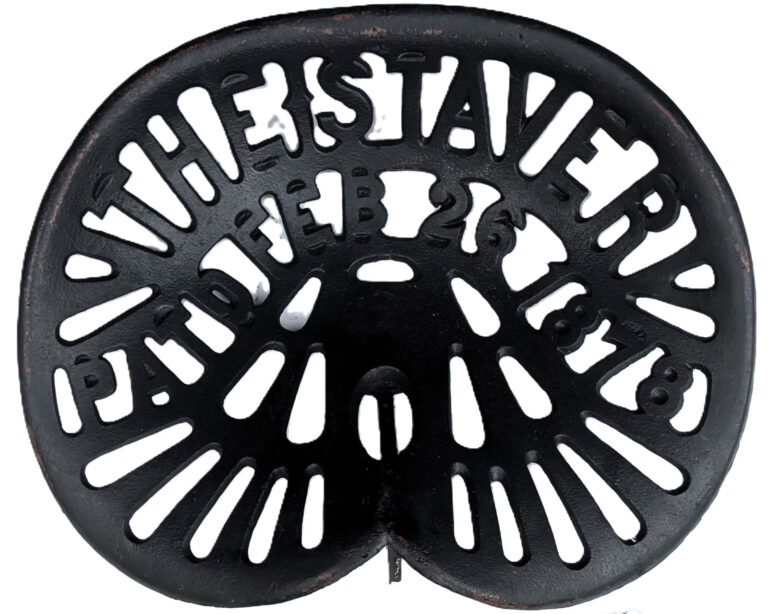
Jeanine Kintigh from Webber, Kansas, has been a long-time cast iron seat aficionado. While her late husband, Roger Kintigh was often known for being the seat buyer of the couple, Jeanine has never lacked in her knowledge or enthusiasm. Roger passed away in 2021, and since then, Jeanine hasn’t bought very many seats until lately. She became the secretary and treasurer of the Cast Iron Seat Collectors Association in 2018 and has spent countless hours since helping the Association run smoothly. She not only does the day-to-day work of bookkeeping, but also travels all across the country promoting the hobby. Recently, she helped with another of the Cast Iron Seat Collectors Association’s sales and had her eye on a seat that neither Roger or Jeanine had been able to buy before.
Jeanine helps with a lot of the pre-work on the sales and had told fellow collector Tom Wilson early on that she had interest in the “Staver” seat. Tom replied, “Ok, but you better bring your checkbook.” Little did either one of them know at the time, but she would not only end up taking it home with her, but she’d also set a new record high for a publicly sold cast-iron implement seat. In her modesty, she wasn’t going to boast about how much she spent; however, those in attendance all had to take a moment to compose themselves from the shock wave. She had almost doubled the record high that her late husband Roger had set in the spring of 2018.
After the sale Jeanine told Tom, “I told you I wanted it, and it was going to come home with me. I’m not just the woman that does the grunt work of being the secretary – I’m still a collector. I get tired of people thinking I’m just here to make their coffee.” Now it hangs in her house beside the very similar J.I. Case cast-iron seat that also has the same patent date of 1878 molded in. The J.I. Case patented seat was actually the last cast-iron seat Roger had bought for Jeanine at a Nixon auction for Bud Porter in Spring of 2018.
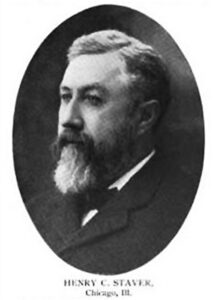
So, what does she know about the Staver seat to want to buy it, besides the same look as the Case seat? Well, since she bought it, fellow collector Suzie Roundy from Wisconsin sent her some paperwork about Henry C. (Clay) Staver, who was born in Loganton, Pennsylvania, in 1844. Henry’s parents, Frederick and Rebecca, moved to Clarno, Wisconsin, in 1854. Henry would marry Frances H. Marshall in 1871 and have one daughter, Frances Mary Staver Twining. His wife Frances would die in 1875 at the age of 26. He’d eventually be married to Sidnora Boggess in 1877, and they’d have a total of 4 children.
In 1865, at the age of 21, Staver went to Warren, Illinois, where he clerked in a hardware store for 3 years. Later, he became a salesperson for Mack and McCraken of Monroe, Wisconsin. Then in 1871, he established the firm of Staver Bros., which he didn’t stay with for long before he went to Sandwich Mfg. Co. as a salesman. In 1875, Staver became half owner of the Kansas Implement Co., which would end up consolidated with Moline Plow Co. In 1879, he moved to Racine, Wisconsin to be the secretary of the J.I. Case Plow Co. By 1885, he was in Chicago and had formed the H.C. Staver and Co., which were jobbers of implements and vehicles.
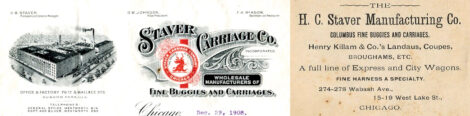
Around 1890, H.C. Staver and Co. had combined with Abbott Buggy Co., to make the Staver and Abbott Mfg. Co. (381-385 Wabash Ave., Chicago). It would go bankrupt by 1896. Before the turn of the century, Henry founded the Staver Carriage Co., which would become a million-dollar business. In 1905, Staver Carriage would be granted a patent to convert a carriage to electric power.
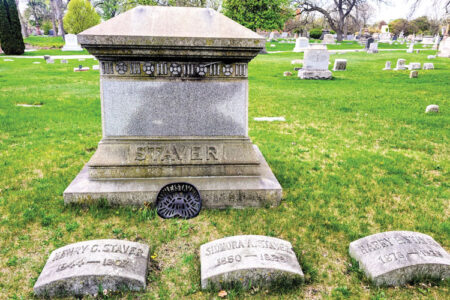
Henry Clay Staver would die on the operating table from heart failure in 1907. His 30-year-old son Harry would take over the business, and push it into automobile manufacturing.
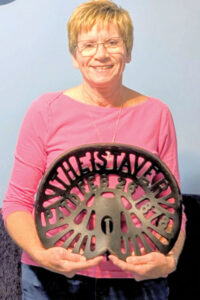
This still leaves the questions of where was the seat poured, and what was it on? The date on the seat is Feb. 26, 1878, which is before Staver went to Case. We can assume seats like Jeanine’s were poured for several years, but there’s no telling how long. Was there an implement that Case put Staver’s name on? If we assume Staver used the “Case patented” seat to make a mold for his own equipment, then it wouldn’t be until around 1885 when he was in Chicago making implements for himself. If anyone has better documentation, Jeanine would love to know if it was poured in Wisconsin or Illinois.
For more information on the Cast Iron Seat Collectors Association and our sales, or to become a member, contact Jeanine at castironseatclub@gmail.com
Also, be sure to check out the Cast Iron Seat Collectors Association podcast, Chasing Farm Primitives and Creating Friendships, for more great old iron stories!


