
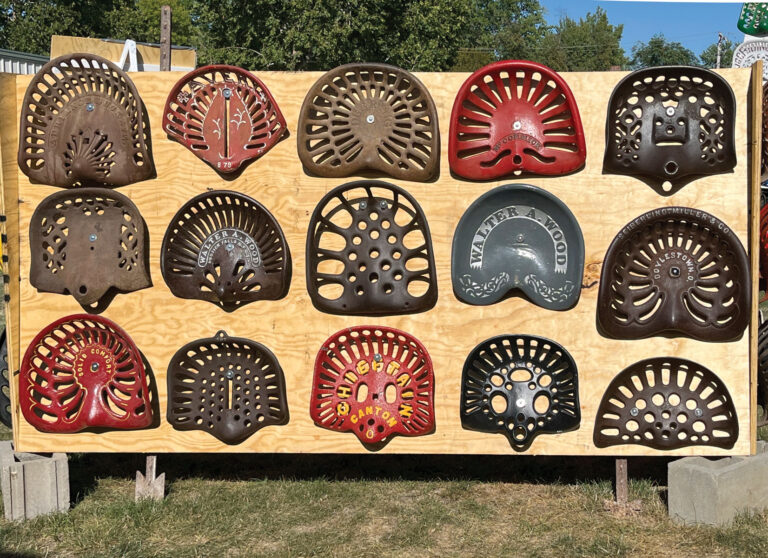
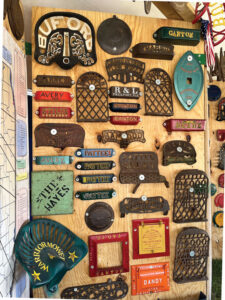
In a lavish display late last summer, members of the Cast Iron Seat Collectors Assn. built on the success of their first 50 years to set a course for the next 50. Looking over a stupendous display of seats, mower lids, planter guides and more at the Midwest Old Threshers Reunion in Mount Pleasant, Iowa, outgoing President Tom Wilson sketched his vision for the future.
“I think cast iron seats will have enduring appeal for collectors,” he says. And that’s especially true, he adds, if people continue to value the intangible benefit of membership: building friendships and genuine connections. “Social media presents a challenge,” he admits. “But social media posts can’t compete with real relationships. You can only build those with face-to-face interactions.”
The times, they are a changing
In an effort to remain relevant, the group has gone through a period of intense change. The seat collectors have launched a series of podcasts on Spotify, they’ve bought a 16-foot-long trailer to support member auctions, they’ve released a new book on seats and seat values and they’ve created a bona fide non-profit with 501(c)3 designation (meaning donations made to the group are tax-deductible).
“Becoming a non-profit has helped us so much financially,” Tom says. “Now we can apply for grant funding and hold sales. It also helped on printing costs for our new seat book.”
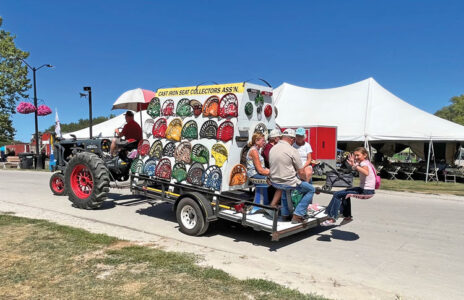
Perhaps most significantly, the group has strengthened its appreciation for its members’ varied interests. “Most seat collectors also collect some other kind of old farm iron,” Tom says. “Some are interested in mower lids. Some get really specialized. We have a couple who are really interested in the genealogy of company founders.
“Others may have worked for Deere & Co., or maybe their folks had a dealership,” he says, “and they’re interested in anything and everything related to the history of John Deere. Some are very interested in agrarian industrial art.”
The seat collectors have had success in getting younger folks interested in membership. “We listen to our young people,” Tom says. “We want to know what they’re interested in. And as more young people get involved, we’re driving down the age of our board members.”
Getting them interested
Established in 1973 in Atlantic, Iowa, the group faces new challenges in a new era. Seats are harder to find these days. Prices can be (but don’t have to be) high. And it’s increasingly hard to get people to stop and take a look at a display.
At the Mount Pleasant display, large state maps showed the locations where seat manufacturers once operated. “If we can get people to stop at our display, we may be able to find a manufacturer that was located near the town where they live,” Tom says. “Maybe they’ll get interested.”
Budgets dictate what people collect. “You don’t have to spend a lot to get into the seat hobby,” Tom says. “You can work on a nice collection for $50 a seat. This hobby is very inclusive.” And that, he says, is what it’s all about: Chasing farm primitives and creating friendships.
Drilling deep into the history
As a little boy, Johnny Majewski routinely peppered his dad and granddad with questions about old farm equipment. How did you use that piece of equipment? What machines did you use on your farm? What did your dad use when he farmed?
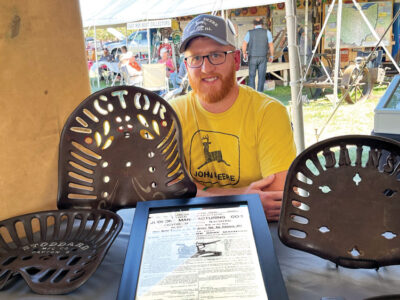
Now a grown man, Johnny – who lives in Washington, Iowa – remains fascinated by old iron. “My wife calls me an old soul,” he admits. But today, he answers his own questions, which are invariably linked to the ancestry of early manufacturers. “I research every cast iron seat I bring home,” he says. “I’ll do Google searches to figure out which company it came from, and then I’ll do a genealogy search on the company owner. A lot of times, the owner’s daughter married the son of another manufacturer.”
In addition to the history of cast iron seats, Johnny appreciates the artistry of every piece. He welcomes duplicates into his collection, but he’s lukewarm on passing fancies. “I tend to go off the beaten path,” he says. “If a piece is really popular, it’s probably not for me.” He prefers seats in original condition, but if he finds one he really likes and it’s been painted, he can still make a home for it in his collection.
Putting in the work
Johnny grew up playing with old John Deere farm toys that had been his dad’s before him. “And I still have all mine, too,” he says. “I’ve watched old home movies from the 1950s that show my dad playing with a John Deere 70, the same toy I played with when I was a kid.”
That kind of enduring interest has paid off in a keen appreciation of what farming was like for his granddad. “I have a clear idea of what my granddad’s farming routine was. He had a Farmall F-30 that he traded for a John Deere 60,” he says. “That Farmall is gone, but I have the clevis off of it.”
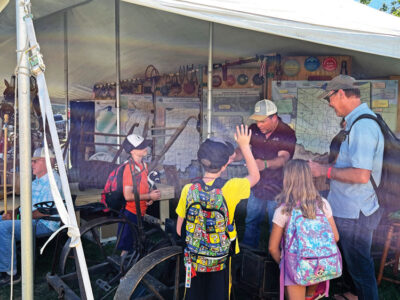
As a new board member of the Cast Iron Seat Collectors, Johnny embraces the opportunity to network with likeminded people. “Other members have helped me learn what to look for and to be patient as I look for a seat in the right price range or condition,” he says. “You’ve got to put in the work to find what you want.
“This is the most passionate I’ve ever felt about a hobby,” he says of his new position. “It just gives me so much joy. And I’m meeting so many great people. This is a unique group. The friendships are what I really enjoy.”
In his father’s footsteps
Collections only rarely survive the collector. Ross Steiner’s 200 cast iron seats are the exception. However, Ross’ son, Glen, not only kept his dad’s collection together: He went a step further and joined the group – the Cast Iron Seat Collectors Assn. – that his dad helped found (in fact, Ross was the group’s first president).
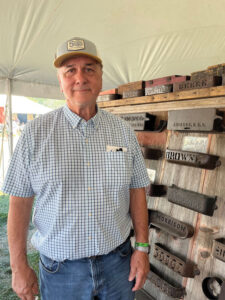
Ross collected seats for 30 years. “He started in the mid-’60s, when I was in high school,” Glen recalls, “and he was already involved with the seat collectors then. A neighbor of ours was taking a trip to Japan, and I asked him to bring me back a Minolta camera. It wasn’t long after that I was taking photographs of cast iron seats for the first seat catalog that Donald Sites put together.”
When Glen built a house in 2008, the 200 seats he’d inherited from his dad were installed on the walls of the new home’s basement. Glen began picking up seats here and there. Next thing he knew, he had a collection of more than 300 pieces.
Appreciation of artistry
Having grown up on a farm, Ross Steiner had a solid working knowledge of which seat went with which implement. But his son – who today lives in St. Ann, Missouri – was raised in the city with only occasional visits to his grandparents’ farm in Jerseyville, Illinois. For Glen, cast iron seats spoke less of the farm and more of industrial artistry.
“To me, when you look at all the castings, it’s an art form,” he says. “How in the world, in 1880, did they think to add hearts and curlicues? They just really put their all into the design and execution of metal castings.”
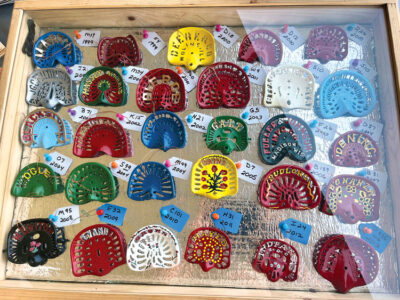
As his collection grew, Glen found himself following his father’s footsteps in another way: He became increasingly involved in the Cast Iron Seat Collectors Assn. Late last summer, he was installed as seat collectors president. It is a different group than the one his father knew.
“Back then, there were 14 members,” Glen says. “Now we have nearly 300.” He remembers his dad as a prolific writer, communicating with other members in an era before email and text messages. “And Mom would type his articles for the first newsletter.”
Perfecting the display
For the 50th anniversary celebration at the Mount Pleasant show, Glen built a brawny structure to hold something like a ton of seats. Echoing the lines of a Christmas tree, the structure’s design delivers a nearly museum-like view. “When seats are laid out on a table,” Glen says, “you don’t really see them.”
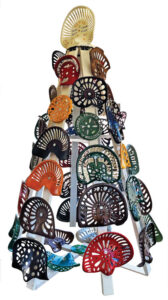
Unlike a tractor or an engine, the appeal of a cast iron seat is nearly entirely based on the visual experience. Having spent his life around antique seats, the new seat collectors president understands that. “I don’t know what seat goes with what implement, and I don’t know what town a seat comes from,” he says. “I just really love the art of seats.”
“I love everything about it!”
Pearl Walthes was a blur of action at the seat collectors display at Mount Pleasant. In nearly constant motion, she managed registrations for the daily seat drawing, chatted up collectors and jumped on the group’s parade entry as it headed for the parade route.
At 11 (she’s since turned 12), she doesn’t know everything, but she knows plenty, including the origin of the humble cast iron seat. The daughter of highly motivated collector Kenny Walthes, Pearl enjoys collecting, hunting and restoring. “I love to go to shows with my dad,” she says. “I love everything about it!”
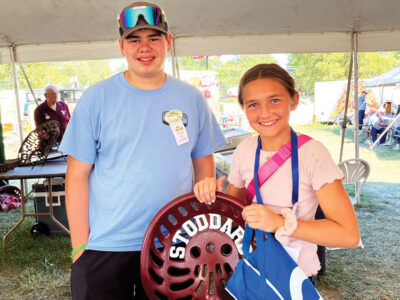
That includes road trips in pursuit of collectibles (“We’ve gone to North Carolina, West Virginia, Illinois, Missouri, Ohio and Virginia”) and long summer nights spent working on the family’s collections (“I love working with my dad out in the shed”).
Collectors Podcast
Tom Wilson, a friend of the magazine and Cast Iron Seat Collectors Assn. member, hosts a podcast for the club called Chasing Farm Primitives and Creating Friendships. You can listen to him on Spotify to hear some of his old iron stories.
An offer she couldn’t refuse
Even so, she says it came as a surprise when, at a 2022 show, then-President Tom Wilson slapped a $20 bill on the membership registration table, pointed at her and said, “Now you’re a member of Cast Iron Seat Collectors, and I want you to serve as an at-large board member.”
“I was a little shocked,” she allows, “but I said ‘Sure!'” As an at-large member, Pearl is a non-voting member of the board but she’s otherwise in up to her ears. She joins board meetings online, attends the annual meeting and election of officers in person, and is an eager volunteer.
At Mount Pleasant, the seat collectors gave away a cast iron seat every day. “I run the drawing,” Pearl says. “It was Glen Steiner’s idea to have a drawing. At one of our meetings, he asked if anybody would be willing to help. I said ‘Yes! I’d love to help out!'” She made an easel, created signage, monitored entries, encouraged visitors to sign up and presided over the daily drawing and seat presentation. “I’m having lots of fun,” she says, beaming.
Looking down the road
Growing up in the middle of an impressive collection of antique farm equipment, Pearl is already captivated by old iron. “I like learning how people used to live,” she says. “They had to use all this stuff. We have electricity and tractors, but this is all they had.” She likes pieces with original patina, but does not deny the eye appeal of a nicely painted seat. “They’re so bright and shiny,” she says.
She chatters happily about collecting antique salt and pepper shakers, about her brother’s collection of plastic cars, about meeting famed pickers. Visits to antique stores are fun, Pearl says, when you have something specific to look for.
At one point, her gaze shifts to the drawing registration table. For just a minute, the young board member considers the future. “We’ll have to brainstorm about what we can do next year,” she says with a quick smile – and then she is off on another mission. FC
For more information, The Cast Iron Seat Collectors Assn. will hold its 2024 annual show July 11-14 at Greenville Farm Power of the Past in Greenville, Ohio. Visit Cast Iron Seat Collectors Assn. on Facebook. For membership information, contact Jeanine Kintigh, 2696 280 Road, Webber, KS 66970.


