

One of the largest and oldest independent farm implement manufacturers in the country at the turn of the 20th century was the Johnston Harvester Co.
Located in Batavia, N.Y., the Johnston line of farm machinery is unfamiliar to many collectors.
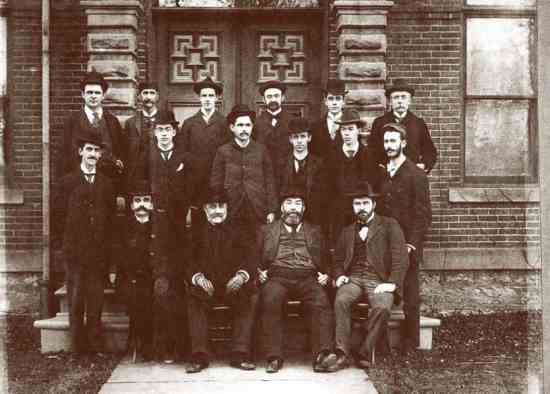
The son of a doctor, Byron E. Huntley was born in Mexico, N.Y., near the eastern end of Lake Ontario, probably around 1830. By 1844, young Huntley ended up in Brockport, N.Y., a small town on the Erie Canal 25 miles northeast of Rochester, where he attended the Brockport Collegiate Institute. When illness forced him to withdraw, he transferred to Madison University in Hamilton, N.Y.
After leaving college and presumably regaining his health, Huntley went to work in the office of a Brockport factory, Fitch, Barry & Co. It’s unclear what products the firm produced at the time, but in about 1845 Fitch, Barry & Co. began to build the new McCormick reaper. During those early years, Cyrus McCormick had small factories manufacture his reaper under license in several parts of the country before he established his own factory in Chicago.
Huntley worked in the office for several years. In 1850 he bought into the company, which was renamed Ganson, Huntley & Co. The firm didn’t do much for a couple of years, but may have taken on a new partner, because in 1853, Huntley, Bowman & Co. began to make the Palmer & Williams self-rake reaper as well as the hand-rake Brockport reaper.
Starting with a hand-held husker
Meanwhile, in 1860, a man named Samuel Johnston (about whom nothing much is known) began a long string of inventions in a tiny New York hamlet called West Shelby by patenting a hand-held corn husker.
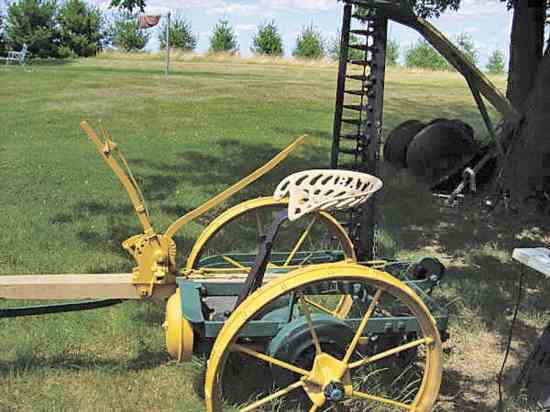
Johnston next turns up in 1862 in Buffalo, N.Y., where he patented a one-man hand-rake reaper with a swinging, cantilevered hand rake that could be easily operated solely by the driver (most hand-rake reapers of the day required a second man to work the rake). On the same date Johnston received a patent for a corn-harvesting attachment for the reaper that not only cut the corn, but also left it in bundles ready for tying.
In 1864 a patent was issued to William Shaw and John Manz, Wilmington, Del., for a self-rake reaper with gearing to cause the rakes to sweep gavels of grain from the semi-circular platform. This patent was reissued in 1868 to Johnston, by now in Syracuse, N.Y., as the assignee of Shaw and Manz.
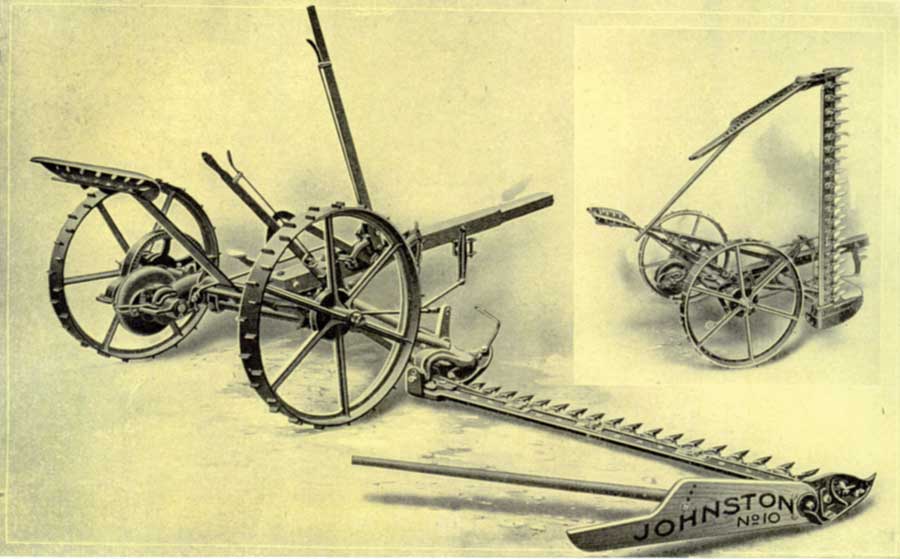
In 1868, Johnston, Huntley & Co. was established in Brockport to make the Johnston Sweepstakes harvester. Two years later, a joint stock company was organized, with Johnston as president and Byron Huntley as secretary-treasurer.
Beginning in about 1870, Huntley made many trips to Europe, peddling his machinery and setting up a branch office in Paris. In 1871 the firm’s name was changed again, to Johnston Harvester Co., with capital stock of $300,000 (later increased to $500,000).
Johnston abandons partnership
The plot thickens. In 1874, Johnston withdrew from the firm and apparently began to make harvesters on his own. The 1888 Farm Implement Buyer’s Guide lists both the Johnston Harvester Co. of Batavia and Sam’l. Johnston & Co. of Brockport as sources for reapers. Johnston continued to improve his harvesters, with a string of patents to his name. The last one I found that’s his for certain is dated December 1885. After that he fades from view, although his name lived on, emblazoned on the smokestack and letterhead of the Johnston Harvester Co.
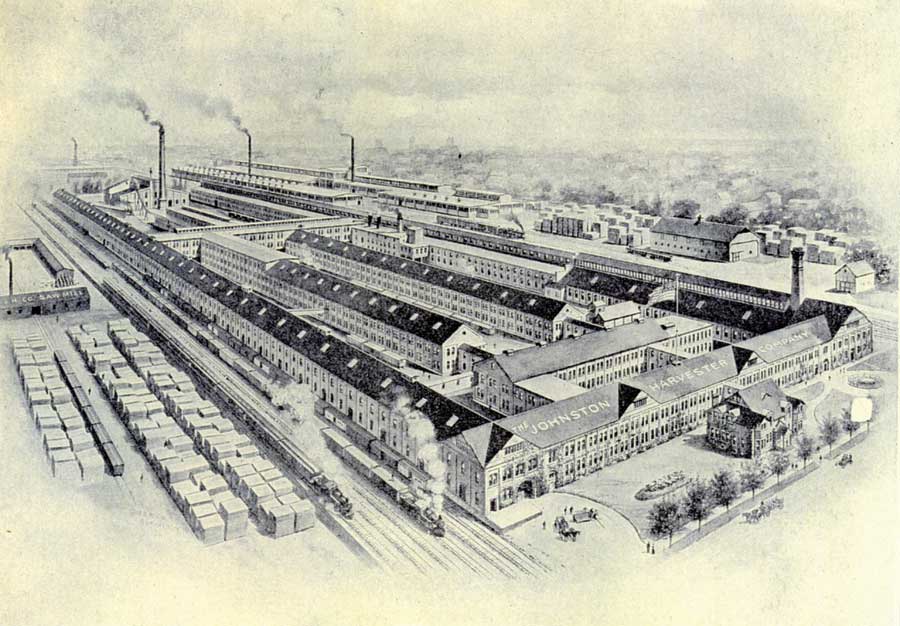
Fire, a common menace to 19th century factories, destroyed the Brockport factory in June 1882. The railroads had bypassed Brockport and the only way to ship materials and products was via the Erie Canal, so it was decided to relocate 20 miles southwest* to Batavia on two main rail lines.
The new factory in Batavia was soon in business. The Johnston Harvester Co. had its ups and downs. Demand for machinery was high, but apparently management was shaky: The firm was forced into receivership in 1888, when liabilities totaled almost $500,000 with only about $5,000 cash on hand. The company had been unable to pay its bills for more than a year and the creditors were getting antsy. A judge appointed George Dana as receiver and the company remained in production with Huntley as vice president. The firm prospered under the new management; Huntley became president in 1891 and held that office until his death in 1906. Edward W. Atwater then took over and the company’s steady growth continued until his death in 1910.
Massey-Harris builds a platform
At that point the Massey-Harris Co., anxious to establish a toehold in the U.S. and gain a ready-made overseas outlet, bought a three-quarter interest in Johnston Harvester. At the time, Johnston employed some 1,300 men and did an annual business of about $2.5 million, with about one-quarter of that from export sales. Although the firm became a subsidiary of MH, the factory’s name and local manager were retained for several years. Business again increased, with production up some 50 percent under MH control. In 1913, the Johnston works did $17.3 million in sales. In 1916, the company built 8,000 self-rake reapers for shipment to Russia. In 1917, Massey-Harris bought up the rest of the outstanding Johnston Harvester shares and the factory became Massey-Harris Harvester Co. Inc., dropping the Johnston name.
After World War I ended, MH survived the world-wide Agricultural Depression of the early 1920s, then experienced a boom between 1925 and 1929, linked to the recovery of the world economy and expansion in western Canada. The farm economy in the U.S., however, didn’t bounce back as much and the old Johnston Harvester Co. suffered from being located far from the West, and from not having a strong dealer network west of the Mississippi.
Then the Great Depression plunged the entire world into financial disaster. Farm machinery sales dropped 50 to 65 percent in 1931. It’s a miracle Massey-Harris survived, but it did, and things slowly began to improve in 1934. The development of the small MH combine definitely spurred the company’s recovery.
Facing an uncertain future
During World War II, the Batavia plant wasn’t involved in much war work and little farm machinery was produced, although the company enjoyed a short boom after the war’s end. Labor unrest resulted in a four-month strike in the latter half of 1953. The Harry Ferguson/Massey-Harris merger took place in 1954 and all plants were put on notice to show a profit or be closed. The union at the Batavia plant got raises for its members in 1955 and 1956, but was forced to take wage cuts in 1957, which didn’t help much, as the old Johnston plant was shut down on June 6, 1958, after 75 years. FC
Sam Moore grew up on a farm in western Pennsylvania. He now lives in Salem, Ohio, and collects antique tractors, implements and related items. Contact Sam by e-mail at letstalkrustyiron@att.net.*Sam Moore originally wrote that Batavia was located southeast of Brockport; read his Letter to the Editor about his correction: “Putting Batavia, N.Y. on the map – again.”


