


Snow-covered rural roads were huge obstacles
for early automobiles-but one tackled easily by the Model T Ford
Snowmobile. Virgil D. White, Ossipee, N.H., patented an attachment
converting a Model T into a Snowmobile in 1917; the conversion kit
hit the market in 1922.
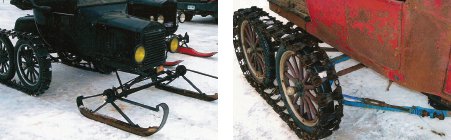
White’s Snowmobile (a name he’s credited with creating)
consisted of wood-and-metal skis and rear-mounted tracks. The rear
axle and driveshaft, rear spring and radius rods were replaced with
a 7-to-1 Ford truck worm gear drive line attached to the frame by a
pair of cantilevered semi-elliptical springs. Special heavy-duty
wheels to fit the TT rear axle were provided along with anti-skip
chains.
Roger Pedercini, North Adams, Mass., attended a Snowmobile club
winter gathering in 2008 at Lake George, N.Y. “I learned the rear
axles were narrowed to provide a 4-foot width on the tires,” he
says. “In that era, the Model T was in competition with the
horse-drawn sleigh. Runners were 4 feet apart, so tires spaced the
same could follow in the sleigh tracks.”
Because of the extra torque required when changing to the
Snowmobile configuration, Roger explains, most drivers opted for
the Ruckstell 2-speed axle upgrade, which provided an extra-slow
speed.
Used by doctors, delivery men, utilities, fire departments and
school districts, the Snowmobile was available in three gauges:
56-inch for areas where automobiles were standard; 44-inch for
those using tracks from horse-drawn bobsleds; and 38-inch for use
where narrower sleigh tracks were common. In 1926 the kit sold for
$395.
The conversion kit was versatile: Owners could replace the skis
with wheels for use in mud and sand. “Sandmobile” units were sold
for use in South Africa, Algeria, Egypt and the Florida
Everglades.
In 1923, White produced about 70 units. By 1925, manufacturing
rights were sold to Farm Specialty Mfg. Co., New Holstein, Wis.,
which began to market its version of the product in 1926. Farm
Specialty later bought the patents of the Snowmobile company. From
1924 to 1929, the Snowmobile company manufactured about 3,300 units
per year in its plant at West Ossipee and had a branch warehouse at
St. Paul, Minn. The Snowmobile company closed in 1929.
For more information: – The Ford Model T Snowmobile Club is
a chapter of the Model T Ford Club of America. For membership
information, contact Charles Stewart, club treasurer, 315 Settles
Hill Rd., Altamont, NY 12009;
www.ModelTFordSnowmobile.com.
– Roger Pedercini, 448 Walnut St., North Adams, MA 01247;
(413) 664-6020.


