
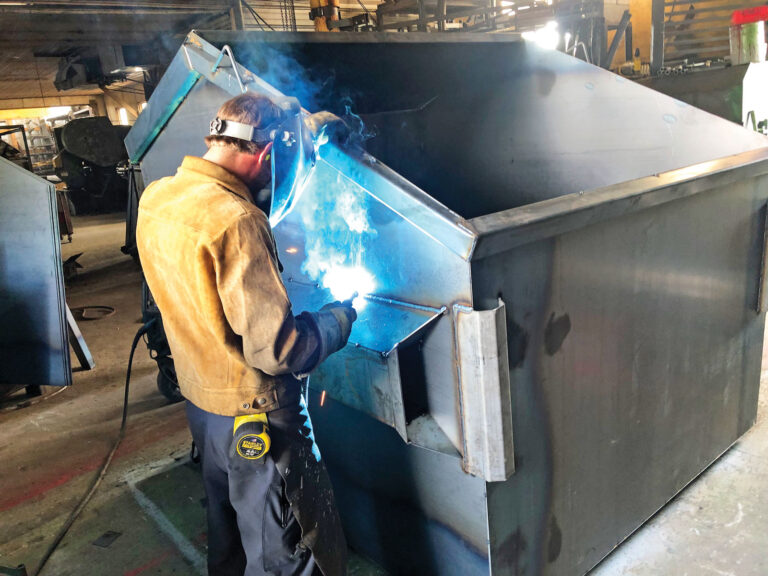
Amish farms dot the southern half of the hill country of Monroe County, Wisconsin. We see these folks working the fields and come across their horse-and-buggy transports on local roads. There is another facet of Amish life that is virtually unknown. Hidden in the shops, barns and buildings is a thriving manufacturing industry.
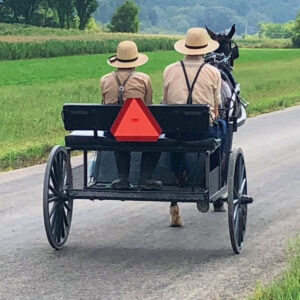
In an area bounded by Norwalk to the north, Ontario to the east, La Farge on the south and Cashton on the west, among the wooded hillsides and lush valleys, one can find more than 130 Amish businesses and manufacturing sites. They are bordered on the east by the Ocooch Mountains. Amish country lies in the heart of the Driftless Area, 24,000 square miles missed by the last glacier and characterized by steep hills, deeply carved river valleys, forested ridges, spring-fed waterfalls and cold-water trout streams.
Resourceful, hard-working and innovative
Old Order Amish families came to this rural area in 1966, attracted by the excellent farmland and low land prices. Today, it is one of the largest Amish settlements in America, having grown to more than 300 families embracing more than 2,000 individuals.
Amish craftsmen, farmers, woodworkers and growers are busy throughout the year. Locally sourced materials support a market of active sales and production. Built for immediate sale or custom orders, furniture and wood products are available at shops locally. In the spring, summer and fall, flowers and vegetables are widely available on farms throughout the region. Amish bakeries, with cookies, cakes, breads, and pies, are sprinkled across the countryside.
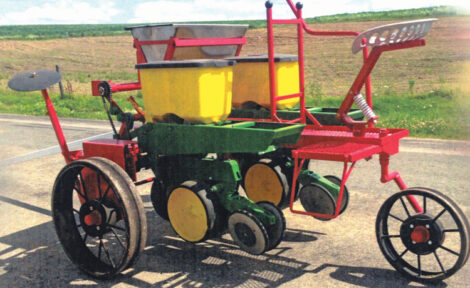
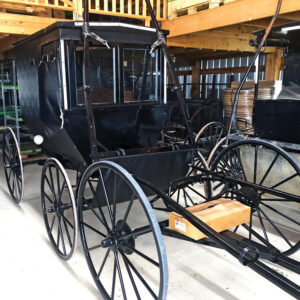
Amish craftsmen make farm machinery, such as manure spreaders, sprayers, dumpsters and corn planters. They also produce metal siding and fascia, harnesses, leather goods, stainless steel tanks, stoves, buggies, carriages and water heaters.
They are master woodworkers, turning out a vast array of tables, rockers, chairs, cabinets, sheds, gazebos and furniture of every description. You can’t venture far down a country road without encountering an Amish-operated sawmill.
The Amish are ahead of their time. They’re off the grid. No electricity for these folks. Gasoline and diesel engines power lathes, saws, shears and metal-bending rigs, all accomplished through an intricate system of pulleys and belts.
We recognize that Amish is synonymous with hard-working, thrifty and honest. But these folks are also very clever and ingenious in developing successful machine operations. They make much of their own machines and tools.
In today’s world, a unique lifestyle
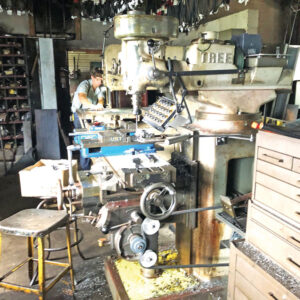
I asked one young man, John, who had just finished working on a turning lathe, what it’s like to be raised Amish. “We go to school for eight years, starting at age 6,” he said. “We’re done schooling at 14. We work on the farm for our family, but we can be hired out for machine work or helping the neighbors on their farms. When we’re 16, we can rumspringa.”
I had to ask, “What is rumspringa?” “It means running around,” he said. “We’re freer from our folks, with less restrictions. We might use cell telephones, watch television, wear jeans, play sports, go bowling. Me and some of my friends went into Best Buy one time. Some guys might try smoking or drinking beer, but not me, of course.” He says that with a laugh.
The young-looking, clean-shaven lad continued. “Most all of us will decide to commit to the Amish community and will be baptized and accept the way of life of Amish,” he said. “Rumspringa is a way to meet girls and date.”
I asked John how dating works. “At 16, we can join Young Folks,” he said. “We Amish have church every two weeks on somebody’s farm. Church is from about 9 to noon. Then we eat, and everyone goes home around 2 or 3. But when chores are done, Young Folks go back to the same farm and sing songs in German. It’s a lot of fun, and the boys and girls get to know each other. At age 21, we can start earning our own money.”
Amish one-room schools and Amish community telephone booths can be spotted across Amish land. Amish speak German at home and church. The children are immersed in English when they attend school. Amish refer to us as “the English.”
Ask a typical Wisconsinite what they know about the Amish, and they come back with “furniture, baked goods, produce and quilts.” Well, there’s much more coming out of the shops and cottage industries. Much of the goods are made for the Amish community as well as for sale to the “English.”
If you need it, they can make it
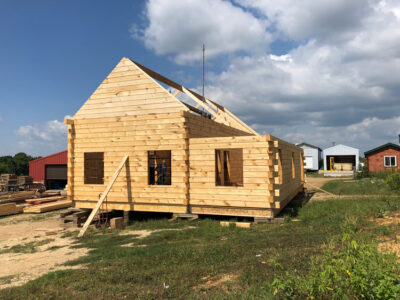
On a recent visit to Amish country, my guide, Tom Wolf, and I visited some manufacturers. Miller Farm Shop makes corn planters, cultimulchers (used to break up and smooth the ground for planting, ensuring good soil-to-seed contact), carts, sprayers, dumpsters and beet harvesters. Aaron Miller, an Amish lad from Hillsboro, was welding. Country Lane Woodworking on Hwy. XU makes exquisite cabinets with soft-close doors that close automatically the last couple of inches. The Handle Shop turns out handles for cant hooks, axes, hatchets, grain binder rollers, forks, shovels and baseball bats. Half of their building is the owner’s home, half is for the shop.
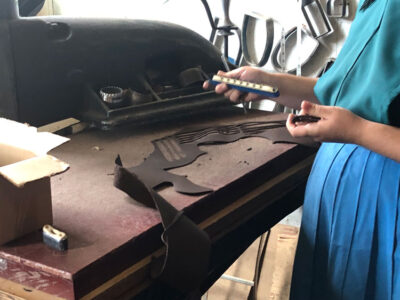
At Stainless Steel on Monarch Ave., the Borntreger family produces fabricated metal fascia and siding. John Miller at Sunrise Metal Fabrication was forming galvanized steel into piping of all kinds. During our visit, John was making covers for steam engine tops for weather protection. We were greeted by John J. Helmuth at Valley Farm Parts, a fully stocked hardware store. At the Leather Shop on Oneida Road, off Hwy. 33, we observed two young Amish ladies making leather single-hook corn huskers. One of them will start teaching school for the fall term.
Evergreen Sales Machine, run by the Hershberger family on Hwy. D maintains a large inventory of hardware, including a massive supply of V-belts. While Tom and I visited with the owner, an Amish teen brought in a broken shaft for repair. A workman turned out a new one in 45 minutes. Hershberger demonstrated a machine called a double-head notcher that cuts out indentations for pallets so that a forklift can pick up the pallet on any side. All the machinery is powered by a 4-cylinder Kubota engine. The exhaust is run through a heat exchanger to heat the building in wintertime.
The image of Amish as farmers is engrained in our mental picture of these industrious people. But that depiction is not complete if we ignore their ingenuity and creativity. The products and goods turned out from their shops are unparalleled in variety and quality. As one Amish man told us, “We don’t make junk stuff. We take a good deal of pride in producing the best. Our reputation is at stake.” FC
Larry Scheckel grew up on a family farm in the hill country of southwestern Wisconsin. He and his wife, Ann, are retired teachers living in Tomah, Wisconsin. Contact him at 1113 Parkview Dr., Tomah, WI 54660; email: Lscheckel@charter.net; online at his website.


