
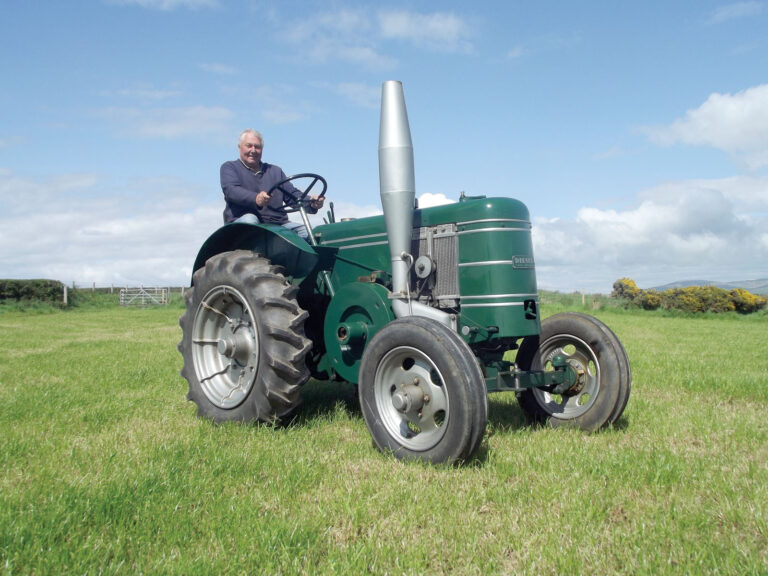
The iconic British-built Field Marshall tractors have a history that goes back to the 1840s when William Marshall bought an old engineering works in Gainsborough, England. Marshall named the site the Britannia Ironworks and began producing road-going steam engines. When his two sons joined the business, the company became known as Marshall, Sons & Co., and they became famous for producing steam-powered traction engines and threshing machines. The company began dabbling with the internal combustion engine as early as 1908, but their first successful tractor, the Marshall 15/30, was produced in 1930. The 15/30 was a diesel-powered 2-stroke single-cylinder tractor and was heavily influenced by the German-made Lanz Bulldog. The 15/30 was followed by the 18/30 in 1932, and in 1935, the 12/20 was introduced. An improved version of the 12/20, named the Model M, was introduced in 1938, and it continued to be produced until 1945.
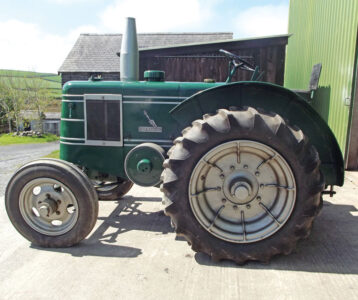
Due to the fact that the company dedicated its resources towards the war effort during the period of 1939 to 1945, not many tractors were produced, and ideas for improved designs were put on the back burner. However, as soon as World War II ended, Marshall introduced its new and improved tractor, the Field Marshall, the first of which is now known as the Series 1. The Series 1 offered 38hp and featured a new stylish design of tinwork in Brunswick Green. The Series 1 was followed by a Series 2, 3 and 3A, and there was also a tracked version, built in conjunction with John Fowler of Leeds, which was known as the Track Marshall. Marshall acquired the John Fowler & Co. business in 1947. Fowler had been credited with the invention of the steam-driven ploughing engine, and initially, Fowler acted as a subsidiary of Marshall, though the two companies eventually merged.
Field Marshall tractors featured a distinctive single-cylinder 2-stroke diesel engine coupled to a large flywheel. The single-cylinder design was common in European countries, with Lanz being the most popular producer. The difference was Lanz used a hot bulb engine, whereas the Field Marshall had a very different starting method (more on that later).
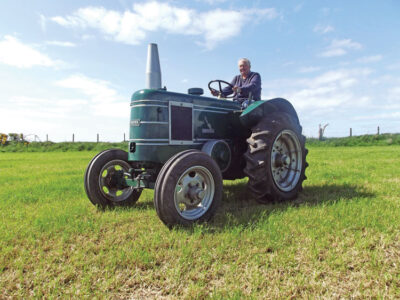
Field Marshall tractors continued to be produced up until the late 1950s, and they were known to be robust, reliable and powerful, but these sturdy little beasts came at quite a cost – the standard tractor was priced at £550 ($600 at the current exchange rate). If one wished to invest in a deluxe contractor’s model the cost was over £800 ($874). When compared to other post-war tractors, these were costly machines, so they were usually only purchased by contractors or larger-scale farmers. Field Marshall tractors were often used to haul threshing machines from farm to farm, and once in place, the tractor acted as a power plant, powering threshing machines and stationary balers via a belt in the same way that the steam traction engines once had.
Unique beat
The real distinguishing feature of the Field Marshall tractor is its unique sound. Out of that impressive chimney stack comes a wonderfully loud thumping sound. The beat of this engine is so powerful that when it’s stationary, the whole tractor judders as if it is chomping at the bit. There’s many a Field Marshall owner who will freely admit that the sound is what attracted them to the tractor.
Peter Watkin, owner of the tractor featured here, was absolutely drawn to Field Marshall tractors because of their alluring sound. Peter grew up on a mixed farm that has been in the family since 1815 and is still farmed by his brother today.
“When I was a small child, I remember hearing a tractor with a strange thumping sound coming from next door’s smallholding,” recalls Peter, “and I wondered why our neighbour’s tractor sounded so different to other tractors, and I remember asking my father about it.” Peter’s father explained that the reason this tractor sounded so different was because it had a single-cylinder engine. Peter recalls being captivated by the sound of the tractor, so much so that he hoped one day that, he would be able to own one.
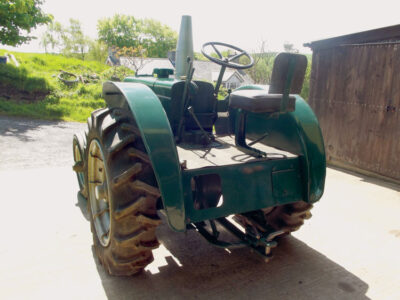
As he grew up, Peter became interested in old oil engines, many of which he bought from neighbouring farms. Peter learned a lot of skills by tinkering with these old engines, and in 1977, he became one of the founding members of the Mid Wales Vintage Machinery Club. He never forgot his early fascination with the unique-sounding Field Marshall. Although these tractors were outdated, they remained more expensive than other old tractors, and Peter was reluctant to spend the kind of money these tractors were fetching.
Eventually, in 1983, Peter got his hands on his very own Field Marshall. Peter describes how his dream finally came true, “I was reading a farming paper one morning when I saw a tatty looking Field Marshall advertised for £300, but I was just about to start my day’s work, so I couldn’t ring up about it and this being before the time of mobile phones I was panicking that it would be gone by the time I got home!” Finally, here was a Field Marshall at the right price, but Peter was in danger of missing it if he didn’t act quickly. Unable to phone that morning, Peter asked his brother to phone the owner on his behalf and tell the owner that he would buy the tractor. Peter went to collect the tractor the following weekend. Although the tractor required a lot of work, it turned out to be a very lucky find. Even in 1983, bargain Field Marshalls didn’t come along very often….
Nut and bolt restoration
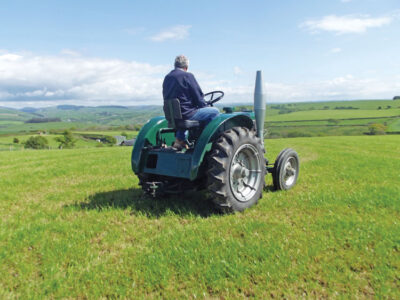
Peter recalls when it arrived, the tractor had some serious damage in the form of a broken big-end bolt that had not only smashed the crankcase but had also smashed its way into the gearbox. “Although it was all there, it was essentially in bits,” explains Peter, “with the piston out and the cylinder head off.” Peter wasn’t in a hurry to get the job finished, he wanted to savour this long-awaited project, and in the end, the restoration of the tractor took around two years. Peter had to repair the damage to the crankcase with some careful patching, and since the casting was all in one piece, he had to make and shape pieces to fill in the missing sections. There was also a lot of sorting out to do on the tin work. Peter had to fit this in around his day job of running a plant hire business, so the project had to progress in small bursts. Some parts had to be made from scratch, and other parts had to be painstakingly repaired, all of which took up a great deal of time. While one can save a lot of money by doing the work oneself, it is probably best not to put a price on the hours one has spent on the job. If you do, your tractor might not seem quite such a bargain after all! In this case, the restoration (slow as it was) was time well spent. Today, Peter has a beautifully restored tractor that starts and runs exactly as it would have when new.
There was no part of the tractor that Peter didn’t take apart to service or repair, so the finished job is a true ‘nut and bolt restoration.’ Restoring the entire tractor was time-consuming, but it meant Peter got to know the tractor inside out. In that respect, it was a real apprenticeship into the ways of the Field Marshall tractor. In order to preserve as much as he could of the original tractor, Peter tried where possible to repair what he could of the damaged parts of the tractor rather than replacing them with new or second-hand parts bought elsewhere. The mudguards (fenders) and the tinwork at the front of the tractor were badly damaged, and Peter carefully and sympathetically repaired these areas. He straightened bent sections and painstakingly patched the holes and seams where the old sections joined the new repairs, now only visible from underneath.
Peter made some parts for the tractor himself in his workshop. There were some parts that he had no choice but to buy, such as the track rod ends, the kingpins, and the steering wheel. Luckily, replacement parts are still available for Field Marshall tractors through a company called Robert H. Crawford & Son of Boston, England. Crawfords have a long association with Field Marshall tractors because they acted as agents for Marshall as far back as the early 1930s. What’s more, Crawfords bought all of Marshall’s remaining stock of parts and drawings when they became available for purchase in the 1970s. The company has been able to carry on supplying their existing customers with parts for their Field Marshall tractors to the present day.
This Series 1 Field Marshall was Peter’s dream tractor, and he knew he was restoring it to keep and not to sell, so this inspired him to do what he calls a “proper job.” He was determined there would be no shortcuts. Peter has been acquiring engineering skills since he was a schoolboy, so this was always going to be a thorough restoration. “I always preferred ‘hands-on’ learning to academic learning,” he explains, “and I was never out of the metalwork room at school.” After leaving school, Peter honed his engineering skills at a local college. Since then, he has repaired his own machinery when possible.
Firing up
There are collectors who own antique tractors who are more than happy to accept their old tractors are difficult to start. Peter isn’t one of those collectors. Throughout the restoration, his aim was to end up with a machine that would start the first time without any trouble, and that is something he has managed to achieve.
Starting a Field Marshall isn’t a simple case of turning a key or pressing a button. In fact, there is quite an art to starting these tractors, so much so that people love to watch Field Marshalls being fired up at shows because it is quite a spectacle.
There are two different methods of starting the Field Marshall tractor. There’s the “handle method,” and there’s the “cartridge method.” Whichever method you use, first apply heat to the engine by means of a smouldering rolled-up paper containing saltpetre. This roll of paper is set alight and inserted into the cylinder head using a special screw-in holder. This heat source acts as a rudimentary glow plug.
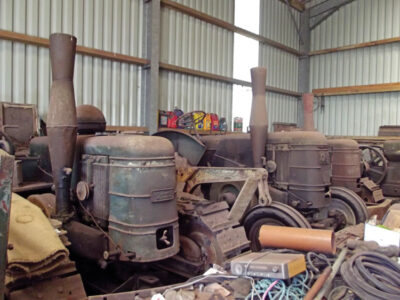
To use the handle method, the engine is warmed with the smouldering paper roll, and then the engine is turned over using a handle placed in the “starting dog” on the flywheel. A decompression valve makes the engine easier to turn, and the engine can be decompressed by turning the flywheel three or more revolutions. A spiral grove on the outer edge of the flywheel determines the number of turns made. With the flywheel in the correct position, the handle is fitted in place and turned swiftly. If the tractor is in good order, it should fire up with just a couple of turns.
The tractor can also be started using the cartridge method. Again, the smouldering paper acts as a glow plug, and then a cartridge is loaded into a special breech area on the tractor’s intake system. The cartridge is fired by giving the protruding pin a swift tap with a hammer. The charge from the cartridge sends the piston into a stroke, and the engine should burst to life. Some people feel the cartridge method causes carbon deposits and can block up the decompression valve. It is also said that using cartridges puts strain on the engine. The starting handle method is probably best. If nothing else, cartridges cost money, whereas the handle method costs nothing, so it makes sense to start the tractor with a handle.
Starting the tractor for the first time after the restoration was quite a monumental moment for Peter. There’s little more exciting in life than hearing a tractor that you have painstakingly restored firing up for the first time. Initially, Peter started the Field Marshall using the cartridge method. These days, he is able to start the tractor by hand cranking it, and he demonstrated this perfectly. As Peter swings the handle, the tractor gives its first couple of un-rhythmic pops, and I wonder for a second if it is going to fire up or not. Then the popping becomes more rhythmic, a wonderful beat is underway, and talking is rendered almost impossible.
Towards the end of their production run, some of the last Field Marshall tractors made were fitted with electronic starters, and although this must have been useful at the time, there is something about the archaic system of starting these earlier tractors that makes them all the more fascinating. These iconic tractors were often referred to as “poppers,” because of their unique sound, and they could be heard running from far away. For many of our older enthusiasts, the sound of them at work brings back strong memories of the threshing days of yesteryear. FC
Josephine Roberts lives on an old-fashioned smallholding in Snowdonia, North Wales, and has a passion for all things vintage. Email her at josiewales2021@aol.com.


