
Readers may ponder the coverage of a rebuilt locomotive in Farm Collector. Since the invention of railroads, farmers have been dependent on them for the delivery of equipment and the transport of their commodities. U.S. railroads transport approximately 16 million carloads of grain and farm produce annually. In addition, over 1.7 million carloads of food products are moved over rail each year.
Together with fertilizer, this ranks agriculture as a top commodity group dependent on rail service. This dependence exceeds 60,000 carloads weekly, driven largely by corn, wheat, and soybean shipments.
Consequently, railroads are the primary, cost-effective, long-distance means of transport for agriculture products. The rail service is crucial for moving grain from the Midwest to domestic processors and ports for export.
Scale Model Locomotive
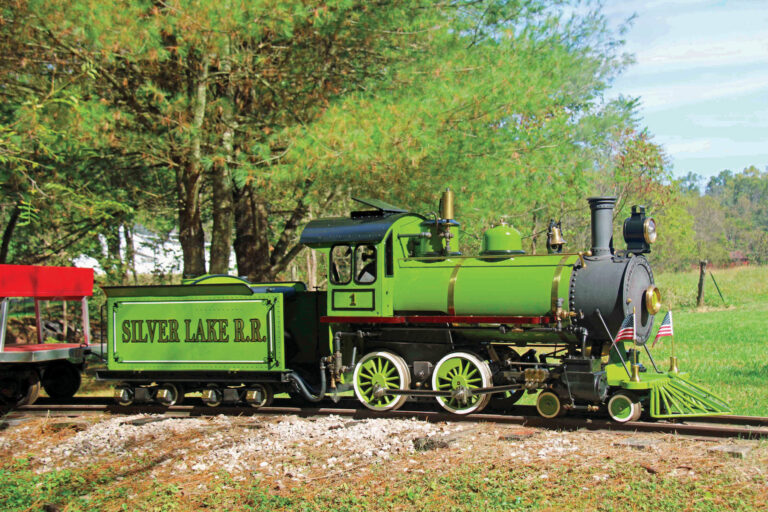
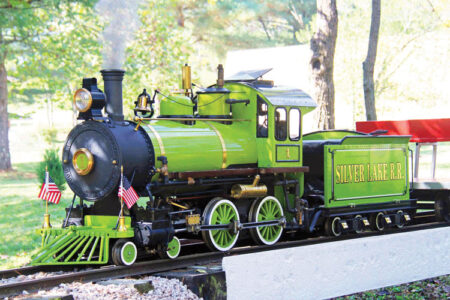
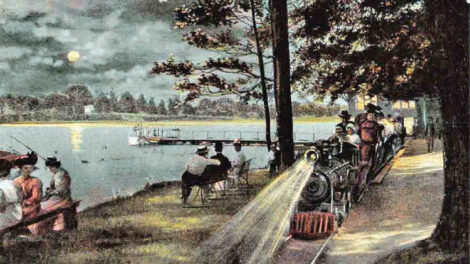
Delving into a different kind of railroad with the Armitage-Herschell scale model train, this rare train was designed as a people mover at the Silver Lake Park near Akron, Ohio. The history of Armitage-Herschell will be covered first with information about the rebuilt train to follow.
The Armitage-Herschell Co., later known as Herschell-Spillman Motor Co., was based in Tonawanda, New York. The firm was a manufacturer of carousels and other amusement rides, including miniature steam locomotives.
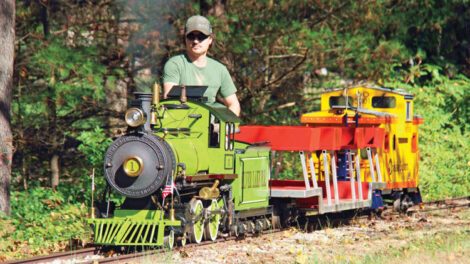
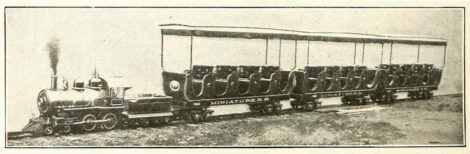
The small locomotive was built in 1901 for the Lodge family who owned Silver Lake Park. The train traveled on a 15-inch gauge railway. The locomotive built by this manufacturer could pull up to 10 passenger cars with seats for 40 children or 20 adults.
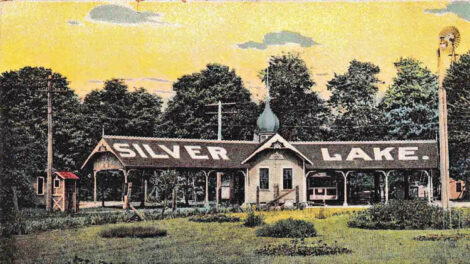
The railway loop began south of the park’s large pavilion built in 1898. The station was on the lakeshore at the boat-landing dock. The original route allowed the passengers to view the lake and the park’s zoo animals. However, the original route wasn’t profitable, as it veered away from the main business. Consequently, the track was laid along a new route. This doubled the journey time, and the train ride experience became very popular.
The park operated through the summer of 1917, when it was closed. But the park railroad continued to operate with popularity. When the park was sold it didn’t include the rails, locomotives, and trains.
William Lodge bought the train-related business and stored it on his farm. The locomotives and related equipment were then purchased by a group of four people. The new owners operated the train in a park near Toledo, Ohio, between 1936 and 1945.
Ownership Change
Chris Arnold and his sons, Shay and Jared, eventually became owners of the Armitage-Herschell train. Shay served as the family’s spokesperson to explain the ownership and rebuilding process.
One of the last owners of the train was Bill Schriber, who bought out the other three. Chris Arnold knew Bill through their mutual interest in scale model trains.
After Bill’s passing, the train was handed down to his son, Jonathan, who put it away in storage. Jonathan happily handed it over to the Arnolds when he learned they wanted to restore and run it once again.
Locomotive Restoration & More
The Armitage-Herschell restoration presented numerous challenges as Shay reported. The salvaged parts included the frame, drive wheels, smoke box cover, cow catcher, cab, and sand dome. The internal usable parts were the cylinder and side rods.
Many of the parts had to be rebuilt from scratch, including the boiler. The frame was bent, which required straightening. Through completion, about 80% of the locomotive required machine fabrication.
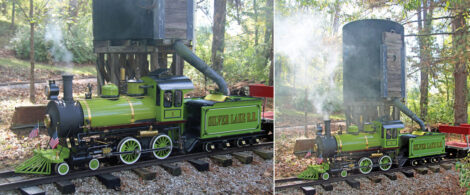
“My family’s interest is rooted in antique engines and machinery, so I grew up in a family of machinists. However, I’m a union pipefitter by trade with experience as a welder and fabricator. My extended family owns and operates a repair/machine shop called Arnold’s Repair Shop located in Marietta, Ohio. These combined abilities were invaluable in rebuilding the locomotive,” Shay said.
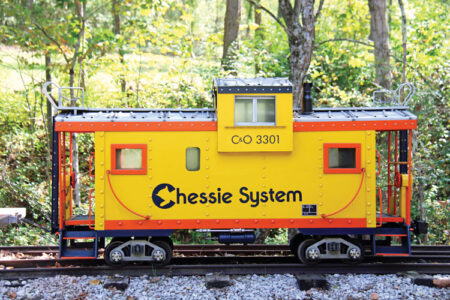
The original Armitage-Herschell train never had a caboose. Subsequently, Jared Arnold expertly crafted one in high-detail. He loosely designed it after a full-sized caboose that sits along the west side of Marietta.
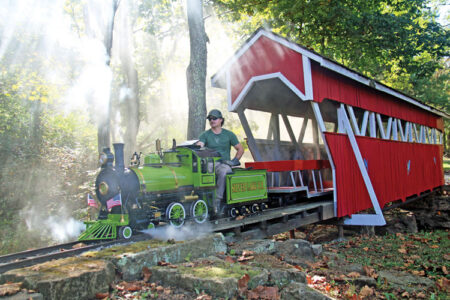
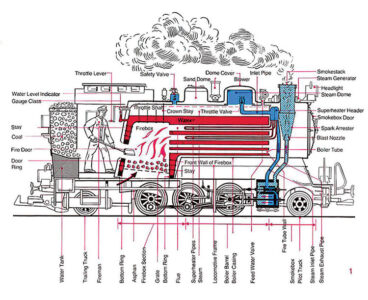
Shay explained that starting a steam engine is a fascinating process. The first step is introducing a blower in the stack to create a draft. Wood is then used to light the fire in the firebox. A wood
fire enables the boiler to rise in temperature at a controlled rate. Once at 80psi, coal is used to reach the desired 100psi. The blower is then taken off the stack. With the blower removed, the pressure from the boiler creates its own draft. From this point, the boiler is heated continuously with coal to reach the 125psi operating pressure.
Show & Entertainment
The Arnolds enjoy exhibiting collection pieces at antique engine and steam shows. A highlight is operating the Armitage-Herschell locomotive and train at an annual fall event.
Shay shared, “There’s a 15-inch privately owned Bluebird & Western Railroad located near Belpre, Ohio. At this location, we give free rides on our train along with owners of two additional scale-model trains. Although there is no set date, we shoot for an October weekend.”
He added, “We typically give rides to several hundred who find it enjoyable. After the half-mile loop is completed, people often go back to the end of the line and wait for another turn. It’s something we enjoy and it provides lots of fun.”
Antique Collection
The Arnolds are dedicated collectors of both gas and steam engines. Their two 15-inch gauge steam locomotives are the 1901 Armitage-Herschell and a 1920 Cagney Brothers. The Cagney Brothers locomotive was first restored by Bill Arnold in 1981 and then again by his son Chris in 2008.
There are two steam tractors in the Arnold collection. One is a half-scale freelance traction engine named “The Goat.” This engine was built by Shay’s grandfather, Bill Arnold. It wasn’t based on anything, just ideas he got from other engines. And a quarter-scale freelance steam engine crafted by Shay’s uncle, Richard Arnold.
The four flywheel engines in the collection are unique models. They include a 9hp 1916 Economy thermoil diesel engine that was sold by Sears & Roebuck, and a 5hp 1911 Ward side shaft hit-and-miss engine sold by Montgomery Ward.
Chris Arnold built two of the flywheel engines from casting kits. He did the necessary machining to build them. They consist of a quarter scale Reed model based on an early 1900s engine, and a quarter scale Bessemer model also based on an early 1900s version.
In addition, the Arnolds have an extensive assemblage of tractors with far too many to list. A special among the assemblage is an original family-owned Advance-Rumely OilPull 25/40.
Final Reflections
The collecting hobby is an excellent method of keeping people occupied, and seemingly always on the hunt for that next special gem. Shay commented on their family’s quest, “We’re always looking for unique pieces of history but never anything specific. If we see something of interest, we usually pursue it.”
Collecting is fulfilling in many different ways. The Arnolds enjoy antique power units with historic value, as noted. If it needs restoring or rebuilding, that adds further satisfaction.
Displaying collection pieces at functions is another dimension. “When we display or provide rides on the train, its special to see the joy people experience. And through these activities, I’m able to share my passion with the community,” Shay said. FC
Freelance writer Fred Hendricks of Mansfield, Ohio, covers a vast array of interesting subjects. Contact him at fwhendricks@gmail.com


