
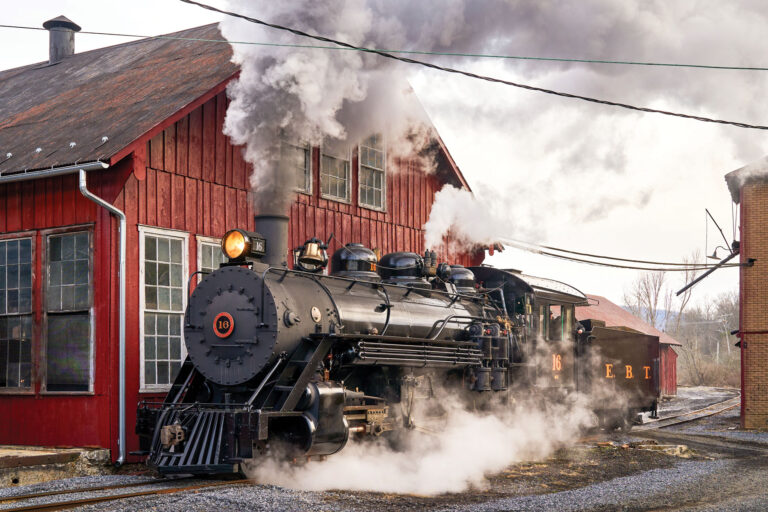
In the hills of central Pennsylvania, a railroad stopped running in 1956. The crews went home, locked the doors, and left everything behind. What they left has become one of the most significant industrial heritage sites in America, and this October, it becomes the stage for something that’s never happened there before.
There’s a moment that happens to almost every first-time visitor to the East Broad Top Railroad in Rockhill Furnace, Pennsylvania. They walk through the door of the shop complex, look up at the belt-driven machinery overhead, smell the oil and iron and coal dust that’s soaked into the timbers over more than a century, and stop walking.
It isn’t a museum smell. It isn’t a restoration smell. It’s the smell of a place that was working not so long ago and could start working again tomorrow. This is the machine shop at the East Broad Top Railroad in Rockhill Furnace, Pennsylvania, and nothing you’ve read about it will prepare you for standing inside it.
There are places that survive by being preserved, stabilized, interpreted behind glass. This is not one of them. The East Broad Top survived by being forgotten, left alone long enough that when people finally came back for it, everything was still there. The tools on the workbenches. The locomotives in the roundhouse. The coal hoppers in the yard. The track, the bridges, the tunnels. Sixty-some years after the last coal run, the railroad that time left behind is running again and it’s unlike anything else in the country.
History of East Broad Top
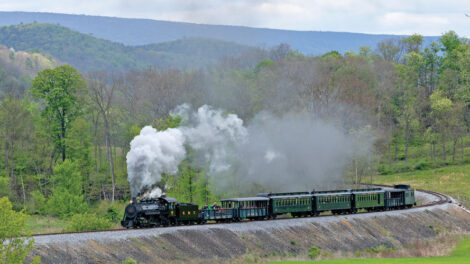
The East Broad Top Railroad and Coal Co. was chartered in 1856, when this corner of south-central Pennsylvania was one of the premier iron-making regions in the eastern United States – before Pittsburgh became the Steel City. Construction began after the Civil War in 1872, and the railroad was built to a three-foot narrow gauge, a practical decision for a mountain coal road threading through the ridges and hollows of Huntingdon County. Its primary purpose was to haul the semi-bituminous coal (Broad Top Coal), out of Broad Top Mountain to power industrial furnaces and steam plants across the region. The railroad also carried ganister rock, lumber, passengers, and general freight. At its height, the East Broad Top (EBT) operated over 60 miles of track with approximately 33 miles of main line.
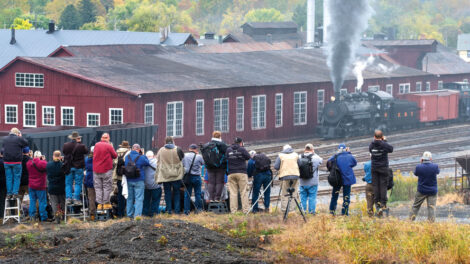
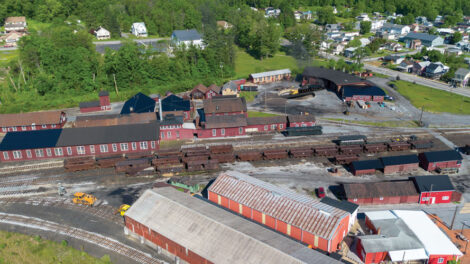
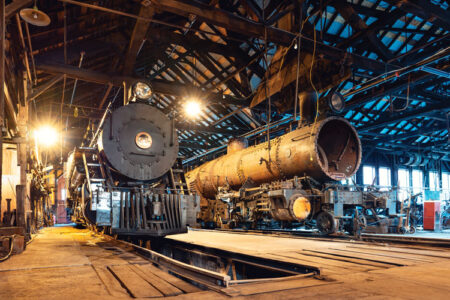
The shop complex at Rockhill Furnace grew to match the railroad’s needs. A machine shop, blacksmith shop, foundry, and roundhouse gave the EBT the capacity to be almost entirely self-sufficient. Nearly 300 steel coal hopper cars were built in those shops, fabricated in large numbers over just four or five years. Six steam locomotives worked the line in its final operating years.
The railroad was generally profitable through the 1940s. The post-war shift away from coal as an industrial fuel ended that. Demand for Broad Top coal waned through the early 1950s, and the railroad suspended operations in 1956. The mines closed with it. Crews went home. The doors at Rockhill Furnace were locked, and the equipment, all of it, was left behind on the assumption that the mines might eventually reopen. They never did.
Railroad Returns
What happened next is what sets the East Broad Top apart from every other defunct railroad in the country. The Kovalchick family, owners of a salvage company in Indiana, Pennsylvania, purchased the property in 1956. They didn’t scrap it. In 1960, they opened a tourist excursion service – running not a reconstruction or a re-creation, but the original railroad, on original track, behind original locomotives. The EBT was designated a National Historic Landmark in 1964. Tourist operations continued until 2011, when the costs of private ownership proved too great. The railroad went quiet again, sitting idle for nine years.
In February 2020, the EBT Foundation purchased the railroad from the Kovalchick family and set about bringing it back to life. Regular train service resumed in the summer of 2021. Track restoration has been progressing steadily, reaching some nine miles to Saltillo Station where an extensive reconstruction of the station is underway.
The Smithsonian Institution has described the East Broad Top as one of the most intact 19th-century industrial sites in the country, and as an incomparable national treasure.
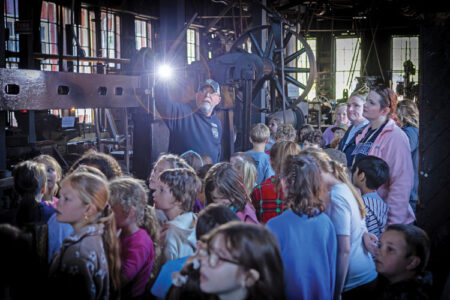
The man now responsible for all of it is Bradley Esposito, general manager of the EBT Foundation, who grew up in Punxsutawney and spent 22 years working for Genesee and Wyoming, a freight railroad operation, before a different kind of pull brought him home to central Pennsylvania. He’d been volunteering at the EBT for roughly 15 years when the opportunity to form a nonprofit and purchase the railroad came together.
“What we’re doing is not an inexpensive project,” he says. “Rebuilding a railroad, it’s like resurrecting a dinosaur. It takes a lot of money.” The Friends of the East Broad Top, a volunteer nonprofit that has supported the railroad since 1983, has raised more than a quarter-million dollars annually in recent years. The Foundation supplements that through admissions, events, and a growing line of contract work; the EBT’s modern machine shop now performs air brake work for passenger car fleets from more than 60 heritage railroads across the country, and boiler work for steam traction engines is the next area of expansion. Every dollar, Brad notes, goes back into the restoration.
What sets the EBT apart, according to Brad, isn’t something you can see in a photograph. “It’s not like a museum where there are collections of things that have been brought in and put behind glass,” he says. “When you come here, you’re going to get dirty if you touch something. You can smell the oil in the wood floors. Everything that’s here has been here its entire life.”
The six narrow gauge steam locomotives in the roundhouse were built for this railroad and have spent their entire existence here: not restorations acquired from other lines, not replicas assembled from period parts, but the actual machines that hauled coal out of Broad Top Mountain in the final years of freight operations. The custom wrenches made in the Rockhill Furnace shops a century ago to service those locomotives are still on the premises. They’re still used on the same engines. Locomotive No. 16, a Baldwin 2-8-2 built in 1916, currently pulls the excursion trains on weekend departures. A second locomotive, No. 15, is under restoration and expected to return to service within the next few years.
“The only thing that has changed,” Brad says, “is the people.”
The EBT Today
The EBT currently runs excursion trains over five miles of restored track to a picnic grove, with work underway to reopen eight additional miles of mainline that have been dormant since 1956. USA Today ranked it the number two scenic train ride in the United States in 2025. But, the train ride, as appealing as it is, may not be what stops a first-time visitor cold.
“It’s always fun to watch people come in and see it for the first time,” Brad says, “because whether you’re initiated to this type of thing or not, it’s pretty mind-blowing whenever you walk in there and see everything. You don’t know whether you’re walking back into 1910 or 1950. It’s just a time capsule that never left.”
The site offers multiple tour options of varying depth – the Hostling Tour, the Master Mechanic’s Tour, and the Archivist’s Tour – as well as extended three-hour tours of the shop complex that this year will include live blacksmithing demonstrations in the restored blacksmith shop. The Friends of the EBT operate a separate museum in Robertsdale, at the southern end of the original mainline near the old mine sites, where walking tours of the mine workings are offered alongside exhibits on the history of Broad Top coal. The neighboring Rockhill Trolley Museum offers combination tickets. Huntingdon County, Brad notes, provides enough to fill a full weekend without difficulty.
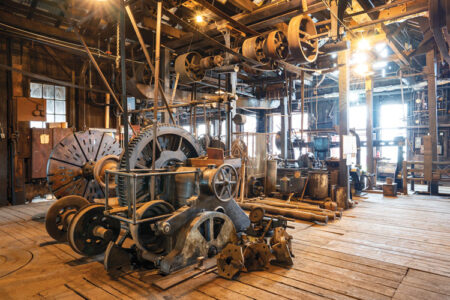
The machine shop at Rockhill Furnace is something specific and rare. It’s the largest and most intact belt-driven facility of its type in the United States, possibly in the world. Overhead line shafts run the length of the building. Flat belts drop to individual machines: lathes, drills, planers, presses. A single overhead drive powers the whole operation, the same mechanical arrangement that powered the factories of the industrial age. It isn’t a display. It isn’t a reproduction. It’s a working shop that simply never converted to anything more modern.
“If you want to get away from tourist traps, if you want to get out where you can enjoy some open air and scenery,” Brad says, “I’ve never met anybody that hasn’t come here and walked away with a greater appreciation for something that you can’t see somewhere else. You can go to Greenfield Village, you can go to Colonial Williamsburg, and you can see those types of things. But the fact that everything here is original fabric, and we’re still using the same wrenches on the same locomotives that some guy made in these shops 100 years ago, that’s pretty crazy when you look at how much has disappeared over the last 50, 60, 70 years. You literally have this little time capsule that never left.”
The EBT and Ladies of Vintage Steam
The connection between the East Broad Top and the Ladies of Steam organization began, as many good things do, with a person who cared about both. Michelle Beaner, whose family has been involved in the steam traction world for years and whose daughters participate in Ladies of Steam programming, had a longtime relationship with Nicole Wallace, the founder of Ladies of Steam.
When she joined the EBT Foundation as development coordinator, she saw an opportunity to bring those two worlds together. The timing finally aligned this year.
Ladies of Steam was founded by Nicole Wallace and Jennifer Clara, who co-built the organization from its earliest days and remain fierce advocates for women in the hobby. Nicole now carries the organization forward as its sole owner. Her relationship with steam isn’t casual or recent. She attended her first steam show at 11 months old, spent more than two decades firing, operating, maintaining, and restoring engines, and currently owns a 1919 16hp Minneapolis steam traction engine that’s undergoing a restoration.
The organization she built reflects that experience and that commitment. “It’s more than history, more than machines,” Nicole says. “Ladies of Steam is a movement built by those who refuse to let steam, or the women who run them, be forgotten. It’s really a platform to encourage women involved in the space and in the hobby. To give them opportunities that they wouldn’t have otherwise.”
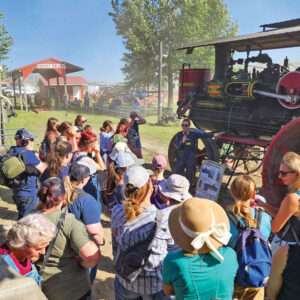
The core of that platform is the Women Teaching Women Steam events: hands-on sessions at which women of all ages and experience levels get access to working steam equipment, with instruction and encouragement from women who know it. The goal, Nicole said, is to plant seeds, to give someone the experience of pulling a throttle for the first time, and to let that experience open a door.
“When they get up on the engine, there can be some intimidation, just not sure what to expect. And then after they pull that throttle, after they learn a little bit about the engines, you can just see their facial expressions change. The experience that they just had was impactful on them.”
The October 10, 2026 Ladies of Steam event at the East Broad Top is something the organization has never done before. Previous Women Teaching Women Steam events have centered on steam traction engines. This one takes place at a National Historic Landmark, with working narrow gauge steam locomotives as part of the experience alongside traction engines, a combination of the agricultural and industrial steam traditions that rarely share the same ground.
“We’ve never had a combination of traction engines and locomotives before,” Nicole says. “We’ve focused on the steam traction engines, and this time we’ll be able to offer an opportunity for access to talking about locomotives, and not only locomotives, but the uniqueness about the East Broad Top Railroad.”
The event will run a full day, longer than most Women Teaching Women Steam events, which Nicole says is intentional. “We’re hoping to be able to magnify the experience even more.”
Brad echoes the fit between the two organizations. “The vibe of the place lends itself to wanting to get into more and more of the traction world,” he says. “It just kind of belongs. It just fits.”
The October 10 event is open to all. It’s a full day at a National Historic Landmark, with working steam traction engines and narrow-gauge locomotives, and the people who know how to run them. “It’ll bring together some phenomenal women that are really, truly passionate about keeping history alive,” Nicole says. That’s as good a reason as any to make the drive to Rockhill Furnace.
Still As It Was
The East Broad Top didn’t survive because anyone planned for it to survive. It survived because a salvage company bought it in 1956 and decided not to scrap it. Because a family ran tourist trains on five miles of original track for 50 years. Because a nonprofit formed at the right moment and found enough people willing to put money behind the idea that a three-foot narrow gauge coal railroad in rural Pennsylvania was worth saving. Because volunteers showed up for four decades before anyone could promise them it would work out.
What they saved isn’t a monument. It is a working shop, a working railroad, a place where the same tools and the same locomotives that were there in 1956 are still there, still capable. The people have changed. Everything else is as it was.
On October 10, 2026, women who carry that same ethic, the one that says this is worth keeping, worth learning, worth doing with your hands will gather at Rockhill Furnace.
The East Broad Top Railroad Heritage Park is located in Rockhill Furnace, Pennsylvania. Full event details and tickets for the October 10 Ladies of Steam anniversary celebration are available at EastBroadTop.com and LadiesofSteam.com.


