Route 1, Rock Falls, Illinois 61071
I am sending you some snapshots and a few lines about a one-half
scale model Case 65 that I built. This engine is popular with model
builders. Each time I see one in the Iron-Men Album I marvel at the
finished product, for I know how much time and effort each person
put into it. This goes for whatever make the builder uses for his
model.
If one wants something bad enough and long enough he makes a way
to get it. I always wanted a steam engine. It occurred to me if I
built one myself it would not cost very much. The Case 65 is a well
proportioned engine. It looked like it would be easy to build. It
would be a one-half scale model.
The patterns were made from blueprints. To get the right
contours and shapes to the castings, snapshots were taken at close
range of everything on the full size Case 65. All parts were
photographed several times from every angle possible. By using the
dimensions from the blueprints and the pictures it was possible to
form the patterns.
Making patterns and core boxes was new to me. If one part could
not be made there would be no use going on. The cylinder with its
ports would be the most difficult, as the steam ports had to be
cored accurately. The cylinder block came from the foundry perfect
for machining. The pattern for the engine frame was a bit of a
problem, but, it too came from the foundry perfect. From then on
the remaining patterns were fairly simple, although it did take a
long time to make the pattern for the flywheel. The Cannon
bearings, the wheel hubs, both front and rear, were cast from
patterns. Everything cast on the engine is an exact duplicate of
the full size engine.
Now about the boiler – I learned that a boiler has to be made by
a licensed boiler maker in order to be state approved. About this
time Iron-Men Album came out with a cover picture of Mr. A. C. Otto
of Sandwich, Illinois, and his one-half scale model Case 65. This
was in 1955. I went to see Mr. Otto but did not get the boiler at
this time because I became involved with another project. Not until
1967 did I get Mr. Otto’s boiler. It was a welded boiler built
to exact scale and licensed for 150 pounds steam pressure.
Mr. Otto has available all the castings for anyone who wants to
make this engine. I did not know this before I started. I had made
and machined the parts of the engine proper, but did not have the
gears and clutch assembly, etc. Mr. Otto had these blank castings
so I got them. These are the only parts for which I did not make
patterns. The gears are designed to allow the engine to move at
about five miles per hour.
The castings too big for my lathe were done at the Bauder
Machine Shop, Sterling, Illinois. Clair Bauder, the owner, made
available to me any machine I needed so long as it was idle. The
men in the shop bent over backwards to help me. To Mr. Bauder and
all the men I am grateful. In this way all parts were machined that
could not be done with my equipment. Incidentally, the cutting of
the gear teeth was quite a project. In cutting the last groove it
was a worry whether that last tooth would be too thick or too
thin.
All brackets necessary to fasten the various parts to the boiler
were welded to the boiler by Mr. Otto, such as the engine frame
bracket and the wing sheet brackets. By this time all the parts
were ready for assembly. The engine frame was the first part to be
fastened to the engine frame bracket in front and the wing sheet in
the rear. The right bearing assembly was fastened to the opposite
wing sheet. Both were braced to the boiler the same as the big
engine. The quadrant shelf was fastened to the boiler and wing
sheets. From here on all parts were mounted in relation to the
engine frame, and the use of blueprints. To pour the babbitt for
the crankshaft, two plates were fastened to the outside of each
bearing. By doing this the crankshaft was held in the correct
position. By tilting the boiler from one side to the other it was
easy to pour the babbitt. All the parts of the engine were
assembled. It was far enough along to run. Air was used to try it.
It ran good in either direction. The ‘D’ valve and all
parts relating to its setting were done the same as the full size
engine.
The governor is a 1′ Judson such as used on some Case
engines.
Both cannon bearings were fastened in place on the rear of the
boiler suspended on springs, the same as the full size engine. The
rear wheels were made and the gears attached. Bronze bushings were
used for bearings in the front wheels. Oilite bushings were used in
the differential. The free side of the differential gear is bolted
to the pinion gear over a bronze bushing.
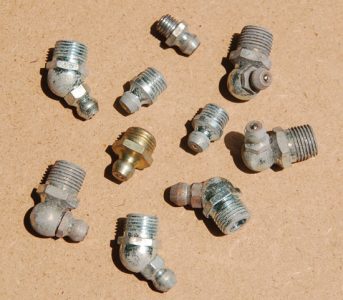
Every part has a zerk fitting.
A good part of the work was done at Mr. S. W. Naylor’s
building in Sterling, Illinois. My lathe, drill press, etc., were
in his building. Thanks to Mr. Naylor, this is where I assembled
the entire engine.
It was a big project. It turned out just like the full size Case
65. The power it develops is amazing. A steam engine is the only
inamimate object when fired up just sits there hissing and
throbbing to get going. Steam has a fascination all its own.
It was not to cost much. This was wrong. By the time I was
finished it had cost quite a few dollars. Anyway, it was fun.
I do not know how long you have been publishing the Iron-Men
Album. I have all the issues from the Nov.-Dec., 1954 issue to the
present. It gives pleasure, no end, to read and reread them.
Thank you for a fine magazine.