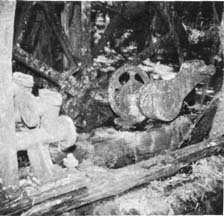
Courtesy of Mr. E. A. (Frog) Smith, 219 Hubbard St., North Fort
Myers, Florida
I am not trying to stock an issue, but rather explain something
you might be interested in.
Mr. J. C. Cobb’s letter and picture in the May-June, 1963
issue, of the old English sugar mill engine at Port Orange, Florida
was most interesting, as I have visited the place. This old mill
was burned and partially destroyed by Seminole Indians in 1836,
later rebuilt and ran until after the Civil War.
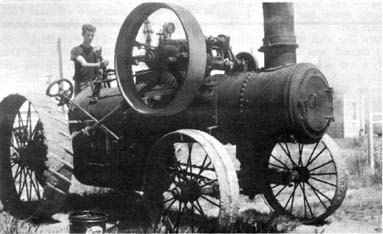
The old boiler, possibly 36′ diameter and 30′ long, is
made of three-eighth plate with cast iron heads riveted in. There
were no tubes in this type of boiler, more widely known in this
section as a ‘gut’ boiler. Another such boiler, except that
it has steel heads, is still in her furnace at the old David Yulee
sugar mill at Homosassa Springs, on the west coast of Florida.
Though more complete and could be made to run again, the engine
at Homosassa Springs mill is not so old as the engine at Port
Orange. It is a box frame job while the Port Orange engine was made
in sections, even to its flywheel which is riveted together.
However, one point stands out in the construction of the engine
at Port Orange. Directly above the cross-head assembly is a water
box in the exhaust line. There the hot condensation in the exhaust
steam is, or was rather, trapped and fed back into the boiler by
one of the twin cross-head pumps. The other pump fed the boiler.
The utilization of hot water condensed from exhaust steam is still
widely practiced to this day. And a must on steamships plying salt
water.
Another engine in Florida, built in 1860, as a hobby by a
Pennsylvania railroad engineer, in his back yard in Pennsylvania,
is still running. Driving a basket mill in Irvine, a few miles
south of Gainesville, Florida.
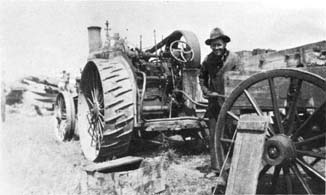
Courtesy of Walter H. Christopher son, Cut Bank, Mont.
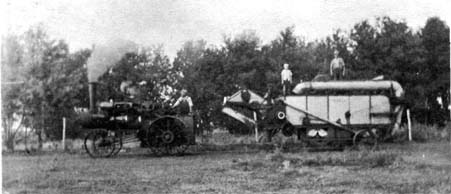
WALT CHRISTOPHER SON’S ANNUAL THRESHING BEE drew a capacity
crowd this year.
The crews, with Justus Fonger helping with the steaming chores
had two steam engines and an Avery gas tractor rared up to take
care of the power chores while Walt was ‘Separator man’ and
with his crew of volunteer bundle pitchers they threshed out
several bundle loads of something.
Kids were standing in the grain box with bare feet helping to
slurp the kernels into position.
Eastman Kodak stock must have gone up a few points that day,
judging from the number of shutter bugs in evidence. Both color and
black & white.
It didn’t appear that the youngsters took too much interest
in something as ancient as a threshing machine, but if you could
have seen the looks on the faces (and the interest) of the
old-timers as they watched the steam engine, the crisscrossed belt;
the separator, the straw blowing gracefully out into the stack, the
kernels of wheat coming down into the truck, it would have been
convincing enough some of them were reliving the days of
‘threshing rigs’, cook – cars, bunk-cars, horses, lunches
in the forenoon and afternoon, up before dawn to curry the team and
sleep on a straw mattress after a big supper. All for 55cent or
less and hour during the days of yore. V. M.
Courtesy of Ralph Thompson, Maxwell, Iowa
I note in the March-April, a Mr. Mair of Ontario, Canada, is
asking for some information about the Eagle tractor. I have never
operated or serviced this tractor, but have seen it on the floor
here at Des Moines. He states that it was sold in Canada by the old
Waterloo T.M. Co. I believe that is the manner in which they were
marketed, that is, thru jobbers. As I remember, it appeared to be a
ruggedly built machine. Too, that they were used by companies to
‘fill in’ by companies who had not yet found themselves
with a tractor of their own to meet the demands of the trade who
were beginning to ask for the internal comb. power plant; during
the period of transition.
The Eagle was built at Appleton, Wis. by the Eagle Mfg. Co. The
largest-the ‘6A’ used a Hercules motor. All were of the
four wheel type. The 6A, was fitted with three speeds forward and
reverse. In the Nebraska tests of Jan. 1, 1937, we find it weighing
5670 lbs. and pulling 4620 lbs. in first gear, thus making it I
assume, a three-four bottom outfit. The tractor made a good showing
during the test. A Waukesha motor, running at 1416 R.P.M. Then,
about this time, the company built two other sizes, each using a
twin horizontal motor of their own. The two last mentioned, were
heavier in weight than the 6A. All accessories were of high grade.
Apparently, their aim was quality. Too, I should add that both the
two cyl., were fitted with two forward speeds.
I note too, that under ‘wanted’ Mr. Hinton of
Carrollton, Ohio, is wanting a Bosch low tension mag. for his E.
Oil Pull. That, of course, is the type that Models E, F. and B.
were equipped with at the factory. The B. of course being the
earlier. Would like to suggest to Mr. Hinton, that we used to tap
out the body of the old movable igniters with which his tractor is
fitted, insert a 7/8‘ plug, and install a
high tension magneto, thus doing away with the old coil box and
batteries or hot shot that he has been using on his E. I don’t
believe there was ever a better magneto built than the one he is
asking for, but they were the old Robt. Bosch – a German built
accessory. Also they used platinum points, which about lasted a
life time. But with the advent of W. W. I., companies here, were
unable to secure them. But true to American resourcefulness, the
American Bosch was produced, but it never measured up to the old
Rob’t. Bosch magneto.
Another feature in this issue, I enjoyed is a review both by
word and by pictures, of the early efforts of the old A. Gaar Co.,
and its final development into the Gaar, Scott Co. Becoming one of
the Country’s most honored firms, building harvesting
machinery. Along with Robinson, M. Rumely, Mr. Case and many others
following the Civil War, saw the absolute necessity for the nation
to have better harvesting equipment. The war as always, had pulled
so much of the man power away from the farms and industry. Can
anyone tell me, if in their earliest years, there was ever any
relation between the old Robinson and Gaar, Scott firms? I have
always wondered about this since, both were located at Richmond,
and their engines were so similar. My earliest recollection of farm
engines include the old Robinson with belt wheel on the left side.
The Aultman and Taylor with it’s rear mounting and shaft drive,
and the old Giant return flue with it’s chain drive. The last
named, was a man killer, with only a rod to be pulled in
controlling the valve. Seems it seldom failed to stop on dead
center – with the latter valve gears this seldom happened. Too,
with the stack at the rear the operator about cooked. They were
hard to wear out though, and did their job in the noble manner that
is so characteristic of steam power. I was reared in the south tier
counties of Iowa, and have cut my share of old fence rails, our
fuel, that were so common to that area at that time.
We obtained our earliest engines I suppose, from England, that
is, they were building them before we did, and I would not take
anything from them, but it does seem to me, that it was left to our
own engines and designers, to develop the lines of symmetry which
characterize the most of our engines, and above all to build into
them the wide versatility which they possess. What an engine could
be built today after much the fashion of our old ones? Developments
in steels, anti friction bearings now available with our thrust
bearings and such, the old A & T. bevel drive, would certainly
reappear. It did have about the finest clutch built. Until last
season, I been able to operate at about four of our shows. But for
reasons of health have been forced to let-up. Sort of a bitter
‘Pill’ to take, but suppose it must come to all of us. But
God has been good to me. Blessed with the most wonderful companion
in the world. We observed our 50’th. ann’y., about a year
and a half ago. Our children are all extremely aware and
considerate of us. Then grandchildren and now, great grandchildren,
really makes life mighty rich.
I imagine we all have some regrets, and I would mention that I
could have so-many pictures and records than what I have had I been
more careful over the years. Have a great many now, but plowing,
threshing, road building and silo filling over the years, would
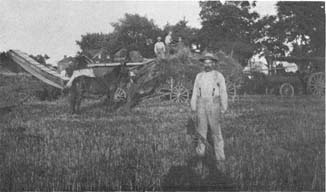
have added many more. I am enclosing one picture however. A bit
different and a scene we’ll not see again – a Canadian wheat
field. When I left for Canada just following W. W. I., wheat there
was selling at $3.40 a bushel. It is the finest hard wheat produced
on the continent. Millers here demanded it to blend with the softer
varieties grown here. Montana, I understand, is our only state
growing hard wheat of a compare able quality. This picture shows a
crop in Alberta on land that cost an Iowa banker but $15.00 an
acre.
Congratulations again, to you on THE ALBUM.