Lewis Kosseth Brown, better known locally as “L.K.,” was born in Illinois in 1856. His family moved to Wisconsin when he was age 7. He was educated in Eau Claire, Wisconsin, public schools and graduated from Wisconsin State Normal School at Oshkosh.
He taught school there until moving to Asotin in what was then known as Washington Territory, arriving on March 25, 1878. Asotin is located in the southeast corner of Washington state next to the Blue Mountains.
After arriving in Asotin, L.K. purchased two claims on Weissenfels Ridge, which he improved and sold before buying the claims of Jim Skinner closer to Anatone, which became the location of his home and shop for many years.
A threshing machine designed for the Palouse
In the spring of 1883, L.K. began the construction of his first steam-powered engine for use at a chop mill in Walla Walla, Washington. While in Walla Walla, he constructed the first pipe boiler in that part of the country, using a double-cutoff method, which greatly reduced the amount of steam used.
L.K. was known to be a salty individual but soon established himself as a skilled machine builder. In 1883, he built a stationary steam-powered threshing machine that was used for 20 years on his and neighboring farms.

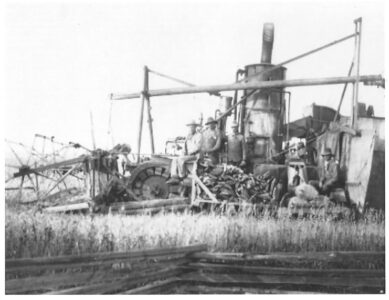
Later, he built a self-propelled, four-wheel drive, steam-powered combined threshing machine with a 24-inch header. Equipped with a vertical boiler, the machine could be used on less-than-level land, an important consideration in the hilly Palouse region.
Self-propelled unit ahead of its time
L.K.’s threshing machine was patented (patent No. 901,588) in 1908. The self-propelled unit, which protected grain from being run over during the harvest operation, was ahead of its time. L.K. custom-built the self-propelled units for $2,200 ($63,860 today), mounting the buyer’s original horse-drawn combine unit on it for an additional $900.

This steam-powered combined unit was said to use 40 to 50 gallons of water and 1/22 cord of slab wood per acre. Understandably, in that it also generated some sparks from the boiler, a man would follow along and put out any fires that started as a result. A second man picked up belts when they came off.
L.K. also patented a front-wheel drive system for traction vehicles, winning U.S. patent No. 939,972 in 1909 (see patent illustrations above and opposite). He used such vehicles to haul people, their belongings and goods to and from the Washington communities of Anatone, Asotin and Clarkston, as well as Lewiston, Idaho, covering a route of more than 30 miles over dirt roads that were often muddy or snow-packed.

This was likely the beginning of the now popular four-wheel drive vehicle. Brown’s machine was reported to be a bit slower than a man walking, but definitely more reliable and faster in mud and snow, and much easier on the shoe leather.
Inventor’s mind never rested
A prolific inventor, L.K. designed and built several notable items commonly used on farms and in the agricultural and logging industries in the Pacific Northwest. It is easy to understand why his Anatone machine shop was always busy and a very popular place to visit, in addition to being a place where tools were built and repaired.
Among his inventions was a four-wheel drive, tractor-type power unit that pulled several wagons loaded with up to 6,000 board feet of lumber from the mills by Anatone to Asotin, a trip of some 20 miles. The tractor unit’s “underbelly” water tank held enough water for the trip. It also carried enough wood to fire the boiler for the 40-mile round-trip.

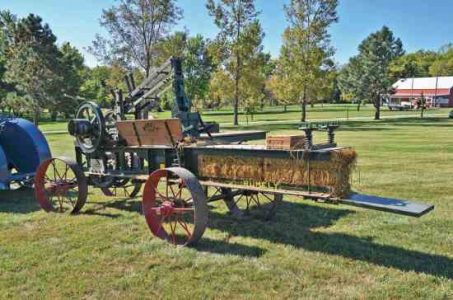
Today, four pieces built by L.K. are known to exist. Rod Sangster, Anatone, has two chop mills, one of which he displays in yearly demonstrations. The remains of one of L.K.’s tractors is in the Cloverland area south of Asotin, and a wooden wheel made from slices of cut logs is on display in the Asotin County museum.
In addition to his business pursuits, L.K. also served as the Asotin County surveyor/engineer for two years and was involved in early efforts to bring irrigation water from the Blue Mountain area to farmland on the bench south of Asotin. He also operated a mobile “farm to farm” steam-powered chop mill unit and cut wood for local people with the same unit while operating his blacksmith shop and farm. He died in 1937. FC
The author acknowledges Rod Sangster, Courtney Smith, Bruce Petty, the WSU Library at Pullman, Washington, the Miller family at the Asotin County Museum and area historians for contributing information used to help research and confirm L.K. Brown’s contributions to early agriculture in the Pacific Northwest.
David Ruark farms in southeast Washington. He and his wife are members of the Lewis-Clark Antique Power Club of Lewiston, Idaho, and enjoy restoring, displaying and demonstrating antique engines, tractors and farm equipment. Contact him at dnruark@wildblue.net.