
A lot of antique farm tractor buffs have never driven a crawler tractor and may not have considered the unique difficulties in steering these machines, or how steering systems have evolved since the first crawlers crawled. It is generally understood that crawlers are controlled by a pair of steering levers (in some cases, a “T” handle, or even a steering wheel), but most people don’t bother with what happens beyond that.
Crawler tractors were born of necessity at the turn of the 20th century in the rich, but boggy, farm lands of the Sacramento, California, River delta. Gigantic wheat farms required big, heavy, steam tractors and combines, both of which were made by the competing Holt and Best manufacturing companies. These big-wheeled monsters frequently sank in the bog, and when they did, there was nothing available to pull them out.
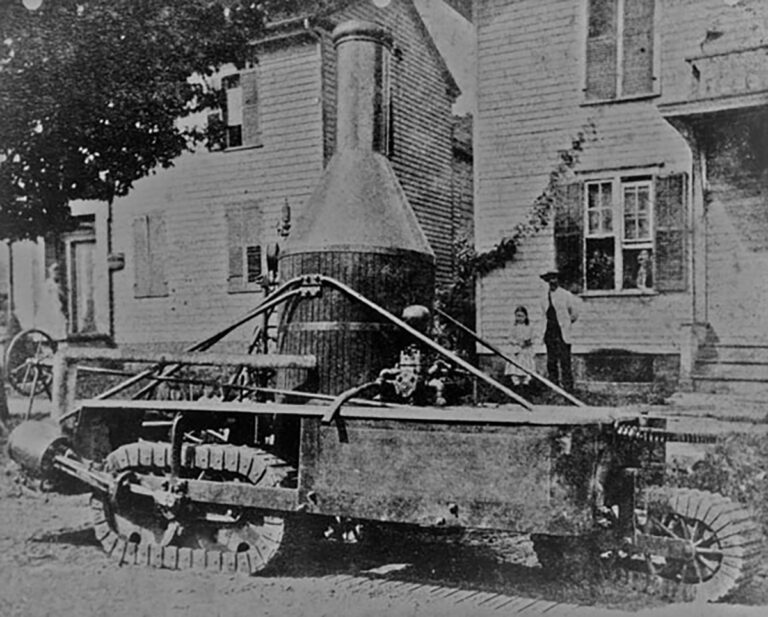
As early as 1858, a successful steam-powered traction engine with crawler tracks had been demonstrated by inventor Warren Miller in nearby Marysville, California. The tracks provided the necessary flotation and traction to work on the soft land. Apparently Miller built only one machine, but others followed, including units by Minnis (1869), Parvin (1871), Stratton (1893) and Lombard (1900).
These machines all used individual steam cylinders for each track; consequently, a differential between the tracks was not required. Steering was accomplished by means of a front tiller wheel. In the case of the Minnis, the tiller was a track also powered by a separate steam cylinder. The Lombard (used exclusively in the north woods for winter log hauling) used skis reminiscent of those on today’s snowmobiles.


Solving the gas engine challenge
By the early 1900s, both the Best and Holt companies were converting their steam traction engines to crawler tracks. Both soon saw the advantage of internal combustion gasoline engines and each developed their own. Holt and Best continued that vigorous competition until 1925, when they merged to form Caterpillar.
When going to the gasoline engine, the problem of delivering power to the tracks became more complicated. The tiller wheel did not have enough authority to overcome the tendency of the tracks to continue in a straight line. Holt solved this problem on its 1907 gasoline-powered crawler by including steering clutches in the drive for each track. By disengaging drive power from the “inside” track, the tiller wheel could then negotiate the turn. Holt did not add track brakes to assist in steering until 1918. The tiller wheel was controlled by a conventional steering wheel at the operator station through a series of shafts, universal joints and a worm-sector gear.
Best’s first gasoline crawler, the Model 70 (later renamed the 75), came out in 1913. It also used a tiller wheel, but the tracks were driven through a differential in the same manner as its gasoline-powered wheeled counterpart. Individual steering brakes were included.


Refining the clutch-brake steering
With the addition of steering brakes, tiller wheels eventually proved to be unnecessary and disappeared from both clutch-brake and differential machines. Although Best used clutch-brake steering on subsequent models, these two optional steering systems characterized crawler tractors by all manufacturers for many years to come.
On earlier crawlers with the clutch and brake system, levers (or a steering wheel) controlled the steering clutches. A hand master clutch was also provided. Foot brake pedals on either side of the platform completed the control system. To make a turn, the appropriate steering lever was pulled, disengaging the corresponding track. That track then slowed, while the opposite track continued at its former speed, thus turning the tractor. The rate of turn, without using the track brake, depended on the load being pulled or pushed.
In fact, going downhill (or with an aiding load), the tractor could turn in the opposite direction, much to the consternation of the operator. This situation is also encountered when unloading a crawler from a tilting-bed trailer and is especially confusing when backing the tractor. The use of the steering brakes becomes almost automatic for most operators to consistently get desired steering.
Another disadvantage of this type of steering is that once a track is disengaged, full drive power is transferred to the other track. Thus, drive components must be oversized to handle twice the normal power. With all power delivered to one track, that track must then push or pull the whole load and spin-out becomes a problem. With clutch-brake steering, pulling both levers back causes the tractor to stop, since both track clutches are disengaged. On some crawlers, the steering lever first disengages the steering clutch; further movement of the lever applies the track brake. In such cases, a foot master clutch and a foot service brake are usually provided.


Mastering differential steering
With differential steering, both tracks are powered at all times. It is still possible to stop the inside track for pivot turns, but a characteristic of a gear differential is that whatever goes into it is divided between the two outputs: If one track is stopped, the other will be going twice as fast as before. Therefore, the steering rate can be jerky and unpredictable. Instead of a steering lever and brake for each track, with differential steering, normally just steering levers are used to activate the track brake.
A disadvantage of the differential method is heat build-up through continuous use of the track brakes. Engine power absorbed in the brake is converted to heat. Another inconvenient fact is that when one track is slowed, the other is getting effectively a higher gear, and if already under full load, the act of steering might cause an overload stall.
For example, as the tractor approaches the end of the field with a high power-consumption implement in tow and attempts to spin around for the reverse pass, there is insufficient engine power to make the turn without down-shifting the transmission. This is not a problem with a power-shift transmission, but if it means stopping and shifting to a lower gear for the turn, it could be tedious.
Cletrac (Cleveland Tractor Co.) devised a fancy differential with two ring gears and two ratios. Thus, stopping one ring gear with the brake lever didn’t completely stop the corresponding track, but shifted it to a slower gear ratio. The tractor could then turn in a small circle, but could not pivot. This was effective especially on high-powered crawlers in making the steering anticipatory and in keeping the heat increase under control.
With either type of steering, clutch-brake or differential, the tractor should go straight when not influenced by the operator. Uneven track tension (or uneven lubrication of track components) can cause the machine to veer to one side. In most cases, crawlers tend to head downhill when working on a slope. Continuous use of brakes and clutches causes wear and overheating. Clutch-brake systems are generally preferred for side hill work, but differential steering with an automatic differential lock also works well. In some later differential-steer crawlers, both lever brakes and foot brakes are offered, and in some cases only the foot brakes. This leaves the operator with both hands free to work the master hand clutch, a loader or a shuttle shift.


Evolution of crawler steering
As time went on, most manufacturers settled on one type or the other, although Caterpillar continued to offer both. My John Deere 440C used clutch and brake steering, but the system was actuated by the steering levers and it had a foot clutch and one foot brake pedal.
Dual hydrostatic transmissions and hydrostatic differentials have been tried, but inherent inefficiencies have proven problematic. Most modern crawlers, especially those of the rubber track variety, use hydrostatic or electric steering trimmers providing a separate input to the main differential to bias the differential outputs, adding turns to one side and subtracting the same from the other causing the tractor to turn. In fact, this type can cause one track to go backward as the other goes forward, making the tractor spin in place.
In the new Caterpillar D7E, electric drive replaces the mechanical connection in the same manner as in a diesel-electric locomotive. The 9.3-liter 6-cylinder engine drives a 480 volt AC generator. Each track is driven by a brushless AC engine. All are sealed and liquid cooled. Pumps, fans and cab air conditioning are also powered electrically. Cat claims this arrangement improves fuel efficiency.


Then there is the Case IH Quad-Trac with four rubber tracks. It has no clutch-brake or differential steering system, or hydrostatics – it simply bends in the middle!FC
After 36 years in the aircraft industry, Bob Pripps returned to his first love and began writing about tractors. He has authored some 30 books on the subject and several magazine articles. Pripps has a maple syrup farm near Park Falls, Wisconsin. In harvesting the maple sap, he relies on a Ford Jubilee and a Massey-Ferguson 85.
The author acknowledges the contributions of Ed and Sue Claessen, Waverly, Iowa, authors of Making Tracks, “the definitive book of C.L. Best’s contributions to crawler tractors.”


