
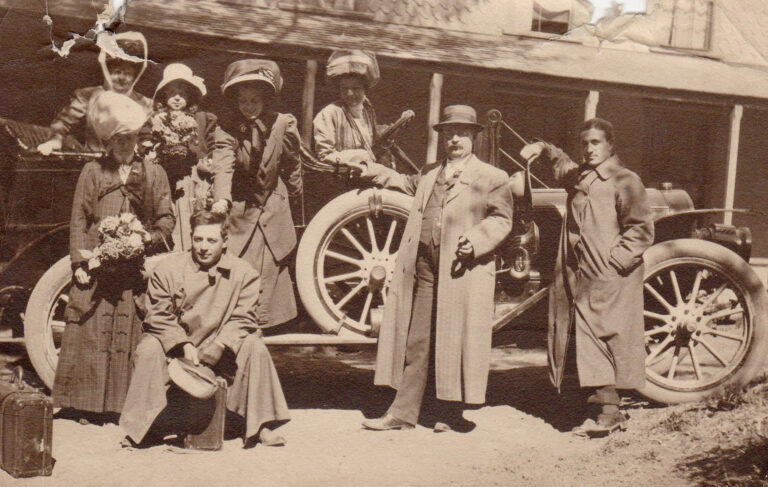
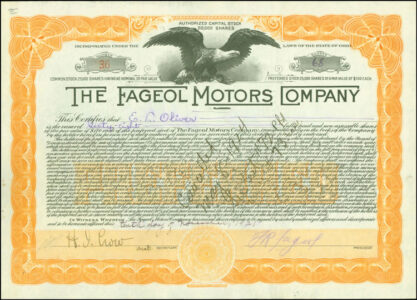
Fageol tractors were an unusual tractor with an unusual name. Their history went through many twists and turns that only peripherally had anything to do with the spudded-rear-wheel tractors. Over intervening years, the Fageol brothers also built motorcycles, sold Nash and Rambler automobiles, Garford trucks, and built Fageol Walking Tractors. Their expertise exists yet today in the production of Peterbilt trucks.
In 1899, teen brothers Frank and William Fageol were seen as special. Especially when Frank, at 17, and William, at 19, began their lifelong careers as entrepreneurs, providing a series of firsts.
Their first first began with building Iowa’s first-ever automobile, a steam vehicle that held eight passengers. During the Iowa State Fair, they filled those seats regularly with paying passengers, ferrying them from their home town of Ankeny, Iowa, 13 miles to the Iowa State Fair in Des Moines.
California Days
In 1904, Frank Fageol headed to San Francisco, followed by William a year later, where they set up the California Motor Co. with Louis and T. R. Bill to build and market the California motorcycle, the first “motor bicycle” in the state.
In 1905, the motor-minded brothers got involved with the Rambler and Nash automobile companies, and Frank Fageol applied for a chauffeur’s license in that year, using the address of the Rambler agency as his place of employment. That would come in handy a few years later with the Panama-Pacific Exposition.
In 1906, the great San Francisco earthquake struck, destroying the city, including the Rambler agency building in Oakland. At that point, Frank Fageol earned control of the Rambler agency, and due to the earthquake, the brothers sold Nash and Rambler vehicles out of a tent for a while, but moved into a frame building in 1907.
Other Fageol brothers followed Frank and William out to California. As Motor Coach Age said in a November/December 1991 article by Eli Bail, “City directories for the 1907-1916 period list a number of other people named Fageol, too. In the listings for 1907, 1908, and 1911 (1909 and 1910 are not available), Frank Fageol is identified as president of United Electric Vehicle Co., an agent for Rambler automobiles. William is listed as foreman, Rollie B. and Claude H. as machinists, and John J. as a salesman. United Electric Vehicle Co. may have been the predecessor of the Eight Wheel Motor Vehicle Co., which was established in 1918 to build gas-electric ore carrying trains and whose patents were used by the short-lived National Axle Co. for eight-wheeled trucks and buses.”
In 1912, all Fageols listed in area directories had some association with the Fageol Motor Sales Co., which now sold Garford trucks and Rambler cars. Rollie’s name was no longer associated with the company in 1913, and John’s disappeared in 1914, perhaps because Fageol Motor Co. was planning to produce a tractor.
Their first tractor, the Hamilton Walking Tractor, had been designed by someone outside the company, the invention of Rush Hamilton from Geyserville, California. Hamilton had patented it in 1915 (along with other patents), and formed the Hamilton Tractor Co. It was an odd-looking orchard tractor, the purpose of which was to tow wagons. Automotive Industries said, “Unlike either the caterpillar or broad wheel type of tractor, or the convertible automobile tractors in common use today (like the Staude Mak-A-Tractor or Smith Form-A-Tractor), the Hamilton machine uses an entirely new principle for getting its traction. Instead of flattening the ground in front of the plow or harrow or other machinery being pulled, this tractor draws its farm implements along after having loosened up the soil by its front wheels with their long blade-like teeth.” According to the Hamilton advertising, they believed the wheels could move the tractor anywhere.
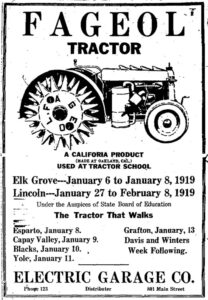
In 1918, that orchard tractor was followed by a true four-wheeled tractor, rated a 9-12, (R. B. Gray, in The Development of the Agricultural Tractor in the United States, calls it an 8-12) with the trademark “spudded” drive wheels, which had metal stakes protruding on either side of the wheel and made it look like a gigantic cogwheel.
In The Development of the Agricultural Tractor in the United States, R. B. Gray writes that “The Fageol ‘walked’ on its ‘legs’ or grousers. It was claimed that because of the wedging action of the ground between two adjacent grousers, the drive wheels would not sink deeply even in loose sand. In the drum of each driver was an internal expanding clutch which coupled the solid live axle to the drive wheel; no differential on the axle.”
So, the tractor the Fageols did build was the invention of Rush Hamilton of Geyserville, California. Hamilton had patented it in 1915 (along with other patents), and formed the Hamilton Tractor Co., and the Fageols purchased the right to manufacture the tractor.
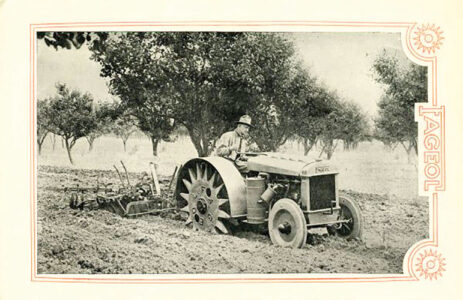
It was an odd looking orchard tractor, the purpose of which was to tow wagons. Al said, “Unlike either the caterpillar or broad wheel type of tractor, or the convertible automobile tractors in common use today, (like the Staude Mak-A-Tractor or Smith Form-A-Tractor) the Hamilton machine uses an entirely new principle for getting its traction. Instead of flattening the ground in front of the plow or harrow or other machinery being pulled, this tractor draws its farm implements along after having loosened up the soil by its front wheels with their long blade-like teeth.”
Fageol Orchard Tractor
In ca. 1915, the remaining brothers started Fageol Motors Co. in Oakland, and advertised the Hamilton Walking Tractor as their orchard tractor for sale. The brothers called it variously Hamilton-Fageol Walking Tractor and Fageol Walking Tractor, but no matter what they called it, the machine had little success, perhaps due to the odd front wheels. The belief of Hamilton was that those wheels with stakes around them could carry the tractor anywhere.
Eli Bail in “Fageol” in Motor Coach Age, November/December 1991, wrote, “The first product of the new company … that rode on spiked driving wheels and was promoted as a ‘walking tractor’ because it mimicked the walking action of the horse when the long spikes (or grousers) on the front (or drive wheels) of this machine, struck the soil and lifted and moved the tractor.”
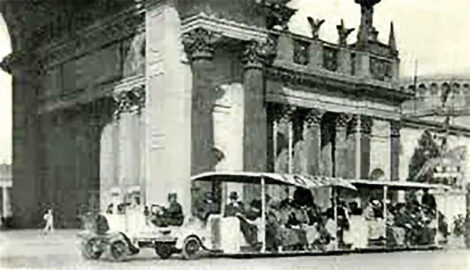
Without big success for the walking tractor, the Fageols searched for a way to make it useful, and returned to what had worked before: transporting people. They applied for the contract for carrying passengers around the 1916 Panama-Pacific Exposition, held in San Francisco to celebrate the city coming back alive after the 1906 earthquake, as well as the finishing of the Panama Canal.
In The Fageol Success, J. H. Fort wrote, “When the Panama-Pacific Exposition was being planned, the problem of transportation within the grounds confronted the directors. Many proposals were submitted and considered, but none seemed as practical as that of R. B. Fageol and F. R. Fageol. The latter, over a period of fifteen years, had been automotive inventor, mechanic, and salesman.
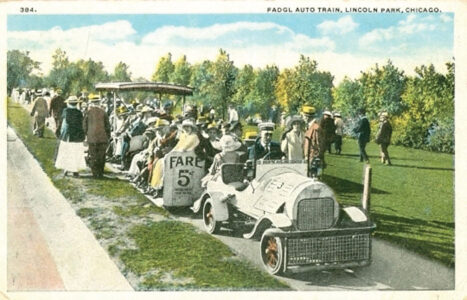
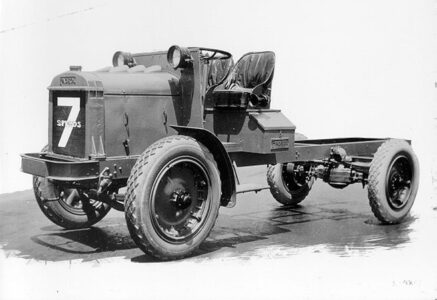
“The Fageols proposed solving the problem by building a small tractor, the first Fageol tractor, using a Ford car motor to draw the passenger trailers around the grounds. They were awarded the transportation concession, but were required by financier Edward P. Brinegar, an automobile dealer who held the transportation franchise for the Exposition and was putting up the money for the project, to call themselves FADGL, printed plainly in large letters on the vehicles because people had such difficulty pronouncing their name.
“The tractors were built in Frank Fageol’s auto agency, financed by Brinegar, and were called Fadgl Auto Train, Inc. They looked more like small cars, with four small wheels, barrel-shaped hoods, and large mesh-filled front bumpers.
“The trailers carried 20 passengers in open-sided trailers around the expo at Golden State Park. The wheels of the trailers were shrouded so passengers’ clothes or feet wouldn’t catch in the spokes as they sat in the trailers with their legs dangling off the edges. If they stretched, they could touch the ground with their feet. A sightseeing trip cost 10 cents, and the project was a huge success.”
Fageol Factory
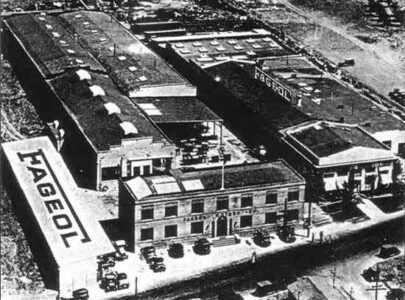
The Fageols’ success translated into enough cash and enough interest, that in 1917, the brothers decided to build their own factory. Automotive Industries, Volume 37, 1917, said, “Oakland, Cal., June 30-The Fageol Motors Co. has started work on the first unit of its new factory for passenger cars, trucks and tractors in this city. The plans of the new plant are for a factory capable of producing the several lines of trucks, tractors and cars, and will be built in a series of units to accommodate this purpose.”
Pacific Service Magazine of June. 1917, said, “Ground was broken June 10th for the Fageol Motors Co. at One Hundred and Sixth Avenue and Boulevard, Oakland, under the auspices of the Oakland Chamber of Commerce. Some 2,000 people were in attendance. The company will build military and farm tractors and marks the second large motor factory for Oakland.”
However, the first tractor out of the new factory was based on the earlier machine they used to pull the wagons at the Panama-Pacific Expo, a machine they called the Fageol Walking Tractor for orchards. A light tractor weighing 1,730 pounds, the Fageol Walking Tractor had a pressed steel frame, four-cylinder engine, and drive to the wheels by internal gears, all of which ran immersed in oil.
The chisel-like stakes were now placed on the rear wheels and were called spuds, or “spudded” wheels. They exerted great drawbar pull and could be covered with bands for traveling on roads. The machine cost $1,065, was touted as the equivalent of four horses, and had a plate on the front that described it as the Hamilton tractor.
It did not sell well, but the Fageols were smart enough to understand that with men leaving for the war, the demand for tractors would be down, and despite many companies having their development radically affected by the World War, the Fageols did not suffer, as they moved into manufacturing cars and trucks, and eventually buses.
A later newspaper article said, “Oakland boasts at least one plant in which the war brought about the manufacture of an entirely different product than that for which the factory was originally designed,” and that was the Fageol plant. No further mention has been found of the “military” tractor Fageols were going to build.
In 1918, the company made a four-wheeled Fageol of either 8-12 or 9-12 (information is unclear), that is, eight or nine horsepower at the drawbar, and 12hp at the pulley. To complicate matters, the successor Fageol rear-wheel drive tractor of 9-12hp was also called a “Walking Tractor” in later literature.
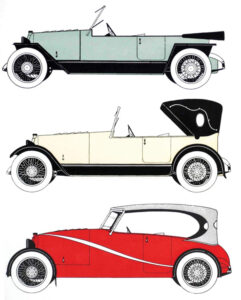
In 1918, Fageol Motors Co. made a 10-15 machine, all including the “spudded” drive wheels, as they were called. Those metal stakes made it look like a gigantic cogwheel.
Pacific Service Magazine wrote in its March, 1922 issue, “Delivery of (Fageol) tractors for farm and vineyard purposes began in 1918. Foreign trade was developed until now the company supplies the Pacific Coast and is sending its tractors to the Pacific Islands, many countries of Europe, and the far east.”
The magazine added, “At present, the Fageol Company is putting out a new type of highway maintenance trucks, passenger busses, and stages. The Fageol inter-city stage was recently introduced. During the present year and next year, the company will continue with its truck and tractor development and will bring out a full line of highway stages, gas street cars and deluxe cars for estates and ultrafine service. Approximately 105 employees are now employed at the Foothill Boulevard plant.”
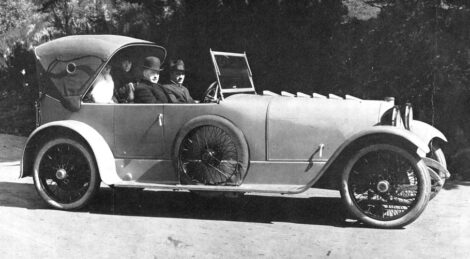
But despite the good words, the factory ceased making Fageol tractors in 1923, due to the on-going agriculture recession, as well as the need to turn to other, more secure government contracts, like making trucks. Their later tractors were also much heavier — 3,600 pounds, double the weight of the orchard, or walking tractor. It had a Lycoming 4-cylinder with a 3-1/2 by 5-inch bore and stroke, with one forward gear, and steering by tiller. An enormous replaceable filter air cleaner took care of the California dust, and the vents on the hoods of the Fageol tractors were very distinctive, like other Fageol vehicles of the time.
It weighed about twice as much as the Hamilton and cost more. The higher price of $1,525 was a death knell for this tractor, as it had no additional features than other, cheaper orchard tractors.
Fageol quit manufacturing their tractors with spudded rear wheels around 1922 and turned to making buses and trucks.
And who knows? If WWI had not come along and involved the United States, perhaps Fageol tractors would have become one of the most popular names in farm tractors, like John Deere or International Harvester.
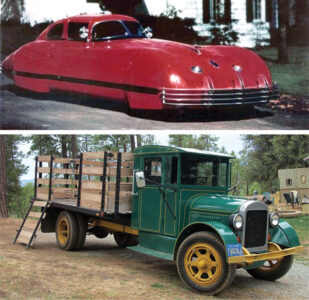
That’s based on the fact that the Fageol truck eventually became the Peterbilt truck, which is still being built today.
Despite the company’s unusual name, it translated into the company’s great long-term success. FC
Bill Vossler is a freelance writer and author of several books on antique farm tractors and toys. Contact him at Box 372, 400 Caroline Ln., Rockville, MN 56369; email: wdvossler@outlook.com.


