
Since it was first organized in 2003, the Twin Rivers Old Iron Association’s (TROIA) Harvest and Kuchen Festival at Delmont, South Dakota, has brought the community together, helped preserve agricultural and family history, and given those who attend an opportunity for both entertainment and education. The event is rooted in Delmont’s Kuchen Festival, which was developed to provide entertainment and local foods (such as kuchen) for pheasant hunters who traveled to the area each October.
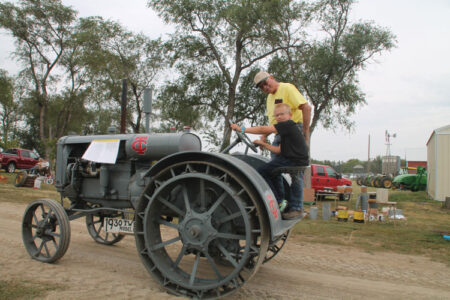
“What I recall is that it all started with a corn-shelling event uptown,” Mike Fechner said. “That gathered a crowd for a couple of years, and it caught my attention. Prior to that, my uncle involved me in the restoration of my grandfather’s 1930 Twin City tractor.”
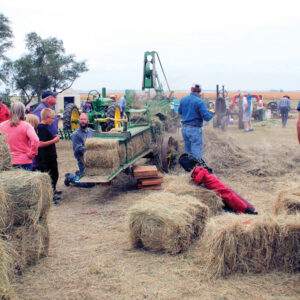
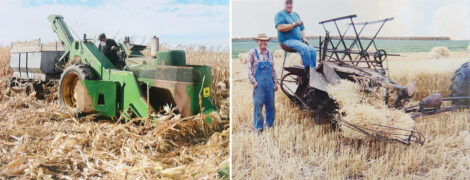
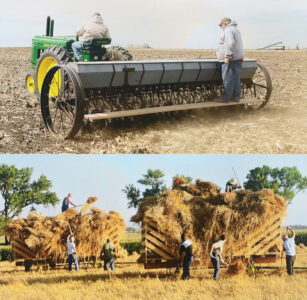
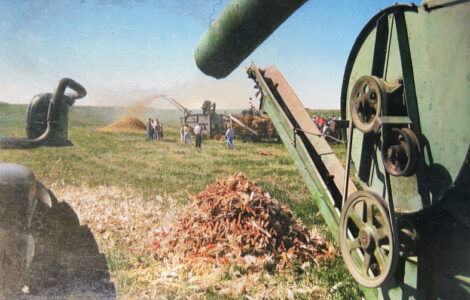
An interest in threshing was already incubating in the community, centered around TROIA Board Member Glennis Stern’s annual family threshing events, which were implemented in the late 1990s. Stern and his family organized their first private event for his wife’s grandfather.
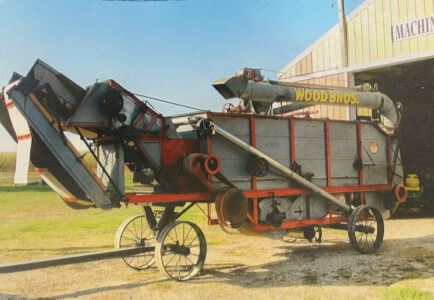
“I went out and bought an old threshing machine and binder and harvested about six acres of oats,” Stern said. “The weather was beautiful that year, and everybody thought it was great. The next year, we threshed again. Before we were done that year, people started walking away, commenting about how much work it was.”
Though the Stern family’s threshing event was losing some of its glamour, Stern’s neighbor approached him about holding a threshing event for his family.
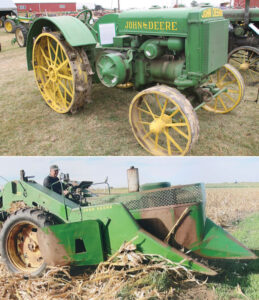
“We threshed two more times at our farm, and that’s about the time TROIA started,” Stern said. “A lot of the association members showed up with some of their vintage equipment, and the show started growing from there.”
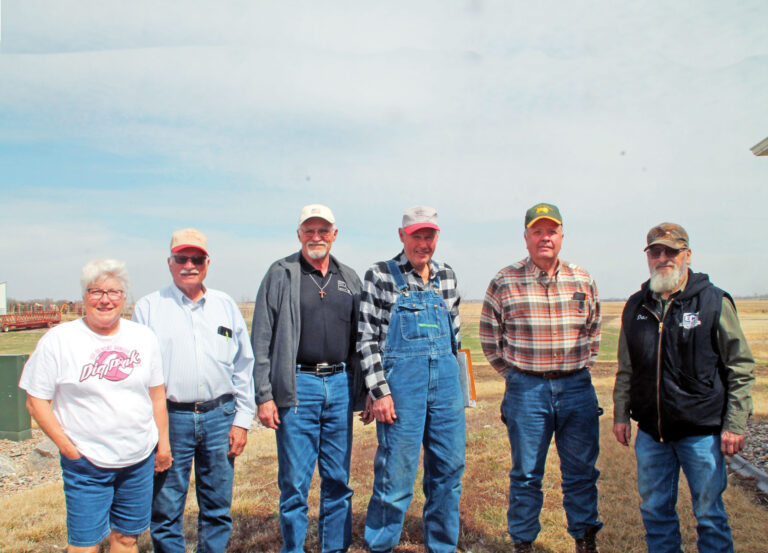
Association members include Stern and his wife Deb; Mike and Lila Fechner; George and Diane Sandhoff; Dan Kurtenbach; Bryan Neugebauer; Brian Weisser; Jim Grosz; and Dale Bitterman. Each of the members has their own vintage equipment collection, some of which belonged to various family members.
“I worked for a John Deere dealer for many years, where I saw old machinery like corn pickers, manure spreaders, and things like single discs,” Sandhoff said. “It’s intriguing to think about how our fathers and grandfathers started farming with horses. All of us have an interest in keeping knowledge of this history going.”
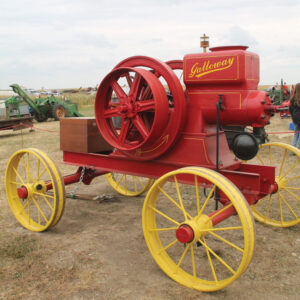
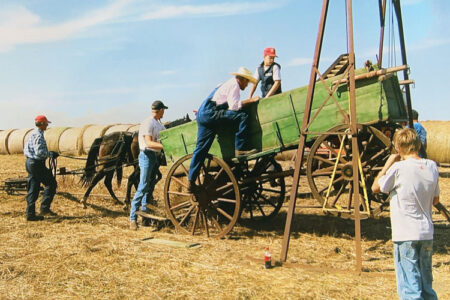
At one point, TROIA had horse-powered activities, including a horse pull, in their show. That opportunity dwindled over time for a variety of reasons. Steam engines, vintage tractors, and small engines now power most displays.
The farm site, a few blocks west of Delmont, where the show has been located since its inception, featured a barn, house, machine shed, and several outbuildings. Over time, with a wealth of physical effort from members, TROIA upgraded and renovated the buildings to house show activities. The remodeled house now holds a unique display of vintage items that change with each year.
“Jeanie Grosz organizes that display each year,” Lila said. “Laura Weiss usually helps her. One year, they displayed military regalia, another year, it was all wedding dresses. One year, she had a collection of vintage dishes, and every year it’s a different historic display.”
Some buildings have been donated, and TROIA members have developed creative ideas to help get them to the show grounds from their original locales.
“We have the town’s first schoolhouse, the Weber schoolhouse,” Stern said. “There was a lot of back and forth before we got that moved in. We used a stack mover to get it to the show site, set it up on railroad ties, and turned it into our kitchen. We get a lot of good feedback about our food.”
Another building, a former pole shed, was dismantled after it was donated. It was reconstructed by members and serves as a shed to store grain bundles, ensuring they are dry enough to thresh on show day.
“Our members have really stepped up to help fund these projects,” Stern said. “For the pole shed, we had to buy roofing materials. We passed the hat, and the cost was taken care of.”
Another shed was moved in and renovated to house restrooms, and two years ago, a Nebraska thresherman’s cook shack was offered to the association.
“We had an opportunity in 2018 to acquire a fully furnished schoolhouse from the Parkston Historical Society that originally sat along Highway 18 between Delmont and Tripp, so we decided to take it. Getting it moved was quite a process. The weather turned quite wet and then COVID-19. So, it was probably three or four years till we finally got it moved. It’s been quite a hit at the show,” Stern said.
The club decided to build a new old-fashioned blacksmith shop. It has a line shaft in to run various machines and a forge.
“It came from a show that was once held in Newcastle [Nebraska],” Neugebauer said. “The building was always a big crowd-pleaser at that show. It’s hard to imagine now that threshing crews traveled around the region, cooking and sleeping in this ‘shack.’ When the activities of that show started moving toward pickup pulls and more modern activities, they didn’t need this building anymore.”
After two years of planning, TROIA members brought the thresherman’s shack to their grounds, where it’ll be renovated and integrated into their annual event.
“Twin Rivers really benefited from COVID-19, when other threshing shows were canceling events,” Stern said. “People still wanted to go to threshing shows. The fact that we’ve always had free admission was also a big draw at that time.”
The crowds that attended and the vendors and collectors who participated in the show during that time have continued to help make the show a success.
“We had one guy come from Sturgis [South Dakota] with his tractors because there were no other shows in his area,” Mike Fechner said. “Jeanie Grosz keeps a guest register in the house each year and gives us a report on how many people signed it and where they came from. In 2024, we had people here from two different countries and between 11 and 13 different states.”
Like most old-iron associations, TROIA constantly works to keep volunteers engaged, add to its volunteer pool, provide a range of activities for all ages, and spread the word about what its show offers. It recently implemented two work nights each month to keep up with maintenance chores and/or new construction. Show plans come out of regular board meetings, ideas, and feedback from members. They also meet within a few days of each show to provide feedback and insight about what might need to be modified or added to the following year.
“We know we need to get young people engaged in this,” Stern said. “We started inviting classes from area schools to come to the showgrounds a few days before our show for a tour. We’ve had fifth- and sixth-grade classes who took a tour. These kids and their teachers have greatly enjoyed the tours, and we know that many of the students come back to the show with their parents because they enjoyed it so much.”
The Fechners’ granddaughter recently started participating in tractor pulls. Fechner’s collection includes some 40 tractors.
“For the last two years, she’s entered tractor pulls,” Fechner said. “At an exhibition last year, she beat me fair and square, by two inches. Her interest motivates me to stay involved with TROIA and other threshing shows.”
TROIA has also gained a reputation for being the friendliest and most accommodating show in the region.
“In a past year, one of our vendors came from Ipswich [South Dakota] and got here Friday night close to dark,” Mike Fechner said. “He had a couple [of] engines to unload, and we had virtually a mob here to help him. He couldn’t get over how much help we offered.”
The 2025 show is scheduled for September 13 and 14. The show runs Friday from 6 to 8 p.m., Saturday from 8 a.m. to 8 p.m. and Sunday from 8 a.m. 5 p.m.
“We open on Sunday morning with a church service,” Stern said. “Anyone who’s interested can go online to register for our parade, and all our information is available at www.TwinRiversOldIron.org.”
Neugebauer notes that the group has made an effort to provide activities for youth to continue engaging them in experiencing the history and ingenuity that served as a foundation for modern-day farms and communities.
“We have a bounce house for kids and a pedal pull,” Neugebauer said. “No cost for any of that, or for admission. The only thing people pay for at the show is food. We know the future of what we’ve developed lies in the younger generations. We want to see it continue on.” FC
Delmont News of 1913
In its day, Delmont was a significant community in South Dakota’s Douglas County. This newspaper excerpt was taken from the city’s 1913 newspaper:
“Delmont is the Gateway City to Douglas County, is located on the C.M. & St. P. R.R., ten miles southeast of Armour the county seat. Population 500 Has two Municipal Banks with over 300,000.00 on deposit, Opera House, Finest Hotel of its size in the state — thoroughly modern. six Churches. Splendid Graded Public school, German Academy. Fine Modern Business Blocks and Beautiful Homes. Delmont is surrounded with the richest agriculture country, dotted with palatial Homes and big barns and is adjacent to a market afforded by five elevators with one of the Liveliest bunch of business men of any town its size in the state. You are always Welcome to our city.”
Loretta Sorensen is a lifelong resident of southeast South Dakota. She and her husband farm with Belgian draft horses and collect vintage farm equipment. Email her at sorensenlms@gmail.com.


