
How did twentieth-century tobacco growers prepare beds for planting tobacco? Learn about the old process of sterilizing tobacco beds with steam-powered engines.
I was born in Adams, Tennessee, in Robertson County, which is the heart of the tobacco growing country, both air-cured and dark-fired. There are large tobacco markets located at Springfield and Clarksville, Tennessee, and at Hopkinsville, Kentucky, all within a radius of 30 miles.
Tobacco plant beds were either burned or steamed. When one was to be burned, the ground was cleared off. Brush and small logs were then cut and piled up several feet high and burned to kill the weed seeds and insects.
There was also a device called a burner. It had a set of wheels on one end and handles on the other. It was about 8 feet long and 3 feet wide, and consisted of a pan-like piece of metal with an opening on the end, where the wheels were located, for the smoke to come out. A fire was built under it and the loose dirt was shoveled up on the burner and cooked and then shoveled off the burner and put back on the plant bed.
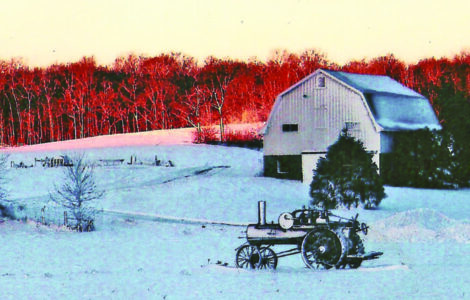
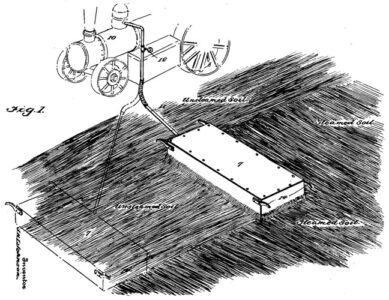
In steaming, a portable boiler – or most of the time, a traction engine – was used. A rectangular metal box usually called a pan, 9 by 12 feet and 6 inches deep, was used. The ground was prepared by plowing or was forked up.
The pan was put on the ground. Dirt was packed all around it to make it steam-tight. Then steam was piped to it from the engine, usually with a 1-inch pipe. Of course, the higher the steam pressure used, the better the ground was prepared. Usually, 150 pounds pressure was used.
A fellow I knew always bragged about the high pressure he had: 175 pounds. He was steaming with an old Keck-Gonnerman engine. I happened to see it one time when it wasn’t under steam and the steam gauge hand was sitting on 50 pounds.
The best way to prepare a plant bed
The water in the boiler was kept as low as was consistent with safety. To make the steam hotter and drier, a pan was usually steamed from 20 to 30 minutes, depending on the farmer who was having the steaming done. Some people steamed 25 minutes, allowing 5 minutes to move the pan and get set again. That would give you two pans an hour. A pan had three metal loops on each side and two on each end.
Back in the early days, the pan had to be picked up by laborers and moved. Large sticks of wood, something like a wagon standard, were cut. They were stuck in the loops and it took six strong people to pick it up and pack it. In later years, the pans were put on wheels with arms. A winch and cable operated by an electric motor and battery picked them up. Others put cables in the loops with a ring in the middle, had a boom made and picked up the pan with a 3-pt. hitch tractor.
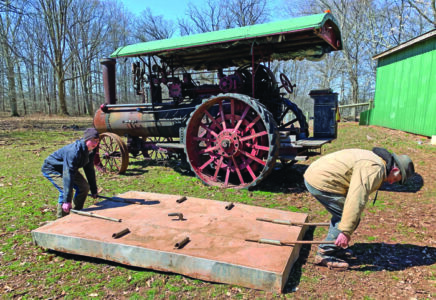
The last plant bed I steamed, in 1978, took just three of us. I took care of the engine and moved the pipe and the other two took care of the tractor and pan. The farmer had to furnish all the labor, coal and water for the engine, and had to feed the engineer at the noon meal.
Steaming was the best way to prepare a plant bed. It killed all the weeds, insects and conditioned the ground. As soon as the pan was taken off and the steam cleared, the plant bed could be sown and the canvas put on to keep weed seeds from blowing in so you would have plenty of strong, healthy plants to set.
Chemicals are now being used as it is hard to get farm labor, and where coal used to sell for $3 a ton, now it’s $25 a ton, plus the fact that there are not too many steam engines left.
Custom steam sterilization services for tobacco farmers
Back in the 1930s in Robertson County, custom steaming was done by Sam Duff with a 20-60hp Case tractor, Luster Strange with 19hp and 22hp Keck-Gonnermans, and Connell McEwing, who ran Mr. Q. Flynn’s 26hp Advance compound. Tobe Overby had a 16hp Advance that he had graded roads with. The drivers were worn slick, plus a big part of the left drive wheel had been broken on a rock. The engine going across a field reminded you of a person with one leg shorter than the other.
Mr. Tobe was one of the lowest water men I’ve ever seen. All he wanted in the water glass was a little moisture. He guaranteed that if any weeds were in the plant bed, there was no charge for the steaming. Charley Browning had a 20hp Advance that he used for steaming in the winter and put on a sawmill in the summer.
Dick Mitchell had a 14-mile run. He would go to the far end and steam his way back home. He had a 20hp double-cylinder Nichols & Shepard engine with a big water wagon, pan wagon and a Buick automobile tied on behind. Going down the road, that was a sight to see!
I was helping him one time and a Tennessee state trooper told him to get the engine off U.S. Highway 41, as the engine still had the steel cleats on the wheels. Mr. Mitchell told him that was the only way he could get to where he was going, and if he couldn’t run on that road, they would have to build him one alongside for him to run on. I knew we were going to get a free ride, but the cop left us alone.
What happened to the practice of steaming tobacco beds?
Among the farmers who steamed for themselves were the Hollingsworth brothers, Rosson brothers, Bill Simmons, Homer Burney, John R. Fletcher, Charles Corbin, George Washington and Felix Ewing, the last two being brothers-in-law and great rivals who tried to outdo each other. Unbeknownst to each other, they both bought steam engines. One was a 25hp Nichols & Shepard, and the other was a 35hp Nichols & Shepard. Both came in on the same railroad flatcar.
The fellow who bought the 25hp engine wouldn’t unload it, but sent it back to the factory and exchanged it for a 35hp engine that ended its days pulling a sawmill before being scrapped in World War II. Steaming plant beds was hard work. It was hard on an engine, as there was no “let up.”
Steaming started around Nov. 1 and continued until the 10th of April. Usually, the weather was cold. The engineer had to get up early to have steam by daylight. If it got too cold and wet and the engine was sitting miles away, he would have to bank the fire for several days or else drain it to keep the boiler from freezing, and then fill it up with a bucket or tank pump, which was slow, tedious work.
But after all, it was fascinating work, each farmer depending on the other for help, like as in threshing wheat. While steaming, eggs, potatoes and the like were put under the pan and cooked and that tasted good on a cold winter day. Steaming plant beds went out in the 1970s. It is another part of Americana that is gone; something the younger folk will never be able to see. FC
Billy M. Byrd, who lived in Madisonville, Kentucky, until his death in 2001, was a retired railroad engineer with the Tennessee Valley Railroad Museum, and a founder of the Tennessee-Kentucky Steam Thresherman’s Show in Adams, Tennessee. This article first appeared in Iron Man Album in 1983.
Originally published as “Steaming Tobacco Beds” in the September 2023 issue of Farm Collector magazine.


