
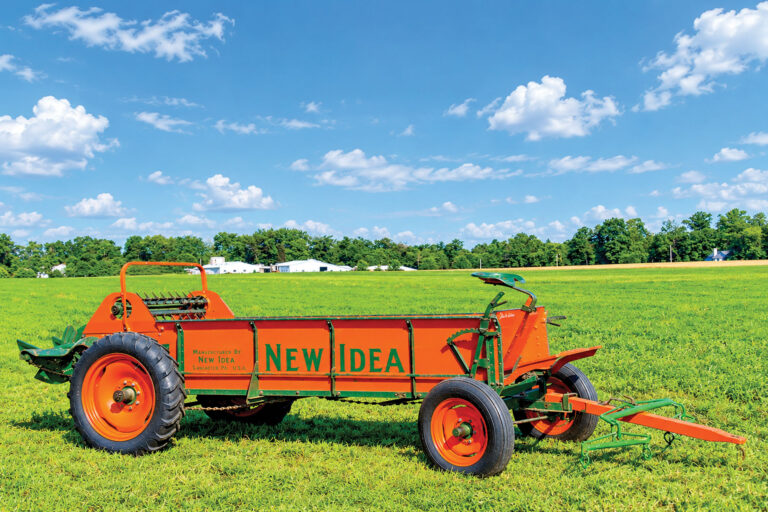
A farm collector’s dream is finding a three-quarter century gem that’s never been used. Aaron Troyer was that fortunate collector when he learned of a 1950 New Idea manure spreader.
Aaron explains, “I connected with a friend during a 2022 auction. He knew of my interest in quality pre-owned farm equipment. With that known interest, he told me about a 1950 horse-drawn New Idea Model 10A spreader in De Smet, South Dakota. It was a rare gem that had never been used.
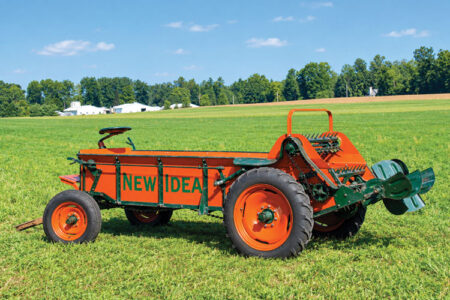
“I contacted Tim Sullivan, who was the owner, to learn about the spreader. I shared with Tim that we were rebuilding a Pequea spreader and he became interested. When the restoration was finished, we exchanged pictures – the New Idea and the Pequea. Following the picture exchange, an agreement was reached to trade spreaders.”
Fascinating Development
Aaron wanted to deliver the spreader to De Smet, South Dakota, in order to visit the Laura Ingalls Wilder homestead. Ingalls Wilder is famous for her “Little House” book series.
It turns out that Tim and Joan Sullivan have an attraction next to the Ingalls Wilder homestead known as Laura’s Living Prairie. Their outdoor museum offers an opportunity for tourists to learn what early pioneer homesteading was like.
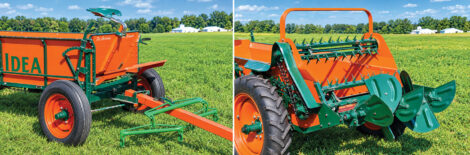
However, Tim wanted to deliver his spreader for the opportunity to tour Amish communities of Holmes County, Ohio. Aaron agreed and then served as Tim’s tour guide, being a well-grounded Amish gentleman. That took place in October of 2024.
New Idea History
Amy Bogaard, a professor of Neolithic and Bronze Age archaeology, discovered that manure was first used as fertilizer on European farmlands about 8,000 years ago. Farmers came to realize that manure wasn’t waste but was very useful. They noted that fields where livestock were pastured showed better plant growth around manure piles. So, farmers began spreading manure manually using hand-held shovels.
The ingenious Joseph Sargent Kemp, a Quebec, Canada, resident, felt there was a better way to spread manure without manual use of shovels. Consequently, Kemp built the first successful manure spreader in 1875. His crude contraption simply dumped the manure on the field without uniform distribution. Farmers would then use harrows to spread the manure more extensively.
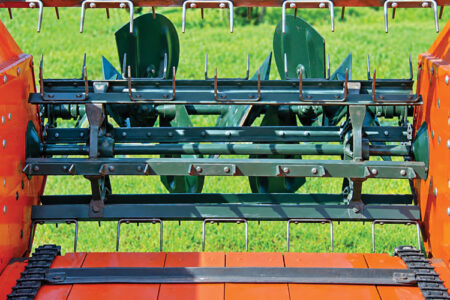
Joseph Oppenheim, a schoolmaster in Maria Stein, Ohio, came up with an improvement. He’d watched schoolboys hit balls with paddle bats, and he concluded that the direction of the ball was determined by the angle of
the paddle. Following that observation, Oppenheim envisioned a series of paddles mounted at angles on a rotating horizontal axle that would fling material farther afield. He patented his vision in 1899 and built a spreader that he marketed under the New Idea name.
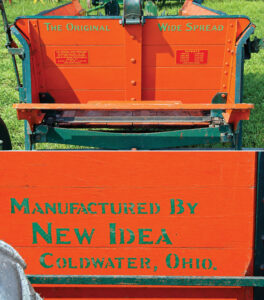
Through a ground-driven arrangement, the manure was dragged to the back of a wagon with wood slats and thrown into the paddles or spreader mechanism. In time, the wooden slats in the live floor were replaced with iron slats connected to a pair of drive chains.
As the New Idea Co. progressed, they established corporate offices and manufacturing facilities in Coldwater, Ohio. Demand for the New Idea spreader gained widespread acceptance. Consequently,it sold well, with branches eventually established in eight states, along with an assembly plant in Guelph, Ontario, Canada.
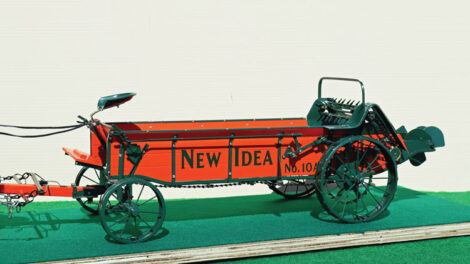
New Idea became the brand that set the standards for spreader performance, durability, and reliability for many decades. The company added numerous lines of farm equipment over time. In 1945, the Oppenheim family sold its controlling interest in the closely held New Idea Co. to AVCO Mfg. AVCO later sold the company to White Farm Equipment Co. In 1993, White sold its New Idea holdings to AGCO (Allis-Gleaner Corp.), the current owners.
New Idea Model 10A
The New Idea Model 10A is a legendary, ground-driven manure spreader built from 1948 to 1963. It became known as the “Cadillac of spreaders” due to its outstanding performance.
The spreader featured a durable, treated-wood box, robust shredding cylinders, and excellent parts. It, therefore, became a favorite for small farms, especially those using draft animals.
As for design, the ground-driven power (the wheels turn the spreading mechanisms) eliminates the need for complex PTO hookups. The Penta-treated yellow pine flooring and sides assured durability over its steel competitors. An upgrade from the Model 10, the bronze-steel backed bushings on the rear axle prevented axle-grooving that plagued its predecessor.
The spreader’s immense popularity and continued use in Amish communities has resulted in companies manufacturing exact replacement parts, continuing the use of the spreader.
Salesman Sample
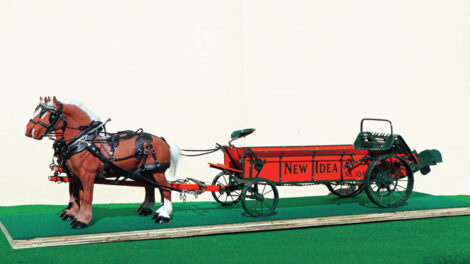
Aaron crafted a 1/8-scale model of the New idea spreader that emulated a salesman sample. A brief reflection regarding salesman samples. A salesman sample is a scaled-down replica of field equipment that traveling salesmen used in the late 19th and early 20th centuries. Unlike most of today’s scale models, they were fully functional.
When the 1/16- or 1/8-scale sample was pulled across a solid surface, it functioned exactly like the real equipment. This would demonstrate features, materials, and functions for the potential buyer.
Before product catalogs, it wasn’t practical for a salesman to carry full-sized farm equipment town-to-town via the railroad. Instead, the salesman carried highly detailed miniatures in portable sample cases to help secure wholesale orders. New Idea products didn’t come on the scene until well past the use of salesman samples.
Scale Model Extraordinaire
When Aaron was still farming and milking cows, he supplemented the family income through the repair of used farm equipment. Aaron reflects, “There seemed to be a greater demand for farm equipment that needed repair than producing milk. As a result, we sold the cows in 1999 and started raising heifers for our neighbor’s dairy farms.
“After the cows were sold, I continued buying used equipment to repair and resell. During that time, I kept thinking about building small-scale farm toys. I dug an old toy truck out of storage. I wanted to make it a livestock transport truck. My son learned about my interest and built the racks for my Christmas gift.”
In 1922, Aaron acquired a 1/6-scale New Idea manure spreader from a friend’s shop. He later resold it through an auction. Aaron says, “That purchase kick-started my interest in scratch-building farm equipment.” Aaron’s desire went well beyond building replicas – he aspired for top-of-the-line scale models that functioned, like the old salesman samples.
Aaron struck up a relationship with a friend who owned a machine shop. The friend took measurements of the real equipment, drafted plans, and made components for the scale model equipment.
The team started by building horse-drawn forecarts and cultipackers. As they gained confidence, they moved on to more complex items such as the New Idea spreader.
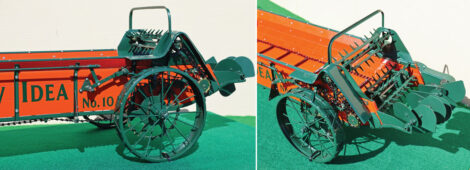
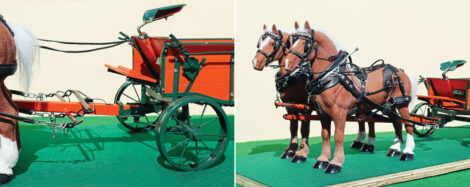
As you’ll note by the accompanying pictures, the 1/8-scale horse-drawn manure spreader is top of the line. Every part functions off the ground wheels, just like the original New Idea spreader. This includes the drag chains on the spreader floor and the rear beaters.
Aaron has additional parts to build copies of the models described, for anyone interested. Aaron’s next project is a 1/8-scale McCormick Deering No. 9 horse-drawn mower. Only time will tell what will follow.
For those interested in learning more about Aaron Troyer’s superior scale models, he welcomes your contact via a note with your name and phone number sent to: 2679 S. Kansas Rd., Apple Creek, Ohio 44606. FC
Freelance writer Fred Hendricks of Mansfield, Ohio, covers a vast array of interesting subjects. Contact him at fwhendricks@gmail.com


