
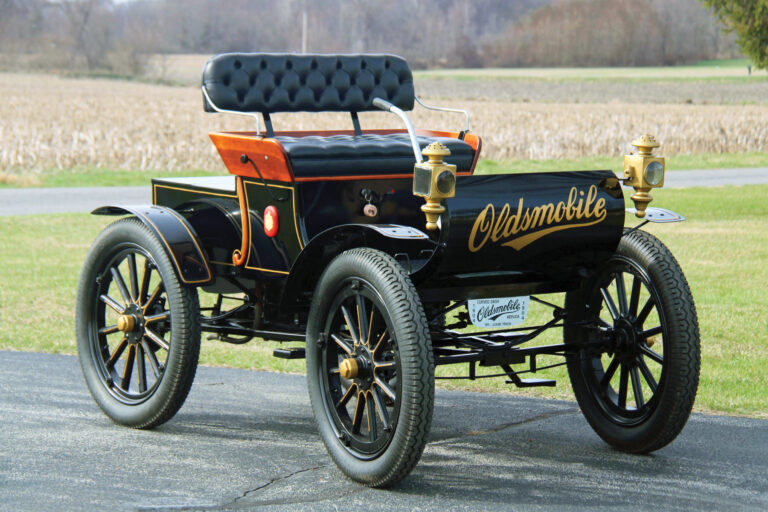
The sprawling size of antique tractor and auto shows often requires a small vehicle for viewing the displays. Louie Frick found that to be the case, especially after becoming a seasoned citizen. Louie said, “My wife Carolyn and I display our antique tractors and scaled-down versions at antique tractor shows. While attending events, we find it convenient to have power mobility rather than walking to view other displays. I didn’t want to buy a golfcart or gator, so I decided to build an Oldsmobile Runabout.
“The Runabout was Oldsmobile’s first automobile made in the early 1900s. There aren’t many of those left to picture or take measurements. Therefore, I trekked up to the R.E. Olds Transportation Museum in Lansing, Michigan, for that purpose.
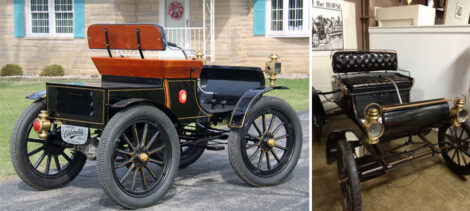
“While [I was] taking measurements from a 1904 Runabout, a museum attendant asked if he could provide help. I indicated the measurements were notes to build one. With that comment, I was offered a blueprint of the automobile. I was grateful and felt like the guy who said you can’t catch rain with a pitchfork. It wasn’t quite like catching rain but those prints saved a lot of time and grief in the building process,” Louie assured me.
Curved Dash Oldsmobile
The Oldsmobile Model R, also known as the “Curved Dash Runabout,” is credited as the first mass-produced automobile, meaning that it was built on an assembly line using interchangeable parts.
The Oldsmobile Co. introduced the model in 1901 with production running through 1906. Built as a city car for short distance driving, it had comfortable seating for two passengers and was sold for $650 over 100 years ago, making it equivalent to $24,700 in 2025.
The water-cooled, single-cylinder engine was rated at 5hp. The transmission was semiautomatic, having two forward gears and one reverse gear, and the Runabout could top out at 20 mph, if the driving surface was suitable.
In 1904, the Model R was replaced by the Model 6C, which had a larger engine. In addition, drum brakes replaced the hand brake. After 2,234 autos were made, the Model 6C was discontinued in December 1904.
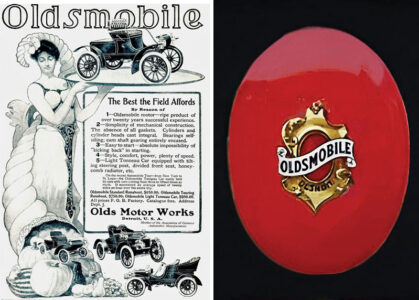
In 1905, Model B was introduced with further upgrades. In 1906, the car received side window curtains, and the dashboard was offered in an upright position called the “Straight Dash.” Final production for the Oldsmobile Runabout ran through 1906.
Scratch-Built Runabout
Working from the blueprints obtained at the museum, Louie expertly crafted his nifty car. The name “Curved Dash Runabout” comes from the curved outside front dash, as shown in the accompanying picture. “Although Oldsmobile constructed the Runabout with wood, I used metal throughout. The curved parts, especially the dash, were a little tricky to construct. But it eventually worked out with the Oldsmobile decal imprinted on the front,” Louie noted.
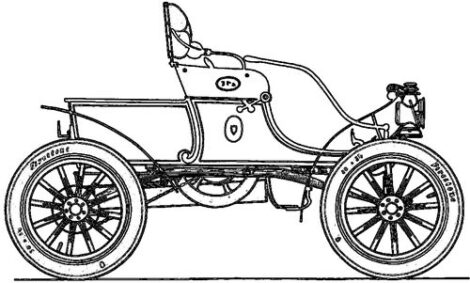
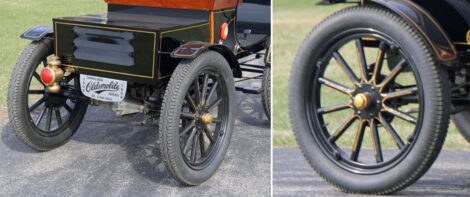
Louie’s Runabout is powered by a Briggs & Stratton engine with a non-descript lawn mower hydrostatic transmission. The front wheels came off an Overland automobile, while the rear wheels are from a Ford Model T car. And the kerosene lights, front and rear, are functional.
As for construction challenges, Louie noted, “I did not have a pattern for the tiller steering, but, through trial and error, I finally made it work. I’m not handy with woodworking, so the seat was built for me. And the upholstery cushion for the seat and back rest was done by an Amish shop in Nappanee.”
Commendations
This professionally crafted Oldsmobile Runabout is praiseworthy, front to rear. Louie Frick, who resides in Bremen, Indiana, dedicated countless hours until it was completed in 2014 when he was 85 years old. Congratulations on the job well done, Louie.
For the curious reader, Louie welcomes your contact about his Oldsmobile Runabout by calling during the evening by phone: 574.286.0495.
Freelance writer Fred Hendricks of Mansfield, Ohio, covers a vast array of subjects relating to agriculture. Contact Fred at fwhendricks@gmail.com


