
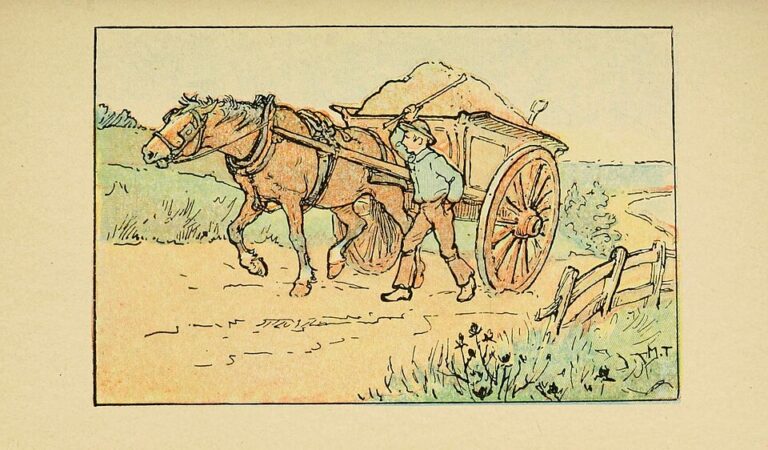
In the days when horse power reigned supreme in the United Kingdom, a two-wheeled cart pulled by a single horse was the normal setup farmers used for hauling all sorts of loads.
In 2007, a chap named John W. Charlesworth who lived in Barnsley, Yorkshire, U.K., wrote to me and described the methods his father and others used to haul a large amount of material. For instance, his father, in order to improve his sandy soil, got a lot of manure from a haulage firm that had about a ton of the stuff every week to get rid of.
John tells us that a man with a lot of something to haul might take two carts and two horses, driving one horse with the second tied behind the first cart. Normally, the trailing horse was just tied to a ring on the rear of the leading cart, but “if the second horse could not be trusted to behave,” John said, “it was tied by a halter shank to each rear corner staff of the cart in front, so it could not get past the first cart.”
After loading, by hand of course, both carts to capacity, the farmer started back. If he came to a hill that was too steep for one horse to make it to the top with the loaded cart, he had to resort to a doubling maneuver.
John continues his story, “The rear horse was unhitched [and) both wheels [of the unhitched cart] had a stone put in front and behind. The prop sticks under the shafts were let down to take the weight of the shafts and the brake was put on to help stabilize the load. [That] horse was [then] hitched in front [of the other horse and cart] with two nine feet long chaining-up chains, which had a hook at each end. Dad has his made from some old hoist chain and the blacksmith put a big link and hook at each end for a charge of one shilling and four pence –about 16 pence at the time, about 1914.”
When that cart was at the top of the hill, it was set up with the wheels blocked, brakes set and shafts propped, the two horses unhitched and driven back down the hill where they were hitched to the second cart and then pulled it up the hill. Each horse was re-hitched to his cart and they plodded on.
Mr. Charlesworth told us, “Our carts were not usually braked on the rim of the wheel. Brakes on the rim of a wheel soon wore the tire away with the grit the tires picked up from the road. An early method used (for braking) was to fasten a horse behind (the cart, and) as it held back its chains slipped to the top of the corner staff so it also pulled some of the weight off the shaft horse’s back. Later, they were braked by two blocks on a beam that was screwed from the back of the cart (I don’t quite understand this; maybe the blocks were forced against the ground behind the cart so it acted as a drag brake?) The handle for this was carried on a hook and staple at the side of the cart, so the carter had to be careful to always replace it or it could easily be lost.”
He continued, “Later carts had what we called ‘lap’ brakes, which were said not to put quite so much weight on the horse’s back. There does not seem to be any mechanical reason for this, but probably the pressure would not be, as we say, dead, that is it would act more as if it was put on by a spring. These brakes were (wooden blocks) held in an iron band that went just over half way round the hub of the wheel. A lever forced the iron bands and the wooden blocks against the hubs.”
Mr. Charlesworth also confided, “When I was at the age a lot of boys want a motorcycle, I only wanted a two-way plough.” (Strange boy. When I was that age, I wanted a Whizzer motor bike desperately and would have never settled for a plow.) John continued, “I did eventually get five [two-way plows]: single and double furrow balance ploughs, a turn-over plough, and what is sometimes called a swivel plough. That is the share is used for both directions as it is L-shaped and a long mold board runs back from each part of the share (The latter was commonly known as a hillside plow in this country).”
John Charlesworth’s letter gives us a look at some of the farming practices in England about the time of the Great War.
While four-wheeled wagons have been around since Roman times, small farmers in Europe and many other areas seem to have been partial to two-wheeled carts. I’d guess that such carts were brought to this country by the early settlers, but the four-wheeled wagon became more popular in North America and nearly every farmer in the United States and Canada had at least one. The farm wagon was used to haul hay, grain, produce, lumber, freight, cattle, and machinery, as well the family to town on Saturday and to church on Sunday. It was truly an all-purpose vehicle, as I’m sure the cart was in Great Britain.
Sam Moore


