
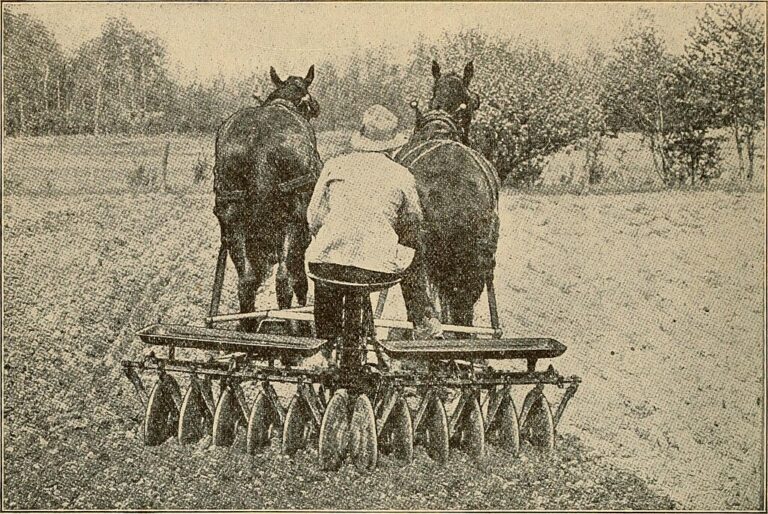
Not long ago, someone asked about the early history of disc harrows.
I’d never thought much about it, but disc harrow blades could hardly have been hammered out of wrought iron on a blacksmith’s anvil, nor could they have been cast from pig iron, the two most popular materials for making parts for early implements. These circular blades had to be sharp enough to cut through trash and soil, which meant they had to be thin. They also had to be tough, so they could withstand hitting rocks in the field, meaning they had to be made from pretty good steel.
In the early 1800s, such tough steel was scarce and expensive. Then about mid-century, the Bessemer process was developed, which made the manufacture of much better grades of steel possible.
In the 1860s, America produced less than 17,000 tons of steel per year. By 1880, after the Bessemer and other processes were developed, U.S. production was ten times that, and continued to grow at an average of over a million tons every year, making steel plentiful and cheap, a factor that made the Industrial Revolution possible and enhanced the fortunes of farm equipment manufacturers as well.
Rolling coulters for plows seem to have been introduced around 1840 and the few early patents I’ve found specify that the blade should be made of “steel saw plate,” or “thin steel.” The dished blades found on disc harrows are tougher to pin down, but seem to have appeared around the end of the Civil War. The earliest patent I’ve found for a disc harrow, or at least a machine with a series of discs side by side on a shaft, is one patented in 1866 by Silas A. Moody of San Francisco, who called it a “sod-cutter.” Moody’s invention consisted of a row of “circular wheels or knives with sharp edges” placed on a horizontal axle. A frame for attaching the pole and a rear platform with a seat for the driver completed the thing. There was no provision for angling the gang of discs, nor were they dished, or concave. Moody made no mention of what material the disc blades should be made, although another inventor who patented a similar machine a year later specified that they be of iron cast on a chill, so as to better to withstand the wear and tear to which they are subjected.”
Frederick Nishwitz from Brooklyn, NY, patented a “revolving harrow” in 1869 that had two heavy beams connected at the front into a V-shape. Under each beam was mounted a row of individual brackets, each supporting a dished disc at its lower end. The angle of the beams was adjustable, as well as the angle of each disc on the beam. Nishwitz’ contraption was probably the forerunner to the modern disc harrow. Again, there is no material specified for the discs.
So, it seems that disc-harrows would have begun to show up on a few American farms in the 1870s, however, like anything new-fangled, conservative farmers would have been slow to accept them. Even into the 1880s, the machines were apparently not in widespread use, as attested to by the following poem that appeared in the January, 1886 issue of Farm Implement News.
HE SAW THE DISK HARROW TRIED
Betsey, I’ve jest been down to Nabor Greene’s,
To see ’em working one of them machines
That’s got a dozen soup plates in a row,
Six on a side — half-twisted they are, so
They scoop the ground in sech a startlin’ way,
That I’m clean settled they have come to stay.
Greene’s boy hitched on thet span of sorrel colts,
And druv the thing over stuns, and holes, and jolts,
And when he struck the corn field on the flat,
He set her all askew, and went for that!
There stood the stubble, thick and tough in rows,
Clear call for plowin’ anybody knows.
It ain’t no use of talkin, for ’twas plain,
That corn field looked jest like ’twas plowed again!
The stubble, roots an’ all, was out of sight,
An’ Greene allowed, for sowin’, ’twas all right,
In which opinion I did full agree,
For ’twas a job all-killin’ slick to see!
That dozen soup plates are a sight to see, I vow!
They do the business of a six-foot plow;
Them colts? — they never sweat a single hair,
An’ six-foot plowin’ seemed right light to bear;
Betsey! I’m clean gone on it, so don’t you doubt
But what I’ll have one — if they ain’t sold out.
When I was a boy, we had a set of McCormick-Deering, six-foot double tractor discs and, although Dad insisted on plowing first, the machine was then usually then run over the plowed soil once or twice to smooth and pulverize it.
Our poetic farmer, who was “clean gone” on “that dozen soup plates” covering six feet width, would be astonished to see today’s disc-harrows which are available with four gangs of as many as 16 discs each, and covering a width of more than thirty-two feet. Of course, it takes a little more that two colts to pull one of these behemoths; for their Sunshine model 1234-32 machine, Agco Corporation recommends 8 to 10 horsepower per foot of width. At 32 feet wide, this is about 300 horsepower! In addition, it will take about 4000 times as much money to buy one.
Sam Moore


