
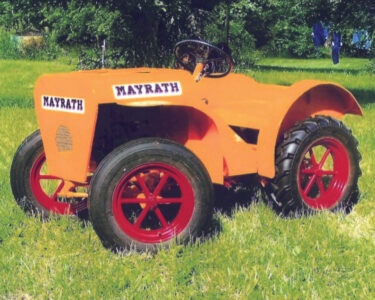
Two of my daughters married Kansas husbands in the first part of the 1980s. In going to visit, I got to know many collectors, accumulators, and junkyards that had piles of interesting parts from old cars, tractors, and whatever.
Along the way, I heard of a tractor made in Dodge City, Kansas, around 1950 called the Mayrath. I didn’t have much interest in it early on, until I heard they were hard to come by. I was told you had to marry the owner’s daughter to get one, and I was already married.
Gene Lahody, collector of Gleaner combines (like me), told me one was advertised in Grass and Grain. I called the fellow selling it to find out about it, and told him I wanted to see it whenever I got out to visit my daughter next. His price was high enough that I didn’t believe it was going anywhere.
I found out that there were many different changes in their history, but only two models. One was a just stripped-down chassis, while the other had a tin body, spring seat, and fenders (that was the one everyone was looking for).
When I got out to see the fellow, I had to wait at his acreage until he got there. There was a penned up dog that acted like if he got out, he’d tear me up and leave only a pile of rags behind.
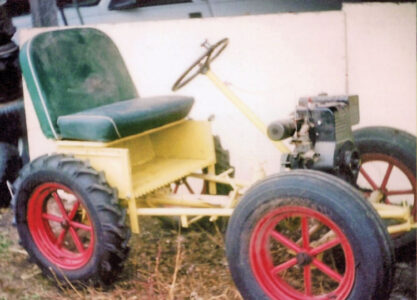
Eventually, the fellow got the Mayrath out, and I looked it over. It was the stripped down model with a school bus seat on it and a Ford Model A transmission in. My new acquaintance offered to start it up, but it hadn’t been run for some time, as the gas tank was dry and had rust in it. I passed on that.
I told him I had to write a check as I did not carry the kind of money he was asking around, and we loaded the Mayrath into the bed of my pickup. I was kind of like that, I had more desire than sense sometimes.
I got the Mayrath to run around, but while running, it would start okay but the engine would get weaker and weaker, like it was short on fuel, then die. I had to drive it so it was uphill from the shed when it died so it was downhill when I pushed it home. I did finally locate the issue on the computer – it was the coil in the ignition.
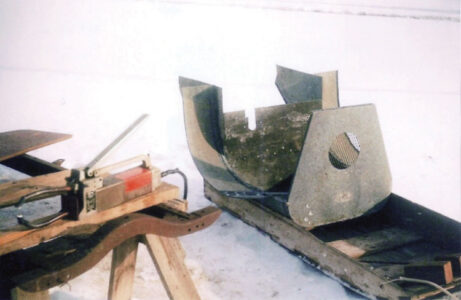
When you looked these tractors over, they looked like the farmer had welded them out of pipe and whatever they had around. I decided, “why not build my own tin body?”
I went to a show in Stockton where I met Art Walkens, who owned the sports model, but he hadn’t brought it to display. He ran a walking floors for trailers factory south of Stockton, which he took me on a tour of. He also set it up that his brother could show me the Mayrath with a body in Bird City so I could get the dimensions. They were a great help to me that day.
Back home, I borrowed a spot welder and cut to size some galvanized tin out of a government bin bottom. While I bolted and spot-welded my shapes together, I darn near burned holes through the tin. But, it made a neat looking rig after I painted it up with some M-M gold.
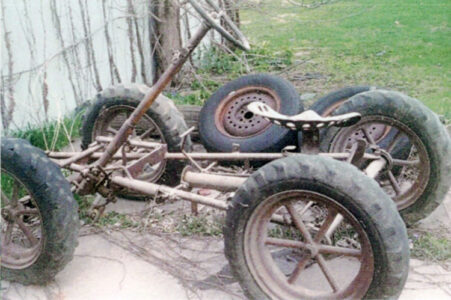
One day, my son told me that a fellow had set out the remains of a Mayrath next to where he worked. I went and looked at it, but it was just the frame with wheels, no engine, and transmission parts in a bucket. The owner didn’t know what he wanted for it. Finally, I offered him about what his dad had paid for it new back in Kansas.
I rounded up an engine, rebuilt the steering column, and found and reworked a transmission. The transmission it came with had only one good gear left in it. I asked the owner what they had done to it, and he told me that I don’t want to know. I put an aftermarket farm hydraulic seat on the Mayrath so I could endure riding it.
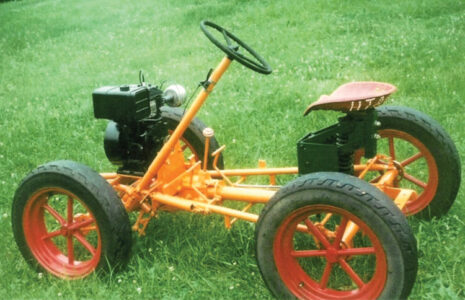
Tires for Mayrath tractors are an odd size. As they were considered riding garden tractors, they came out originally with 5-1/2×16 inch farm-type angle lugs for traction. But the tires happen to be the same as certain Harley-Davidson motorcycle tires (with no lugs). Luckily, I know someone with a motorcycle and a pile of used tires.
I was at the Mt. Pleasant Old Threshers Spring Swap Meet and a cohort told me another vendor has a sign up that listed a Mayrath tractor for sale. I went over to talk to them, and found they were selling two Mayrath tractors for their mother. Their father had bought them in Kansas, but his health had given out and he had passed. The tractors were located just across the Mississippi River from Fort Madison. I arranged to see them while my wife was on a trip.
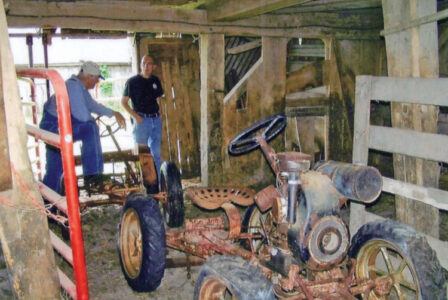
When I got over to see the Mayraths, there were two, as advertised, but they were in considerable disrepair. However, they did roll and came with plow, disk, and blade attachments. As there was little bargaining the price, I wrote them a check.
I just had my pickup, so I could only haul one. They said they’d deliver the other one, as the lady of the house said that she like to visit the stores in Kalona, Iowa. So, that worked out well.
Both Mayraths were stripped down models, but one had an easy ride seat and rear fenders. I rounded up the right era engines, did straightening, welding, rebolting, and cleaining to get them somewhat back to their original shape. All of my models have the tip engine clutch and Ross steering. The brakes on these are quite feeble.
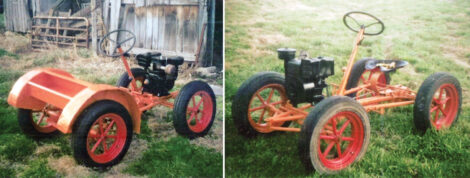
One of this Mayrath pair had good tires. The other one, I believe, sat beside some fertilizer that had rusted holes at the end of the wheel pipe spokes. I later found out that early Mayrath augers had the same type of wheels, six spokes or 3 spokes, that the company welded together themselves. This one ended up with 5-1/2×16 inch used motorcycle tires.
In one of my Kansas daughter’s neighbor’s back lot of machinery, there were surviving parts from two Mayrath tractors. One the neighbor and his brother had reworked for speed in their youth. He also mentioned seeing Mayrath himself demonstrating the Mayrath tractors.
Another time, I talked to a fellow in Dodge City who had worked at Mayrath. I asked him where the factory was, and he told me it was on Santa Fe Street. I learned a lot about Mayrath from him that day.


