
When the tractor testing program began at the
University of Nebraska at Lincoln in 1920, about 160 companies were
building tractors in the United States. That first year, 69
machines were tested, a figure that hasn’t been matched since. The
1920 tests included such names as Allwork, Coleman, Dart,
Emerson-Brantingham, Frick, Gray, Heider, LaCrosse (the only
“line-drive” tractor ever tested), Monarch, Parrett, Samson, Square
Turn, Townsend, Uncle Sam and Wisconsin, as well as more familiar
marques of Case, Fordson, Huber, International and Rumely.

Any manufacturer who wanted a tractor tested at Nebraska had to
make application, pay a $500 fee, and wait until the test could be
scheduled before shipping the machine to the university. Upon
arrival of the equipment, a representative of the manufacturer
unloaded the tractor, made sure it was running its best and then
operated the machine during the “limber-up” run.
A UNL testing engineer then took charge of the tractor and
belted it to a dynamometer. After warm-up, several tests were made,
including a 100 percent maximum test, an operating maximum test, a
rated load test, and a varying load test, all on the belt. In 1959,
with the proliferation of PTO-driven implements and the demise of
belt-driven machines, the belt tests were discontinued and a series
of three PTO tests was implemented. During all these tests,
horsepower output, fuel, oil and water consumption, and operating
temperatures were closely monitored and recorded.

After the belt or PTO tests were concluded, the tractor was
taken to the test track, which was dirt until 1959, when it was
paved with concrete. The tractor was hitched to the test car,
hitched behind (if necessary) additional heavy tractors to increase
the load. The first test was the 100 percent maximum drawbar test,
which was made in the rated (or plow) gear. Next was the operating
maximum test, which measured the maximum horsepower the tractor
developed in each forward gear. Finally, a 10-hour rated load test
was run at 75 percent of the maximum load pulled in the earlier
test.
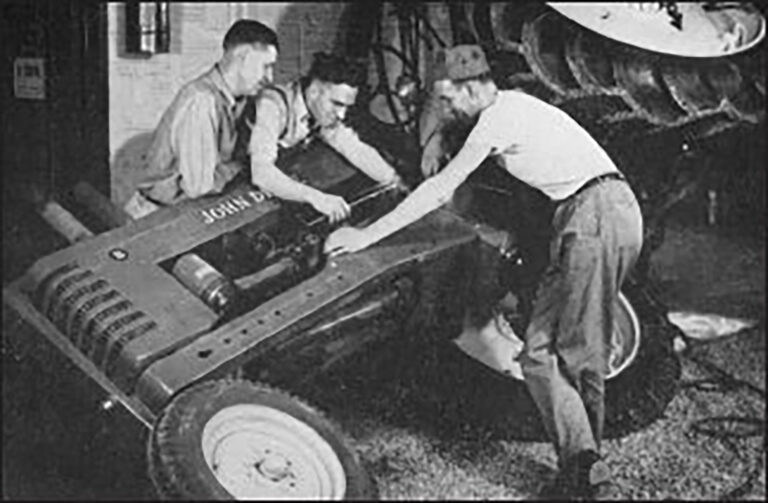
After the tests, each tractor was taken apart to make sure every
part matched specifications. Cylinder displacement was checked by
removing the head and pouring a measured amount of liquid into the
cylinder. This was a simple process on a vertical engine, but
consider a different scenario: In a 1941 photo of a John Deere
Model B with a horizontal engine, the front has been hoisted into
the air until the tractor is standing upright on its drawbar, while
technicians pour liquid into its cylinders. A later photo shows a
Model B lying on its side, while the liquid is poured through the
spark plug hole.

Occasionally, an irregularity was discovered during this
process. One episode involved a tractor that was found to have
polished intake parts. The tractor was rejected and the company had
to submit a second tractor and pay an additional test fee.
During the late 1920s, the Adams test car, with an open top and
rubber tires on wooden-spoke wheels, replaced the old Illinois
tractor test vehicle. The new car had better test equipment and
pulled a ground-driven air compressor to provide a load for small
tractors. Larger tractors still required the addition of heavy
steam or gas tractors to add to the load. In 1940, the test car was
again upgraded with a streamlined, closed cab model that was first
used to test the new Ford-Ferguson 9N tractor.
Testing was discontinued at the end of 1941, as no new tractor
models were made during the war, and wasn’t resumed until late
1946, when an Ellinwood Bear Cat garden tractor (which put out 1.33
drawbar horsepower) was tested. A number of garden tractors were
tested over the years, but the smallest was a Choremaster “B” in
1950. The little, single-wheeled machine weighed 123 pounds, put
out 0.62 drawbar horsepower and pulled 89 pounds.

On the other hand, some huge tractors were tested at Nebraska.
Long-time Test Lab Director Lester Larsen tells of the arrival of
an Allis-Chalmers HD-19, the heaviest tractor to date. Normally,
the tractor being tested was hitched to the front of the test car
and the load was hitched to the rear of the car. Larsen estimated
they would need a load consisting of a pair of big Cletrac
crawlers, followed by a smaller Cletrac and a Massey-Harris 55, and
then a 6-cylinder Oliver and a Case D. He figured such a load might
pull the test car in two, so they rigged up a lever arrangement
that allowed the HD to pull only a percentage of what it was
capable of, and then calculated the maximum pull from that
percentage.
In 1963, the old test car cab was mounted on the chassis of an
1800 Oliver tractor, making a much stronger and more sophisticated
test vehicle. This configuration was used until 2003, when a new
mobile test lab was built by Caterpillar in Peoria, Ill. The new
test vehicle can handle today’s powerful tractors and is loaded
with computerized test equipment to accelerate the testing
process.
Through 2001, Nebraska has tested a total of 1,797 tractors,
including a Dodge Power Wagon, a Land Rover, a Daimler-Benz Unimog,
and a couple of Jeeps. Garden tractors are no longer tested, as the
minimum for testing is now 40 hp. The lab tests 10 to 20 tractors
per year, with each test taking about a week to complete.
Two bills introduced in the Nebraska Legislature in 2003 would
have eliminated the UNL tractor testing program. Proponents of the
bills contended that the tractor industry had changed dramatically
since 1920, and that today’s truth-in-advertising laws would keep
manufacturers in line. Tractor manufacturers supported the measure,
as lab fees are around $24,000 per tractor and the permit costs
$50. In addition, the manufacturer must pay the cost of shipping
tractors to UNL and pay a company engineer or two to be on site
during the tests. However, as of April 15, 2004, after much
lobbying on both sides by interested parties, the proposed
legislation is dead for the time being and tractor testing will
continue as it has for 85 years.
For more information: The Nebraska Tractor Test Laboratory
and the Lester F. Larsen Tractor Test & Power Museum are
located on the East Campus of the University of Nebraska at
Lincoln.
From I-80 East, take exit 409 (Waverly), turn left on
Highway 6 (Cornhusker Highway) and go west about 5 miles to 33rd
Street. Turn left and go 4-5 blocks south before turning left on
East Campus Loop. Enter the second driveway on the right.
From I-80 West, take exit 403 (North 27th St.). Go south on
27th Street about 2.5 miles and turn left on Cornhusker Highway. Go
6 blocks east to 33rd Street and turn right. Go 4-5 blocks south,
turn left on East Campus Loop and enter second driveway on the
right.


