
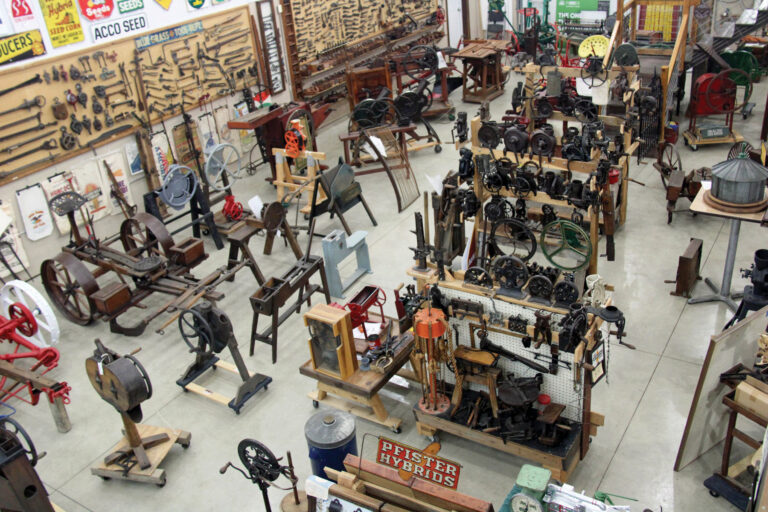
People collect for various reasons. Some are motivated by nostalgia, longing for the past or desiring keepsakes. Still others are intrigued – with a sense of wanting to know more about old items, such as how they were once used. However, the common denominator for most collectors is the hunt for that next great gem.
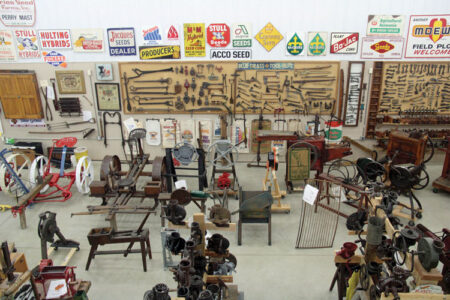
Although Joe Isler has a large assortment of rare iron from yesteryear, he has a special interest. “I’ve always been intrigued by old farm equipment and how it worked. In addition, I marvel at the progression of machinery to our modern day farming.
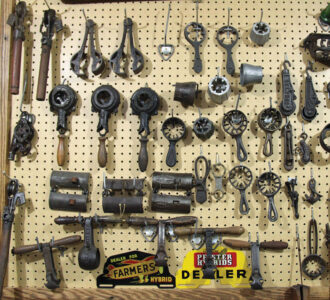
“I’m especially fascinated with old corn shellers, both handheld and those with cranks. My dad said, ‘If you had to use those things, you wouldn’t be collecting them.’ But I got hooked and now, they’re all around me,” he says.
Corn Shellers
When settlers arrived in North America in the early 1600s, Indigenous peoples introduced them to maize (corn) and showed them how to plant, harvest, and prepare it. Those techniques helped many early settlements survive and influenced the way corn was grown and used for generations.
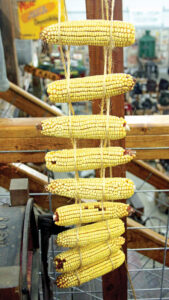
For the next two centuries, nearly every step of growing and processing corn was done by hand. Families shelled corn for food, livestock feed, and seed, while women prepared it in many forms, including fresh, parched, and processed into hominy. It was slow, repetitive work that often left hands sore and blistered.
Small hand-held corn shellers eventually made the job easier. A farm wife might slip one into her apron pocket before heading out to feed the chickens, shelling a few ears along the way. Children often used them to shell popcorn, and farmers relied on them to prepare seed corn for the next year’s crop. Because hand shellers were gentler than larger mechanical machines, they were less likely to crack kernels or damage the seed coat, helping ensure good germination.
The hand-crank corn sheller was a vast improvement over the handheld sheller. Lester E. Denison of Middlesex County, Connecticut, is credited with inventing the first hand-crank sheller in 1839. The action of the hand-crank causes the ear to be pulled between two metal toothed wheels spinning in opposite directions. By this action, the kernels are pulled from the cob and fall into a bucket below the device.
Sheller Assemblage
Joe’s corn shellers cover a wide range of types and brands. The assemblage includes 25 hand-held corn shellers, 40 box-mounted versions, 15 floor models, and 15 corn scrubbers. Details about several are highlighted.
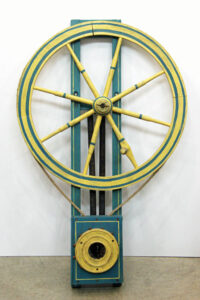
Rufus Porter Corn Sheller: The sheller was designed to be attached to a post. The 48-inch tall mechanism was operated by a 30-inch diameter wheel. The ear of corn entered through an opening in a lower box and was rotated by the upper wheel to separate the kernels. An inventor of countless devices, Porter received the sheller patent on September 12, 1838.
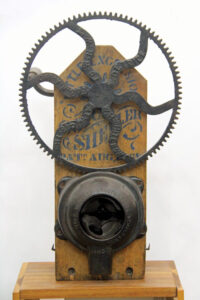
Little Excelsior Bench Sheller: This vintage hand-operated bench corn sheller is often identified as a Whiterow Tuley Mfg. product. They were designed to be mounted on a bench or table for convenience of operation. The sheller was commonly used in the late 19th and early 20th century for livestock feed or small-scale farming. Joe’s Little Excelsior carries a date of August 18, 1868.
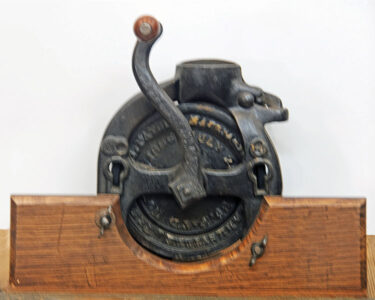
Black Hawk Corn Sheller: A.H. Patch of Clarksville, Tennessee, is credited as the father of the Black Hawk equipment. Research shows one mill and seven corn sheller patents issued to him from 1871 through 1908. Patch operated the Patch Foundry until 1954, after nearly 70 years of worldwide success. The popcorn sheller version in Joe’s collection carries a patent date of November 23, 1886.
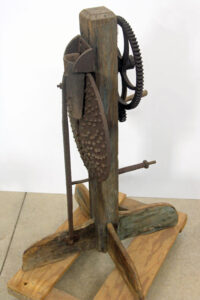
Dickinson Corn Sheller: A somewhat cumbersome sheller, the Dickinson measures 42 inches by 47 inches. However, the efficient device can be operated and moved easily by one person. The recorded patent date on Joe’s sheller is September 6, 1853.
Peck Corn Sheller: The Peck sheller, considered the granddaddy of corn shellers, features a flywheel with shelling ribs and spiked bats that rotates the ear of corn to separate the kernels. The builder was Lemuel Peck of Brookfield, Connecticut, with a patent date of April 9, 1824.
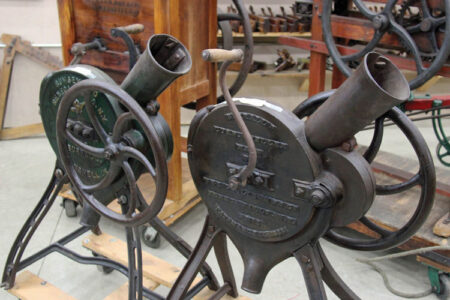
Rumsey Corn Seller: Rumsey manufactured shellers based on the Burrall patent, similar to those made by Goulds Mfg. Co. They’re often referred to as Burrall Cast Iron Corn Shellers by Rumsey & Co. A pair of these rare shellers on display in the Isler Farm Museum consists of both a right- and left-hand version.
Additional Collector Iron
Story space limits details about Joe Isler’s extensive rare iron collection. However, there are three special items worth mentioning.
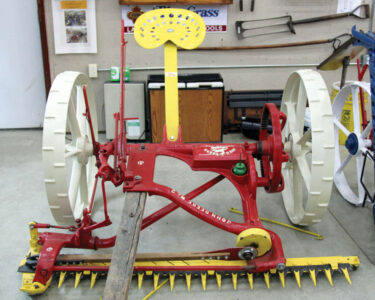
John Deere Hay Mower: A very rare collector piece is the John Deere Model No. 2 sickle-bar hay mower. Developed in the 1890s, the horse-drawn mower was put into production in 1911. It was considered a key piece of John Deere’s early hay tool history.
A unique feature of this museum piece is the reconfiguration for vineyard use, operated from a seat. And the distinct colors of red, white, and yellow for John Deere make it even more rare.
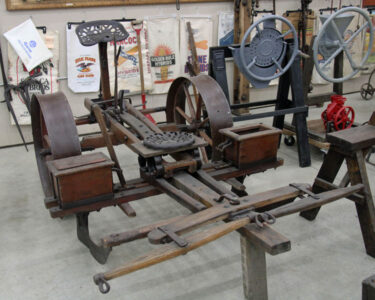
Beedle & Kelly Cross-check Planter: There was a time when everyone drilled their corn in 42-inch rows. The horse that drew the planter was typically 42 inches wide. When cultivating, the horse had to fit between the rows, consequently 42-inch rows.
Farmers in the Corn Belt felt it necessary to cross-cultivate. To accommodate this practice, seed corn was dropped every 42 inches or cross-checked. Early planters had a second seat for an operator to trip the dropping mechanism each time the planter shoes came to correctly spaced lines marked across the field.
Joe’s two-row, hand-check planter is a rare specimen. The horse-drawn, two seat, cross-check corn planter was built by Beedle & Kelly of Troy, Ohio.
Antique Tractors: Joe has a nice collection of antique tractors, several of which have been restored for museum viewing. Watch for coverage of these in a future story.
Farm Heritage
Joe and his wife, Connie, are dedicated fourth-generation farmers in central Ohio. They currently farm 4,500 acres with two sons, Jason and Nate, along with two grandchildren. Their crops include corn, soybeans, and wheat. The sons also have a 2,100 head feeder pig enterprise.
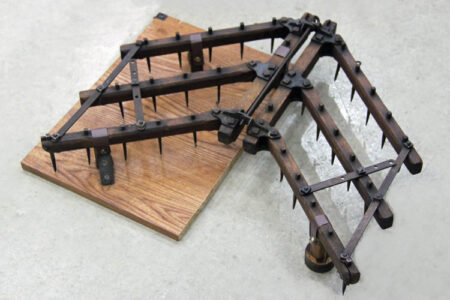
Like with many collectors, display space becomes an issue. As a result, the family constructed a 40-by-60-foot building with a loft to house the collection. It’s heated, well lit, and maintained like a professional museum. When visiting, you’re accompanied by family members who are well-versed about the vast assemblage.
Joe is an active member in the Corn Items Collectors Association and the Ohio Tool Collectors Association. He has exhibited numerous times at their events and served as host at the Isler Farm Museum.
Joe Isler’s Quest
Joe shared his collector quest, “I’m always on the lookout for anything unique. It may be at flea markets, auctions, eBay, or private treaty. I really enjoy the opportunity to wheel and deal when I find something.
“I met a fellow who said he bought many items for $5 and then admitted they were the same value today. My advice: Most cheap items never gain in value.”
The enjoyment of collecting goes far and deep. “I’ve met lots of interesting people through my collector hobby. These connections have helped [me] gain knowledge as to what is collectible. We’re grateful that many of the relationships have become lasting friends.” Joe concludes.
For those interested in learning more about Joe Isler’s old iron of yesteryear, he welcomes your visit or call during the evening at phone: 740-251-8177. FC
Freelance writer Fred Hendricks of Mansfield, Ohio, covers a vast array of interesting subjects. Contact him at fwhendricks@gmail.com


