
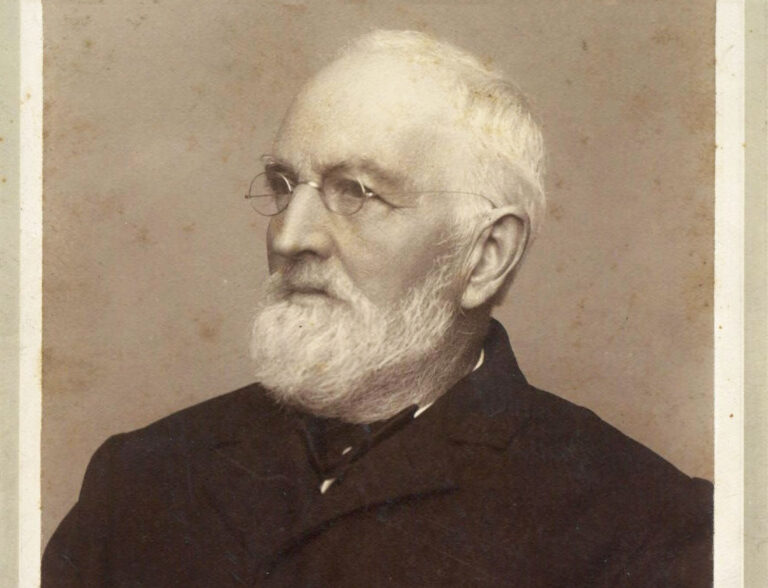
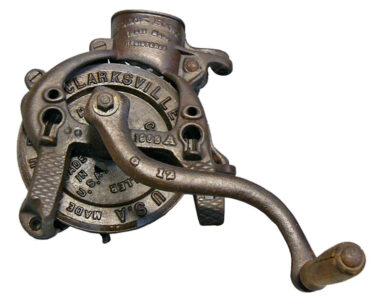
“Persevere, persevere, persevere.” Those words summarize the philosophy A.H. Patch adopted early in life and what likely led to his invention of the Black Hawk corn sheller, a hand-held implement that found an enthusiastic market worldwide.
Asahel Huntington Patch was born in Hamilton, Massachusetts, on Nov. 11, 1825. He was the first of nine surviving children of Capt. Daniel and Lisabeth Gould Patch, Puritans who named their son after a kindly minister of the Congregational Church (a Puritan offshoot), Asahel Huntington. Patch would come to be known as A.H. Patch.
Asahel’s great-grandson, Elwyn Patch of Clarksville, Tennessee, never knew his great-grandfather personally, but a speech that Asahel gave at a 1940s local Rotary Club meeting came to the attention of Elwyn’s late wife, Rubye, who shared those comments through the Montgomery County Historical Society website.
“She wrote nearly word-for-word what A.H. said at that meeting,” Elwyn says. “She always had a passion for history. As a child, she grew up about 14 miles outside of Clarksville. One of her chores on the farm was taking care of the chickens, shelling corn for them. She was fascinated by how the Black Hawk sheller worked, and once she found out I was related to A.H., it gave me a real advantage in our courtship.”
“Diligence, energy and punctuality”
Rubye’s essay notes that A.H. descended “from a long line of tenacious and determined hard-working Puritans.” On his parents’ coastal farm, A.H. “was charged with feeding the poultry – chickens, geese, and ducks. Shelling with his toughened, infantile fingers those hard, flinty New England ears, Asahel daydreamed he would invent, one day, a portable corn sheller so efficient it could shell corn with ease and so inexpensive every small farmer could afford it.”
As with most dreams, his road to success took many twists and turns before the vision was fully realized. In the early 1840s when he was yet a teen, Rubye reports, “Asahel struck out on his own. He walked to Boston some 30 miles south where he put himself in the employ of a grocer, perhaps a relative.” During the day, Asahel would deliver groceries in a pushcart. In the evening, he was to sweep out the store, and finally at nightfall, he was to “sleep under the counter so he could rise early the next morning to get a fresh start.”
Asahel’s “diligence, energy and punctuality” caught the eye of a particular customer, Oliver Ames, who resided in Easton, south of Boston and held a sales office in Boston’s Quincy Market. Ames “shipped every farm implement imaginable, all made in his nearby factories: hoes, shovels, rakes, large corn shellers, and eventually, plows.”
Ames negotiated a deal to “apprentice the ‘boy’ in his Worcester factory for three years for the sum of $60 per year plus room and board.” Asahel agreed to the terms and within three years became factory superintendent.
Forging a new course
When the slogan “Go West” swept through the nation, Asahel was captivated by what seemed limitless opportunities. He traveled as far as “Pittsburgh by rail, then down the Ohio to Louisville. With employers’ recommendations in his pocket, Patch was hired by Miller & Wingate, then a large seed and implement company near the river.” Asahel convinced these business owners of the need to develop a grass and grain-cutting machine, the Kentucky Harvester, a forerunner of today’s combines.
By age 32, Asahel married Sarah Marsh. One year later, their daughter, Fanny, was born. She would be joined by brother George, sister Mary and brother Benjamin.
The onset of the Civil War in 1861 led to the close of the harvester business, but, in 1865, Asahel and young industrialist Benjamin Avery launched a plow company. The business flourished and after three years Asahel retired. According to Rubye’s account, Avery had a statement of business made out and asked Patch to name a satisfactory sum of settlement. The amount named by Patch was rejected on the grounds that it was “Entirely too little.” He in turn suggested a sum which Patch firmly refused on the grounds that it was “too much.” The two close friends and business associates were deadlocked for weeks. A settlement was only reached when they had a third party mediate.
Missteps lead to failure
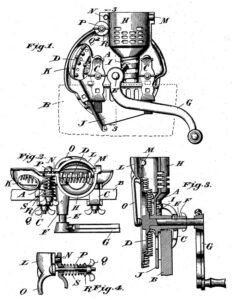
The 1870 Hamilton, Massachusetts, Essex County census shows Asahel as a farmer. “No doubt, happily,” Rubye wrote. In a relaxed atmosphere, he tinkered with, produced and patented (in 1872) his first post-mounted corn sheller. Nothing more is known of this model although it was featured in an 1872 issue of Scientific American.
But trouble loomed on the horizon. Both Rubye and the Montgomery County, Tennessee, family history book note that, at this point in his life, Asahel made some financial missteps with his invention.
“On the verge of becoming a renowned inventor, Asahel unfortunately and uncharacteristically made not one but several unwise investments,” Rubye wrote. “Among them was a frivolous but final bid on ‘the most beautiful country estate in the whole of New England.’ His carefree retirement suddenly ballooned into a daily struggle to pay bills, even small ones. He had to go back to work.”
In 1875, Asahel happened onto a plow factory in the northern Tennessee town of Clarksville. William Douglas Meriwether of Woodstock owned the company. The two formed a partnership, Meriwether & Patch Plow Co.
“The firm had no ups and downs, only downs,” Rubye wrote. “Even if war-impoverished Montgomery County farmers could have afforded a new plow, they wouldn’t have bought it from Asahel, a Yankee.”
“To Southerners, A.H. was just one more Yankee, and he and other Yankee businessmen were isolated in the community,” Elwyn says. “When that plow company failed (after 10 lean years of struggle), A.H. went back North for a time. Whatever business he engaged in there didn’t go well either. So he returned to Clarksville, completely broke.”
Gaining support for a newfangled design
Now 60, Asahel took a seat at his kitchen table. In spite of all the business experiences he’d had up to that point, the seed of his initial childhood dream must have begun to surface in his thoughts once again.
“He must have been thinking, ‘I’ll make me a corn sheller,'” Rubye wrote. “With faith, skill, patience and a pocketknife, Asahel meticulously whittled small pieces of kindling wood snatched from behind the cook stove, sticking them together with beeswax from the honey jar. Sarah, upon noticing all these wood shavings on and under her table, must have exclaimed, ‘Get out of my kitchen!'”
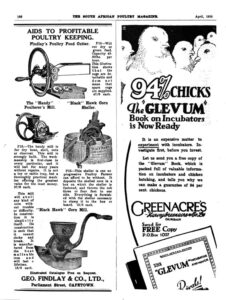
Pursuing his work in the coal shed behind the house, Asahel toiled until his wooden model was ready to be cast in iron at Whitfield-Bates’ Foundry, which voluntarily offered him credit. A former employee, Mack Dix, worked with Asahel whether or not he could be paid, and teenage Benjamin Patch was the errand boy. Benjamin peddled the experimental sheller up and down Public Square, first to Henry Fretch’s store and then to Fox & Smith Hardware.
“Fretch, rather gruff and austere, but with kind impulses and few words, merely asked in one breath, ‘How much does the old man say they’re worth? Take a dozen.’ Knowing the ‘old man’ probably needed cash, Fretch, taking his cigar out of his mouth, called after the boy, ‘I’ll pay now.'”
In his excitement at Fox & Smith Hardware, Benjamin tightened a main bolt on the sheller so aggressively that the sheller broke in half. “Smith, coughing up tobacco juice he had swallowed during the excitement, garbled, ‘Boy, go home and tell the ‘old man’ that if he can make a sheller strong enough to show a few customers, I’ll buy a dozen.'”
Star of the 1893 Columbian Exposition
The experience led Asahel to build a sheller “so strong that if any part breaks or wears out, I will replace it free,” which became the Black Hawk’s guarantee and slogan. As sales soared and the sheller’s popularity grew around the globe, A.H. established his own foundry in Clarksville.
“When I was a child, my grandfather was running the foundry,” Elwyn says. “I remember it as a fascinating place to be. Sometime in the 1940s, Grandfather sold the foundry and the new owners manufactured the Black Hawk sheller until about 1955. When I was growing up, I saw Black Hawk corn shellers at just about every flea market or second-hand sale I went to. They usually sold for $20 or $25. They were plentiful then, but are more scarce now. Today a Black Hawk sheller will bring about $70.”
In an 1887 issue of Farm Implement News, an ad boasts that “This (the Black Hawk sheller) is one of the best of the moderate-price hand shellers now on the market. It costs at retail only $3, which brings it within the reach of the smallest farmers, gardeners and poultry raisers.”
In 1893, the Black Hawk corn sheller won the First Industrial Award at the World’s Columbian Exposition in Chicago. It also went on to win a bronze medal at the 1904 St. Louis Exposition.
“The only complaint was that ‘it don’t pick out the rotten kernels’ and dealers said it never wore out,” Rubye noted. Occasionally, replacement parts were shipped to dealers, and Asahel always paid freight charges.
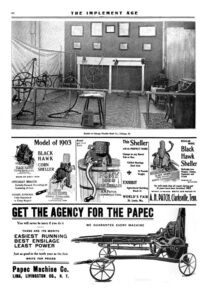
In a 1906 hardware industry publication, an article focused on A.H. Patch, manufacturer of the Black Hawk corn sheller in production since the 1880s when the patent was first obtained. “It has for years been recognized as the standard of excellence for hand corn shellers. Its capacity of from eight to 14 bushels per hour is large enough for all home use. The 1903 model can be clamped to barrel or tub as well as to a box or bin.” The “Pony” corn sheller has a long steel axle with chilled bearing, which makes it very durable and easy to turn. “It is strongly recommended to those who desire a machine lower in price than the Black Hawk, as a first class sheller by the manufacturer who guarantees it for good and satisfactory work.”
In its day, the Black Hawk sheller was sold in every country where corn is grown: Russia, Italy, France, Hungary, Brazil, Egypt, Australia, South Africa, Turkey, Argentina, China, India, Siberia, and Persia, as well as every southern state in the U.S.
A progressive employer
According to Rubye’s essay, Asahel kept no time clock. “On Saturdays, employees simply reported to A.H. their number of hours worked that week. And if business slowed, A.H., rather than laying off his force, hired them to make repairs, new construction, alterations. These talented men took a great deal of interest in beautifying the grounds of the factory, building a tennis court and planting an orchard.
“So, as a white-bearded old man, A.H. Patch’s boyhood dream had come to fruition,” Rubye observed. “Having worked a full day at the foundry and dying suddenly after having consumed a whole mincemeat pie for supper on Jan. 29, 1909, A.H. was finally respected and esteemed by all who knew him. Listed among his pallbearers is every prominent (and southern) Clarksville businessman’s name.”
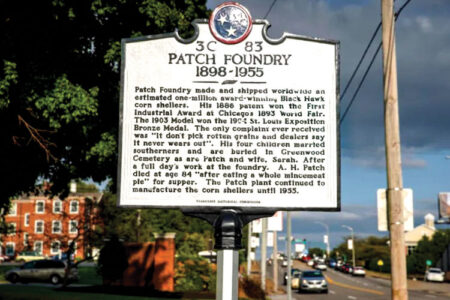
Members of Asahel’s family still reside in Clarksville and advocate for his story to be told. Before she passed away in 2019, Rubye worked to establish a historical marker in the former location of the Patch Foundry, which is now the location of Austin Peay State University. Following Rubye’s death, her youngest daughter, Elizabeth, completed the process. The marker was installed in 2020 and stands at the site where the foundry was established in Clarksville.
A Black Hawk sheller is on permanent display in the “Becoming Clarksville” exhibit inside the Customs House Museum and Cultural Center’s Heritage Hall in Clarksville.
Asahel also produced a grist mill, which was described in one of his ads as “cheaper, better, more convenient than the miller. Make your own cornmeal, hominy, flour (graham, buckwheat or rice) and breakfast foods. Grind grain for poultry. Fast and easy grinding – good work for a lifetime,” a phrase that underscored the commitment to quality Patch demonstrated throughout his career. FC
Loretta Sorensen is a lifelong resident of southeast South Dakota. She and her husband farm with Belgian draft horses and collect vintage farm equipment. Email her at sorensenlms@gmail.com.


