
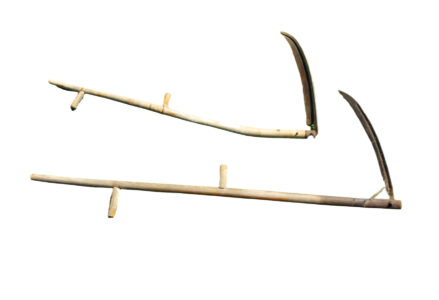
This time, I’ve decided to talk about some of the tools, implements, and artifacts of Britain’s rural past. The people who once used these everyday items are becoming fewer in number, and indeed, many have long since passed away. I feel it’s important to keep the stories of these artifacts, and how they were used, as alive as I can. It makes me wonder, too, if any of these items, or similar ones, found use in the U.S.
I think people tend to treasure things more if they’re worth money. It seems to be human nature to judge the importance of a thing by its financial worth. No one allows an expensive work of art to rot away in the rain, but plenty will allow an old farming tool to decay, as these items often lack any real monetary value. But, these items are a valuable in another way. They’re important relics of our rural and industrial history, and I’m always glad when I see people preserving them.
The strickle
One of the most humble looking of farming tools was the strickle, or “stric,” as it was called in the Welsh language. The strickle is little more than a shaped block of wood, but it had a very important purpose, it was used (in conjunction with sand and grease) to sharpen the scythes that were employed to cut hay and grain crops in the time before mechanization.
If you lived in a region where there wasn’t a ready supply of stone suitable for sharpening metal, then putting an edge on your scythe blade while working out in the fields could be something of a problem. Grindstones for peening and sharpening would’ve been available at the local blacksmith’s yard, or “Smithy,” but because scythe blades had to be sharpened at regular intervals whilst mowing, some form of light, portable sharpening tool was essential.
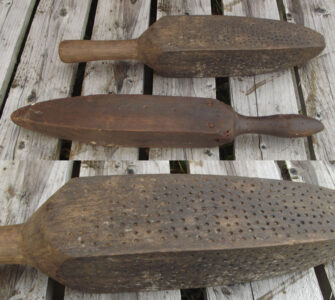
Strickles are something that we might find these days in a curiosity shop, or on a shelf in a dusty old cowshed. An item that someone might question the purpose of, these four-sided wooden devices look more like a type of doorstop than an agricultural tool.
But, at one time, the strickle was a commonplace item. It was quick, easy, and affordable to make, and no farm laborer would’ve been without one. Before the advent of the mowing machine, huge numbers of people were employed in the harvesting of hay and grain crops, which meant that there were once vast numbers of scythes, and strickles with which to sharpen them. Now, however, many stickles have rotted away or been thrown on the bonfire by people who didn’t know what they are, so those that remain are now interesting collectibles.
The strickle was often made of green oak or lime wood, and after shaping it, the maker would punch little indentations into the four flat sides of the tool. When ready for use, the sides of the strickle would be coated with a sticky substance, such as animal fat, resin, or soap, and covered with sand. The combination of the indentations and the fat would keep the sand fixed onto the tool and allow it to be used in a similar way to a whetstone. Coarser and finer sands could be used on the different faces of the strickle, and the size of the indentations might vary in size allowing for finer and coarser sanding.
In a time when nothing on the farm was wasted, animal fat was a common form of grease. This useful substance could be used around the farm for lubrication, waterproofing, and as a base to mix with many other substances. Fat would often be stored in a hollowed out cattle horn, with the wide end corked with a piece of wood, and when fitted with a strap, these horns made useful portable containers. A horn purposely designed for scything work was known as a strickle horn, and these horns could be divided into two, with sand stored in the narrow end, and fat stored in the wide end.
The tools of the trade for anyone mowing crops were therefore a good scythe of the right length, a strickle, and a strickle horn, which would be hung over the farm laborer’s shoulder on a strap. These horns were variously known as grease horns, sand horns, and strickle horns, and their use as containers continued into the time of mechanization. Carrying grease out to the field remained essential for a long time, right up until the advent of the grease gun.
I wonder if you had strickles in the U.S., and what name you used for them.
Potato history
The potato was brought to the British Isles in the 16th century, and it went on to become a staple food here, especially amongst the poor. Ireland was so reliant on potatoes as a food crop that, when several of their potato harvests failed in succession, the result was a famine, which lasted from 1845 to 1852. The Irish potato famine became a defining period in Irish history, resulting in the death of over a million people.
It’s estimated that some two million people left Ireland to escape the famine, with most traveling to America, on what have become known as “coffin ships,” due to the large numbers of people who died on these treacherous voyages. Often, the passengers on board these coffin ships were weakened from hunger before embarking on the journey, and the voyage itself was hazardous, because not only was there rough weather to contend with, but also disease, largely due to overcrowding and poor conditions onboard the ships.
An increase in imported food and new blight-resistant varieties of potato combined to bring a halt to the famine, but potatoes continued to be a staple food on the British Isles. At one time, every farm, large or small, would’ve grown a crop of potatoes. The popularity of potatoes means that there are numerous farming relics that were designed to assist with their harvest, and a collector could easily fill a large outbuilding with potato-related implements, should he or she chose to do so.
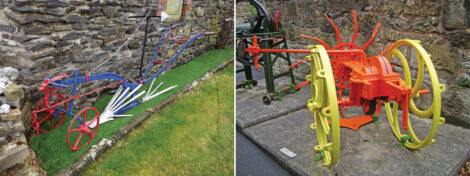
Potatoes were such an important crop that engineers and inventors of agricultural implements have long been in competition over who could make the best implement for lifting them out of the ground. There were simple horse-drawn potato diggers that followed the design of a horse-drawn ridge plow, but farmers and manufacturers were keen to make bigger and better machines.
The Powell brothers were one of Wales’ leading manufacturers, and the item that gave Powell Bros. their real fame was their potato digger. In 1887, this horse-drawn digger underwent trials at Stephen Fairburn’s farm in Gosford, England, and was awarded first prize. This award gave Powell greater recognition, and for the next 30 years, 40 or 50 of these machines were produced every week. Powell was by no means unique, for numerous companies were making potato diggers, and many are still lurking under hedges and in forgotten corners of farmyards today.
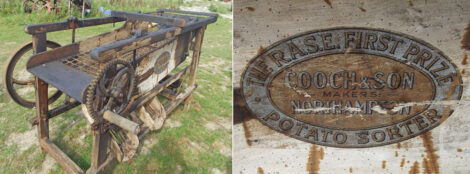
Potato sorters, however, are mostly made from wood, so many of these have perished. Potato sorters (sometimes known as “potato riddlers”) were designed to clean soil or stones from the harvested potatoes. They also separated the potatoes into various sizes. Small riddlers would be operated by hand, and larger one powered by an engine. Once sorted, the small potatoes were often fed to pigs, and the larger potatoes were placed in sacks and stored for human food.
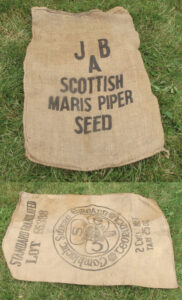
The sacks used to store potatoes, and many other types of produce, were of course hessian sacks. Hessian sacks are another example of an item that was at one time a commonplace sight, but are fast becoming a rarity. Hessian sacks are sometimes known as “gunny sacks,” and, in the U.S. and Canada, they’re called burlap sacks. Traditionally used to carry and store farm products such as grain and potatoes, these sacks are often associated with older farming methods, and they hark back to a simpler time when everything was sustainable and reusable.
Old grain, seed, or potato sacks were never thrown away. Instead, they might be used as a breathable cover to go over the haunches of a damp horse when it came into the stable wet from rain or sweat, and sacks would often be worn by farmers themselves, who would throw one over their shoulders to protect their coats from the rain on wet days. It was quicker and easier to dry a hessian sack than to dry a wet coat, so sacks were useful for an extra layer of protection from the weather.
Today, old hessian sacks are collectable items in their own right. Those who exhibit old carts and trailers in shows like to collect traditional sacks in order to fill them with straw so they can adorn their cart with a period-looking lightweight load. Many old hessian sacks display the names of grain, food, and potato companies, many of which are historic, making them more collectable, particularly to those who live in the region where the product was made.
The seed barrow
Most in danger of rotting away are our wooden farming relics. One wooden implement that was once commonplace and is now rarely seen is the seed barrow.
The seed barrow (sometimes referred to as “the Shandy Barrow”) was a popular and useful labor-saving device based on a simple timber-framed wheelbarrow. The wide seed hopper had a gear within that was driven by the turning of the barrow’s wheel. Within the barrow’s long hopper, a rotating line of circular brushes dispensed the seed through the holes in the underside of the hopper.
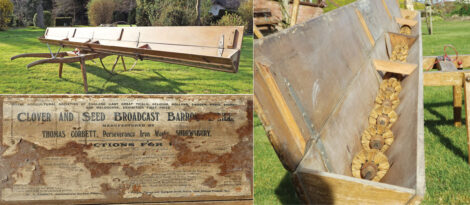
The seed barrow enabled seed to be broadcast in multiple straight rows, vastly reducing the distance that the person sowing had to walk, and allowing for a far more even distribution of seed. The width of the hopper on seed barrows varies, though many are 10 or 12 feet wide. The wider hoppers allow for faster sowing, but they could be difficult to negotiate on uneven ground.
The seed barrow pictured here was made by Thomas Corbett, founder of the grand-sounding Perseverance Ironworks, in Shrewsbury, England. Thomas Corbett was born in 1846, founded his ironworks in 1864, and went on to design and build many different award-winning examples of agricultural machinery and implements, including plows, seed drills, winnowers, chaff cutters, grinding mills, harrows, hoes, and cheese presses. Corbett’s machinery and implements won almost 1,000 awards and medals, and they were exported all over the world. I wonder if there are any in the U.S.
Relics that have stood the test of time
The mixed farms of the past were remarkably self-sufficient and grew almost all of the fodder required by the farm’s livestock on-site. However, this level of self-sufficiency was extremely labor intensive, and large numbers of people were employed, with much time spent dealing with seemingly simple, everyday tasks like preparing animal fodder.
Crops like swedes, mangolds, and turnips were grown to feed to cattle, pigs, and sheep, but they had to be sliced before feeding. This was a slow process, so during the Victorian period, root-cutting machines began to appear on the market. These machines were designed to speed up the job of slicing the roots, freeing up farm laborers so they could spend time doing other work, such as cultivating and harvesting crops. Though rather physically demanding to use, these so-called “labor saving devices” required no training, and it was a simple case of load up the hopper and turn the handle. This meant that root cutters could be powered by women and children, who were paid far less than the male workforce for their work. It’s no wonder that these machines became popular, and almost every farm owned one.
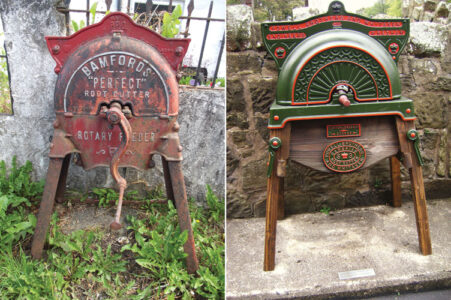
Many different companies offered root cutters as part of their range, and since they are well-engineered, simple, and sturdy, these old these root cutters have stood the test of time. Despite the fact that they’ve often been left outside braving the British weather for long periods of time, they’re still frequently found in good condition.
Another item that has become collectible, and still exists in large numbers, is the simple milk churn. When I say “churn,” I don’t mean a machine to make butter; I mean a tall, lidded vessel designed to carry milk. These vessels are, rather oddly, referred to as milk churns here in the U.K.
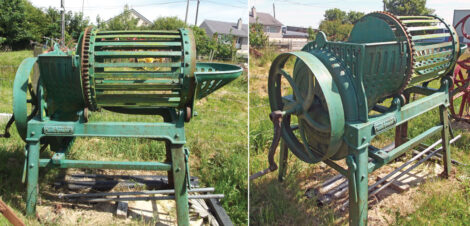
Before the invention of specific vessels to carry milk, milk was always carried in pails (lidded buckets with handles). Pails could be carried in pairs on a wooden yoke, which the bearer carried across their shoulders. But, once our transport network improved and milk began to be transported further afield, the old milk pails proved to be a problem, as they could easily tip over and were the wrong shape for haulage. Farmers had to find better vessels transporting their milk, and this is where the churn came in.
When dairy farmers made their own butter, they sometimes used tall, cone-shaped, flat-bottomed wooden churns, and since these portable churns were more stable than a milk pail, they began to be used for transporting milk. Thus, the word churn accidentally (and incorrectly!) began to be used to describe a milk-carrying vessel. In around 1850, tall steel-lidded vessels became available, but the word churn continued to be used as a name for these new steel containers, even though they were never used for churning milk.
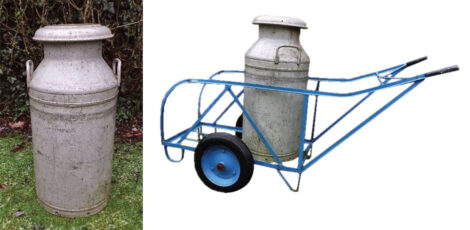
The milk industry was hugely important in Britain. Those living in the countryside had fresh milk from their own cows, or from a nearby farm; but those living in cities also wanted fresh milk, too. The advent of the railway system made this possible. When the railways arrived, it meant that milk could be transported faster and farther than ever before, so city dwellers could enjoy fresh milk.
The railway milk wagons were a standard size, so it was important that the vessels the railway was carrying were also of a consistent standard, which is how the tall vessels that we know as milk churns became popular. Today, milk churns have become popular collectible items, not only desired by those who collect agricultural memorabilia, but also by the general public, who like to use them as planters and display items. I have two: one with a hole in the bottom that my honeysuckle plant grows in and another I use to store my used food tins before I recycle them.
Josephine Roberts lives on an old-fashioned smallholding in Snowdonia, North Wales, and has a passion for all things vintage. Email her at josiewales2021@aol.com


