
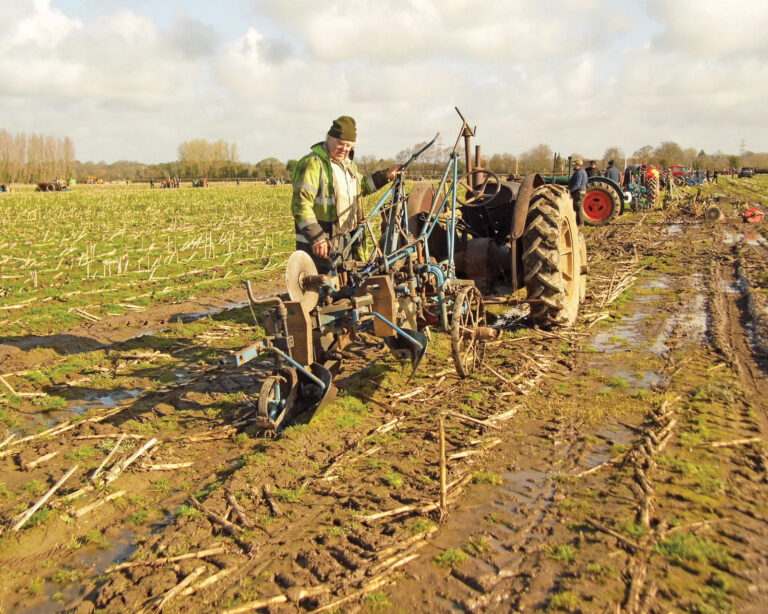
Plowing competitions take place all over the U.K., and they’re always held during spring and autumn (fall) with the hope that the ground conditions will be just right and are neither too wet nor too dry for working on the land. Each region of England, Wales, Scotland and Ireland have their own “local matches,” then there are qualifying matches, which will ultimately lead to the winners representing their own respective counties in the British Nationals.
At one time, when plowing was solely a horse-drawn affair, there were many more small plowing competitions held throughout rural Britain, some only a few miles apart, for both competitors and spectators would’ve had to travel on foot or by horse. These competitions were a great opportunity for local plowmen to show off their skills.
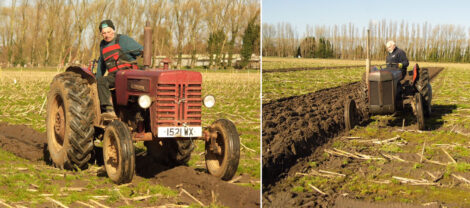
Plowing with horses was considered one of the most skilled jobs in agriculture and plowmen were much revered not only for their ability to produce neat, even furrows, but also for their horse-training skills. Today, there are sadly far fewer people who plow with horses, and most plowing competitions predominantly feature tractors. But you won’t see modern tractors at a plowing competition, for most of the classes are laid on for vintage and classic tractors.
Today I attended the Flintshire Farmers Ploughing Society’s annual plowing match, which was held about an hour away from where I live. Due to the wet weather that we’re blessed with in this country, there’s always a question mark hanging over such an event – will it or won’t it go ahead? Is the land going to be too wet? But people who plow are notoriously hardy, and unless the land is far too wet to drive on, the event will go ahead whatever the weather, and competitors just have to brave the rain.
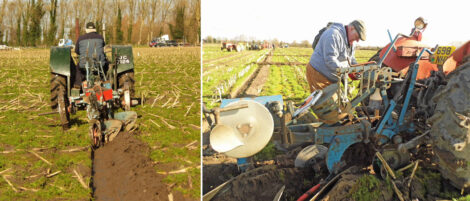
Most people who compete in plowing matches use vintage or classic tractors that have no cabs, so competitors get an (often unwanted) insight into what it was like for their fathers and grandfathers, working outdoors in winter on tractors that offered absolutely no protection from the elements. The difference is, of course, that those who compete in plowing competitions don’t have to plow in cold wet weather on open-topped tractors – they chose to do so! Many competitive plowmen have a background in farming, and, by using the tractors of yesteryear, they are recreating their younger days, nostalgic for a time when they plowed with the little tractors of the 50s and 60s. However, there are also a number of competitive plowmen and women who have no background in agriculture, and they compete because they wish to enjoy using their vintage and classic tractors, and because they want to be a part of a like-minded group who feel strongly about preserving the traditions of the past.
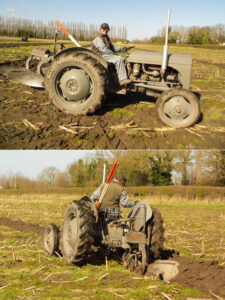
Glancing around the field it becomes immediately obvious that most of the competitors are men, and most are well past retirement age. Under 60s in this game are considered “young ‘uns” and probably have a lot to learn. This is one sport where age seems to give people the advantage, for with age (hopefully) comes years of experience, and the patience to take things slowly and carefully, which is exactly what you need to do if you want to produce a perfectly tidy plot. Producing a prize-winning plot means taking your time to read the ground that you’ve been given, making constant adjustments to your plow, taking measurements, and sometimes standing looking at your plowing while scratching your head. Make no mistake, this is not a high-adrenaline sport, which is possibly why plowing matches don’t tend to attract many spectators, because oddly enough, standing in a cold, muddy field watching lots of tractors moving very slowly isn’t everyone’s idea of a nice day out.
But, if you happen to want to know exactly how to plow using a vintage or classic tractor, you can do no better than to watch, follow, and pick the brains of some of these older competitors. These chaps haven’t learned to plow from a book – or an online video – they were plowing when they were youths, when these classic tractors were new and shiny, and some of them have been plowing ever since. A wet, muddy field full of old tractors might seem an unlikely place to meet leading authorities on anything, but this is exactly where you will find Britain’s best plowmen and women.
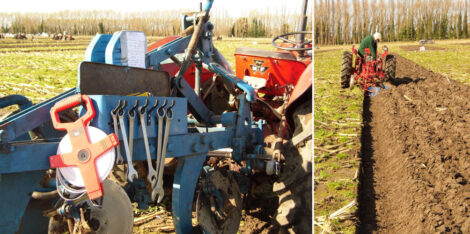
I apologize for the fact that I added the words “and women,” like something of an after-thought, but that’s exactly what women are in the plowing world. For many different reasons it’s a fact that VERY FEW WOMEN COMPETE IN PLOWING MATCHES! I would like to be able to say that things are changing, but I’m not sure they are. When I first started writing about plowing competitions some 25 years ago, you were lucky to see one woman competing. This is still the case today. In fact, today there was just one female competitor, a lovely smiley lady called Ann Shropshire. Ann, who works in the dairy industry, got into plowing through her husband. It was more a case of “if you can’t beat them, join them” than a lifelong passion, but either way, Ann has had a lot of success, and she’s now one of the stalwarts of the Ferguson Ploughing Class in many events throughout the North West of the U.K.
At this year’s Flintshire Ploughing Match, there were 10 different classes:
- Classic Mounted: This is for classic tractors with plows mounted onto the 3-point linkage system. Tractors like the Nuffield Universal 4 and the International B275 were being used in this class.
- Vintage Hydraulic: This is for older tractors with hydraulic plows fitted onto the 3-point linkage system.
- Vintage Trailer: This is for the antique tractors such as the Fordson Model N, used in conjunction with trailed plows.
- Beginners Class: For those who’re just starting out.
- Novice Class: Once you’ve won at Beginner’s level you can move up to Novice level.
- David Brown Class: For David Brown tractors and plows.
- Ford and Fordson Class: For classic Ford and Fordson tractors and period plows.
- Ferguson Class: The tractor and the plow must both be built by Harry Ferguson, and no modern gadgets are allowed.
- Classic Reversible: For later classic tractors that’re fitted with reversible plows.
- International Class: for tractors built by International Harvester.
Alongside the plowing, there was also a Young Farmer’s Club fencing competition, with classes for both seniors and juniors. With each team consisting of three people, competitors in the fencing class must erect a stock-proof fence in a straight line, 30 meters long. The netting, wire, and fence posts must adhere to strict measurements; straining posts must be erected according to the rules, and only hand tools are allowed.
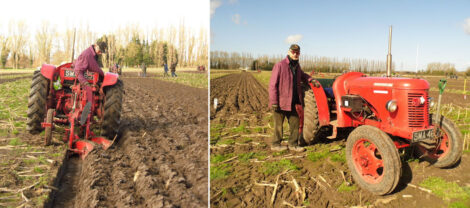
The main attraction, however, is the plowing. While it’s simple enough to take photographs of the tractors plowing (because it’s not as if these vehicles are moving quickly), it is, however, much more difficult to actually speak to any of the competitors, as they’re generally very involved in the task in hand, and have little time to stop and chat. If there’s any chatting, it’s done over the sound of the tractor running. Although a plowing competition isn’t a race, there are certain parts of the plowing that have to be completed in a set time. For instance, once competitors have finished “opening” their plot (making the first two runs), they must pause for the judge to view and mark their work before they can go on to the next stage. The plots are around 75 yards long, and competitors tend to plow around 42 furrows, depending on how they adjust their plows. The work is judged a second time during the plowing, after the competitor has completed the first 11 or 12 furrows, and then the work is judged again at the end after the competitors have all completed their “finishes.” The finish is tricky as it involves joining your plot onto that of your neighbor, and if your measurements haven’t been quite right during the plowing, this is where things really go badly wrong! The competitors have a set time in which they must finish, and this is generally four hours. Taking this length of time to plow a small plot would seem absurd to anyone who plows for a living, but to compare commercial plowing with competitive plowing would be like comparing herding cattle on horseback to dressage.
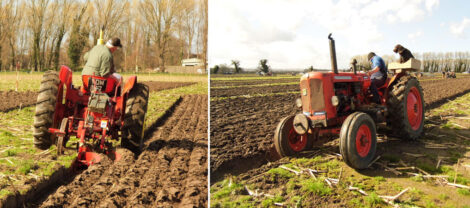
In competition plowing, every minute detail is judged. Drivers get on and off their tractors to measure their plots, their furrow width, and their furrow depth, and they’re constantly adjusting their plows accordingly. The judges give scores out of 20 for the neatness of the opening, the straightness of the runs, the firmness of the furrows, the uniformity of the work according to depth and evenness, the entrances and exits of the plot, the finish, and the general appearance of the plowing. Marks are removed for any grass or stubble that’s showing, and for messy areas where the plow leaves and enters the ground. Judges are usually well-seasoned plowers, who have plenty of wins under their belt, and they’re always on the lookout for people who are attempting to “garden” their plots, because any stamping down of messy bits or removing stray bits of stubble is not allowed.
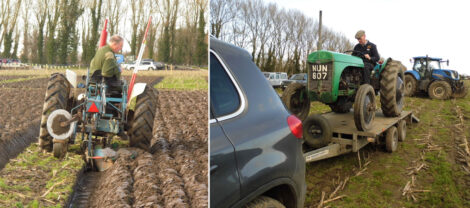
Once the competitors have finished their plots, the judges get on with the task of adding up the scores, while the competitors can finally switch off their tractors and relax. Now is the time to catch up with friends, to discuss the ground conditions, and to make guesses as to who might have won their class. If they’re lucky, and if it’s one of the larger plowing matches, the competitors might get a nice freshly cooked dinner in a marquee. If it’s a smaller event, they’ll probably have to make do with a burger from a takeaway van, but either way their lunch is free, insofar as it’s included in the entry fee, which is usually around £20 to £30. You could say it’s a cheap day out, but it’s not when you consider all that goes into getting to the event.
Not only do competitors require a tractor and plow, but they also need a vehicle and trailer to get the tractor to the event. Many use pickups or Land Rovers to tow their tractors to plowing matches, which is why small vintage and classic tractors are so popular – they’re light and easy to tow!
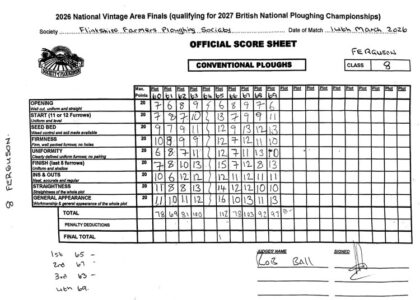
Once the competitors have eaten and caught up with their friends, it’s generally hoped that the judges will have their results ready. Experienced competitors will know if they stand a chance of winning something or not, but one never knows for sure until the results are announced. The winners receive a cup and sometimes a small amount of prize money. Then everyone loads their tractors and heads off home. The majority of competitors live within a 50 mile radius of the event, but some of the more serious competitors might travel many hours, or stay overnight to attend the event.
The wife of a competitive plowman once described plowing matches to me as being “The most boring spectator sport ever created,” and that description still makes me laugh. I can see why plowing matches don’t appeal to the general public, and why there aren’t many spectators. For a start, being held in exposed fields in what is generally inclement weather, and with rarely much to amuse anyone who isn’t a plowing or tractor fanatic is less than appealing. However, for me it’s not just about looking at the tractors and the plowing, it’s about looking at the characters that compete. There’s something really quite refreshing about folk who quietly plug away at their curious hobbies, with endless dedication, for no financial reward. It’s not done for glory or for money, but simply to perfect an age-old skill, and the fact that some of these people who’re competing, and hauling their tractors long distances in order to compete, are in their 80s, is really quite remarkable.
Josephine Roberts lives on an old-fashioned smallholding in Snowdonia, North Wales, and has a passion for all things vintage. Email her at josiewales2021@aol.com


