
Learn how one Michigan family maintains their antique tractor collection in active use as a way of preserving their legacy and traditions.
Some antique tractors are trailer queens. Others, in their work clothes, have been mechanically restored but rarely tackle anything resembling work. A lucky few, carefully maintained, remain in active use.
Various age qualifications are used to designate an antique tractor. One reference requires the tractor be 25 years or older in order to carry the antique designation (the same as cars and pickups). By that measure, Tim and Sandy VerHage rely exclusively on antique power for their farming operation near Allegan, Michigan.
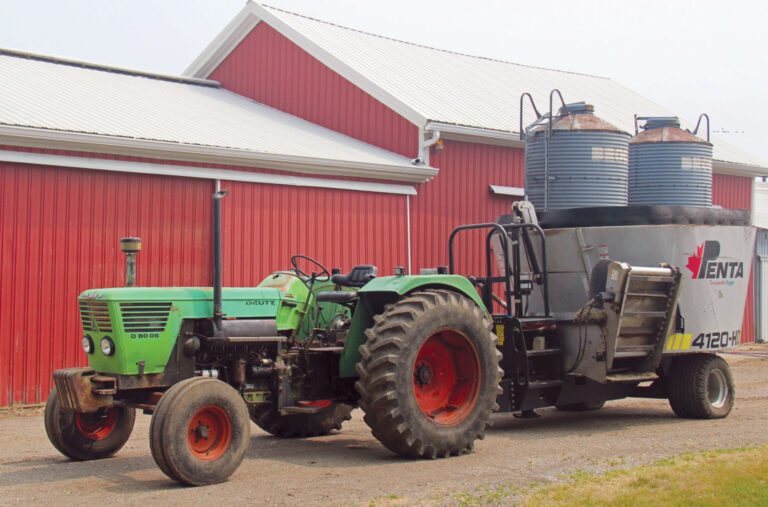
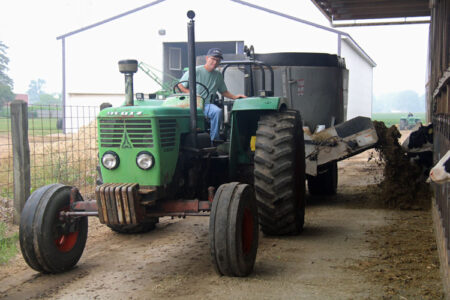
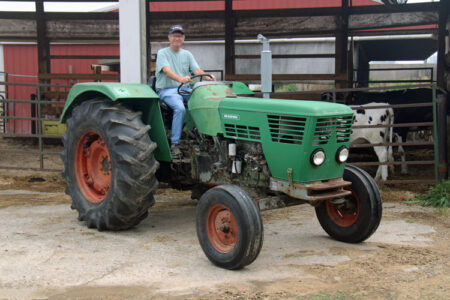
Durable antique Deutz tractors have extended their useful life at VerHage Holsteins. “My dad, Lawrence ‘Dutch’ VerHage, bought the 1970 Deutz Model D 6006 tractor because it was less expensive than other brands,” Tim says. “Neighboring farmers came by to see the tractor because it was one of the first in our area.”
But it would not be the last. The 6006 worked out so well, Tim and his dad purchased a new Model 8006. “The Deutz tractors are like the Energizer Bunny,” Tim says. “They just go and go. Through their extended life, they proved to be low maintenance as well. By all measures, these are antique tractors but they get regular use around the farm.”
The Deutz tractors replaced an assortment of early tractors. “With somewhere north of 15,000 hours on it, the Model D has required engine and clutch repair work,” Tim says. “We rake hay and haul wagons on occasion with this old, dependable tractor.”
The VerHages’ 1977 Deutz Model D 8006 was purchased new in 1978. “We recently had the engine overhauled and the clutch replaced,” Tim says. “This tractor has passed 20,000 hours. It sits on our feed mixer wagon and is used every day.”
Powering up with Deere
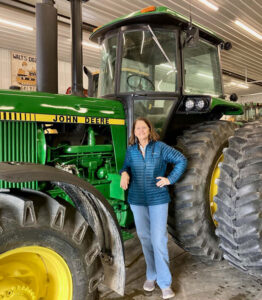
The VerHages’ current farming operation is powered primarily by John Deere tractors. “My first green and yellow tractor was a 1985 Model 4250,” Tim says. “I purchased the tractor in 1988 with 1,600 hours on it. Sandy enjoys driving the tractor, so she lays claim to it.” Now with more than 15,000 hours on it, the 4250 had some engine work done over the years.
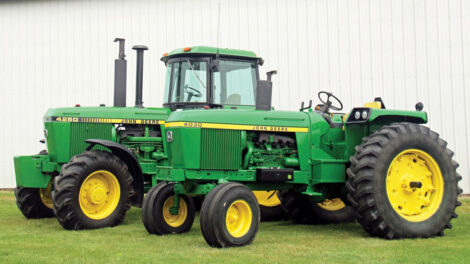
Their 1977 John Deere Model 4030 diesel is rated for 67hp on the drawbar. “I bought this tractor in 1995 from another farmer,” Tim says. “With its age and heavy work load, some engine work has been needed. We use it primarily to rake hay, plant sweet corn and operate the field sprayer.”
Tim’s newest John Deere is a 1985 Model 4650 he bought in 1996. “It’s been a good workhorse with no drivetrain work had,” Tim says. “It’s our highest rated tractor at 142hp.” He uses it for field tillage and chopping hay.
A four-generation favorite
A 1948 Allis-Chalmers Model C is not only an antique tractor but also an heirloom. Now fully restored, the Model C has been used by four generations of the VerHage family. “My dad traded some calves with his brother for the Model C in the early 1960s,” Tim says. “Grandpa VerHage drove it after it first came into the family. Dad, along with his four brothers, also operated the tractor.
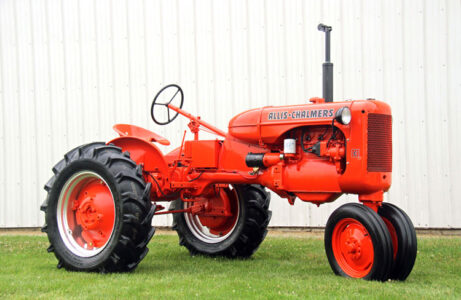
“My mom’s dad and his three sons drove the tractor,” Tim says. “Sandy’s dad (Ernie) spent time behind the steering wheel. Sandy drove the Model C as did our daughter, Julie, raking hay with it. If my count is correct, that totals 14 family members who have driven the Model C.”
The tractor was first restored 50 years ago and again in 2003. It was completely overhauled and repainted in 2022. “I’m sure it’s in better condition than when it left the factory,” Tim says. “The cost for restoration is four times it’s material value. But the sentimental value is worth much more.”
Honoring the VerHage farm heritage
Various pockets of Michigan were a draw for immigrants from the Netherlands. Tim’s great-grandfather left his birth country in the early 1900s. He settled in southwest Michigan and started farming. Dutch VerHage purchased the farm in the 1960s. In 1986, soon after Tim and Sandy married, the couple acquired the farm from Tim’s mother. Tim worked the farm for three years after his father’s death before he bought it from his mother.
Dutch VerHage grew corn and hay on his 40 acres and rented another 100. “Dad always milked a few cows,” Tim recalls. “Back then, the milk was shipped in cans to the dairy. He also drove a milk truck full-time. In 1972, the herd was expanded when Dad bought 30 cows. The milk was then refrigerated in a bulk tank. The dairy farm allowed the flexibility to drive a school bus part-time. And he drove the milk truck on weekends.”
Before Dutch settled on Deutz tractors, he relied on an Allis-Chalmers Model D-17, a Massey Ferguson Model 30, an Allis-Chalmers Model C and a Minneapolis-Moline Model U.
Tim’s tractor experience started when he was still cutting his eye teeth. “We have a picture showing me, as an infant, sitting on Dad’s lap while he was driving the Allis-Chalmers Model C,” Tim says. “When I came of age, I guided a Massey-Harris Model 444 pulling a wagon with green chop. As for the first field assignment alone, it was cultivating corn at age 10 with the same Model C.”
Those early experiences driving a tractor are marked by fond memories. “I really felt proud when Dad gave me the first field assignment,” Tim says. “It was special, realizing that Dad trusted me to cultivate corn. The corn rows looked nice with fresh black dirt laying against the green corn stalks. And the weeds were gone.”
Proper maintenance matters
Tim was 21 when he took over the farm operation after his dad’s death. The farm included 35 Holstein cows and crops of corn, grass hay and Sudan grass for green chop.
Today, the VerHages have expanded their herd to about 70 registered Holsteins. VerHage Holsteins were the top-producing herd in Michigan for eight years. The couple sold their lactating herd in 2017. They first raised heifers from their own herd; today they raise heifers for a nearby herd.
The couple has grown sweet corn for wholesale and retail customers for 35 years. “It consists of 15 acres with plantings staggered every five to seven days beginning the end of April until about June 15,” Tim says. “With a team of helpers, the corn is picked by hand and packaged in crates. It goes directly to the store where customers get that farm-fresh market experience. We also sell our corn along the roadside.”
Tim learned early on that proper maintenance of well-engineered farm equipment can extend its useful life. “I can’t imagine what it was like farming with equipment made over 100 years ago,” he says. “I really appreciate the machinery we have today, including the old Deutz tractors.”
Freelance writer Fred Hendricks of Mansfield, Ohio, covers a vast array of subjects relating to agriculture. You may email Fred at
fwhendricks@gmail.com.


