
When the streamlined new Farmall H, with its 21.37 drawbar horsepower (DHP) and 5-speed transmission, was introduced in 1939, Case dealers had nothing to directly compete with the popular machine.
Oh sure, there was the Case Model D, introduced in 1939, but its 36.05 DHP was comparable to the 33.05 of the Farmall M. The venerable Case R had been streamlined some in 1939, painted flambeau red and given four speeds instead of three, but it had just 14.21 horsepower at the drawbar. The new Case V series tractors were being advertised as 2-plow machines, and a VC tested at 18.55 DHP, but the VC looked smaller than the H and was, by about 1,250 pounds. Something had to be done!
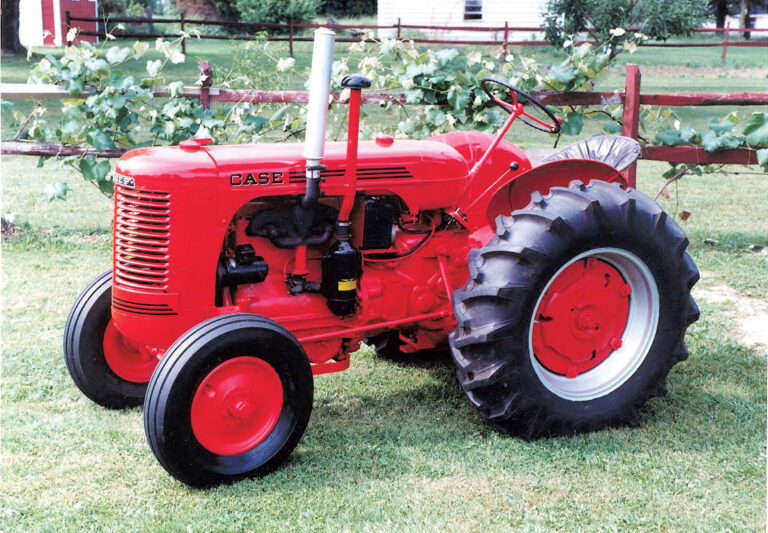
The Case Model S series was announced in 1940, with the first tractor shipped in November, and was intended to go head-to-head with the Farmall H. The newly designed machine used a Case-built engine of 3-1/2-by-4-inch bore and stroke, had a 4-speed transmission and used Case’s familiar roller chain drive to the rear axles.
The series was offered in a row-crop version, the SC, a standard tread S and the SO orchard tractor. During the 1940s, a model SI industrial version was built and was popular with the U.S. Army Engineers. The rear wheel tread on the SC could be adjusted by sliding on the axle, and/or reversing the wheels, rather than having to put in the awkward spacers Case used on the old RC and CC tractors.
The Model SC version of the new Case tractor was tested at Nebraska in the spring of 1941 and returned 19.33 DHP while burning distillate, close enough to the Farmall to give some comfort to Case dealers. Besides, the SC looked the part, with its 38-inch rear tires and high operator’s position.
The Case Model S was built until mid-1954 before it was replaced by the Model 300. Although the S series was popular, with a production run of 77,050 units, that pales in comparison to the nearly 400,000 Farmall H tractors that were produced. Still, the S was a sweet running and attractive 2-plow tractor in its day. FC


