
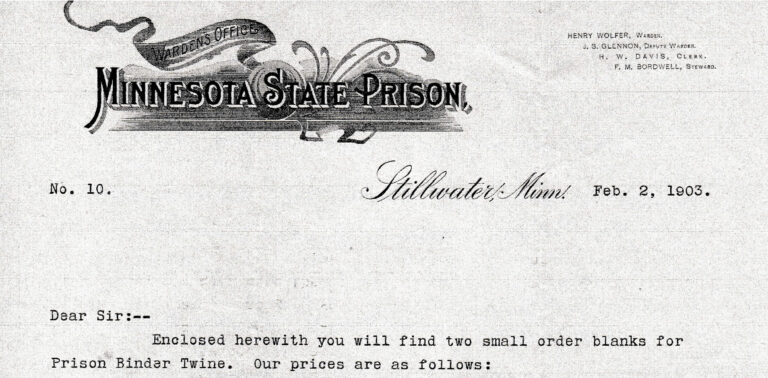
Farmers have been tight with a nickel since the nickel was invented, so it comes as no surprise that enterprising salesmen found a way to offer a bargain. The surprise comes when the salesman is also the warden of the Minnesota State Prison.
In this 1903 letter, Warden Henry Wolfer offered sale pricing on binder twine to an individual farmer, but also extended the deal to clubs the farmer might be associated with. “These prices are from 3 to 4 cents per pound below prices named by other manufacturers for twine of equal grade and quality,” he noted.
Twine, threshing machines and farm implements
Why was Warden Wolfer peddling twine? Because the Minnesota State Prison in Stillwater had operated prison industries since 1859, when prisoners were paid 75 cents a day to make shingles and blinds. Beginning in 1876, Seymour, Sabin & Co. – the earliest forerunner of the Northwest Thresher Co. – operated a prison industry building Minnesota Chief threshing machines.
By 1890, seeking to maximize their potential profits, the state began to play a larger role in management of the prison industries and launched a binder twine operation. By 1937, some 600 prisoners were engaged in twine production. Over time, the state-owned operation expanded to include hay rakes, hay loaders, sickle mowers, manure spreaders, gravity boxes, barge wagons and flare-box wagons.
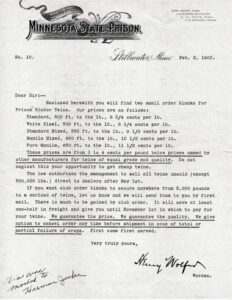
Dennis Jeske, Hanska, Minnesota, shared Warden Wolfer’s letter. “This is a copy of a letter my grandfather got from the Minnesota State Prison,” he says. “It was originally mailed to Herman Jeske.”
Twenty-five million pounds of twine
Housed in a 3-story masonry building, the Minnesota State Prison twine factory in the 1930s featured 500 spindles and related machinery. Raw sisal and Manila hemp fiber were delivered to the prison by rail in 400-pound bales. The bales were opened and kinks shaken out of the long strands by hand before being put through a series of breakers, machines used to comb, straighten, soften and oil the fibers before they reached the mechanical spinners.
In 1937, some 600 prisoners produced roughly 25 million pounds of twine. By the 1950s, the handwriting was on the wall. At that point, baler twine was the main cordage product (although binder twine was still being produced). In the 1970s, the twine factory was closed due to waning profitability and because it no longer “provided marketable vocational training for inmates.”
MINNCOR (the Minnesota Department of Corrections industry program) was created in 1994 after other farm equipment manufacturers threatened legal action, claiming unfair competition. Because prisoners did not have to be paid union wages, Minnesota prison industries equipment could be sold at a much lower price. MINNCOR ceased production of agricultural wagons and gravity boxes in 2006.
In more recent years, Minnesota prison inmates learned a skill and earned a wage by building furniture, producing custodial and correctional products, and working in printing, upholstery, sewing and laundry services. Production of farm equipment on the inside remains little more than a page from the past. FC
To submit a vintage document for publication, send it to: Iron Age Ads, Farm Collector, 1503 S.W. 42nd St., Topeka, KS 66609; or submit high-quality digital images by email: editor@farmcollector.com


