Most of our farming relics are made of wood or metal, both of which are prone to decay. Even our modern-day plastics have a limited lifespan because, as the saying goes, “nothing lasts forever.” But, then there’s stone – stone is permanent; it was here before us and will be here long after we’ve gone, making it probably the best ever building material.
Stone farm walls
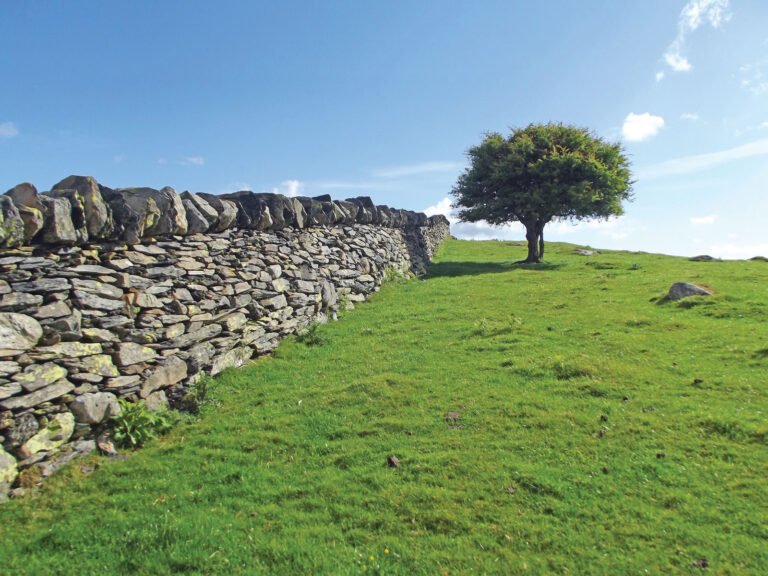
One of the most striking features of our countryside here in the U.K. are the miles of dry stone walls that wind their way across the landscape, acting as the most durable of all field boundaries. The term “dry stone wall” simply means a wall built only of stone that contains no cement or mortar of any kind. A dry stone wall can have a longer life than a wall built using concrete, but it requires a significant amount of skill to fit the stones together to form a strong structure that will stay up.
Building a dry stone wall isn’t simply a case of piling stones one on top of the other. Rather, it is quite an intricate process, involving careful placing of the sturdy foundation stones; using interlocking stones to provide stability; and using “coping stones” that sit upright on the top of the wall and prevent livestock, and humans, from jumping onto the top.
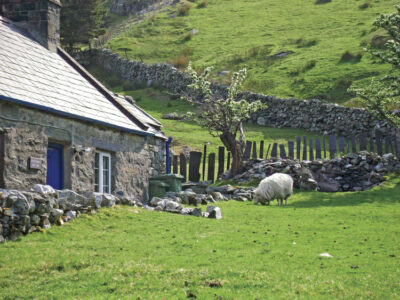
One thing the U.K. is good at is producing stone. We have an abundance of different kinds of stone here, but those used to build farm walls can be roughly divided into two types: quarried stone and stones that were dug out of the ground when clearing virgin land to make way for farming.
When our ancestors first began to clear the land to make way for cultivation, they came across stones that had to be removed from the soil, and it made sense to use them for something useful. Here in Wales, there’s a lot of stony ground, and there would have been a lot more in the past, but many of our fields have been created by the gradual process of removing stones in order to improve the land. Stone walls, therefore, served two purposes. They were field boundaries, but they were also a good way of getting rid of all the stones hindering cultivation.
A “clearance wall” is the term used for a wall made out of stone that’s been dug out of the ground. In some regions, there were huge amounts of stone to remove, and rather than carry it off the premises, farmers built extra wide walls around the fields in order to use up this abundance. These extra-wide walls are known as “consumption walls” due to the vast amounts of stone that they “consumed.”
Stones dug out of the land are usually randomly shaped, and any “waller” (a person who builds walls) will tell you that building a wall from these odd shaped stones is much harder than building a wall from quarried stone that’s been “dressed” (prepared into square or rectangular shapes). In Welsh, the name for these awkward shaped stones is pennau cwn, which means “dog’s heads,” as so many of the stones are slightly oval, and roughly the size of a dog’s head. Making a wall out of these vaguely rounded stones is especially difficult, and only the best wallers can manage to produce a tidy, strong wall out of pennau cwn.
The men who built them
Very few dry stone walls are made “new” today. Some wallers will erect new decorative dry stone walls around properties or places of interest, but most of the work of a waller involves repairing and rebuilding our nation’s old, damaged field boundaries. Quite simply, in this day and age, no one can afford to pay people to collect stone and to build vast long walls for use as field boundaries. This sort of work only took place in the past when extremely wealthy landowners could employ workers and pay them very little in the way of wages. Most of the walls that act as field boundaries in the U.K. were built in the 18th and early 19th centuries, but there are some that were built thousands of years ago.
It’s estimated that there are between 125,000 and 180,000 miles of dry stone walls in the U.K., and it’s thought that once there were probably over a million miles of dry stone walls, but many have been removed to make fields larger, and some have fallen into neglect and the stones have been re-purposed elsewhere. Many of our dry stone walls are protected today, and government grants are available to help farmers repair them when necessary.
We protect our dry stone walls for many reasons. They’re seen as important, historic features of our landscape, and they’re monuments to our social and agricultural past. But, on a practical level, dry stone walls are also just about the best farm boundary anyone can have. They are stock-proof and durable, and they provide shelter for livestock in windy environments. Dry stone walls also provide a microclimate for all manner of creatures, such as shrews, toads, lizards, and bees.
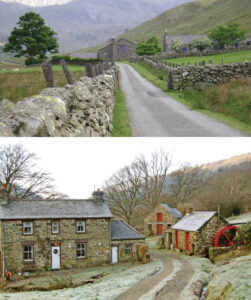
There’s little more beautiful than an old stone farmhouse, with matching stone outbuildings and picturesque stone walls that wind their way around a mass of little fields. Durable, eternal, and achingly beautiful, the walls were (and still are in some cases) the way a traditional farm has always looked. Built from the local stone, these farms seem to have evolved from the landscape, and they look so much a part of the countryside.
I think what makes these old walls and old stone buildings so special is that we know there aren’t any more of these being built. Sadly, no one builds homes, or indeed farm buildings, purely from stone any longer, so it’s crucial we protect those that we have, and we don’t allow anyone to knock them down in favor of modern buildings.
The thousands of miles of dry stone walls that stretch across our landscape were built to mark boundaries and to control livestock, but they also illustrate the U.K.’s diverse geology, for each region has different types of stone. A farm wall in Derbyshire, for instance, looks quite different from a wall in North Wales. One thing that’s obvious when looking at any of these dry stone walls is that an enormous amount of work went into building them. Some walls wind their way up mountainsides in great long stretches, and others border small fields, making the landscape look like a beautiful patchwork when viewed from above. These walls were built as a community effort, involving large numbers of workers.
Some walls have a rather sad history. In Ireland, there are walls called “famine walls,” which were built during the time of the Great Famine (also known as the Potato Famine), which began in approximately 1845. Despite the fact that many were starving in Ireland during the time of the famine, there were still plenty of wealthy landowners. In order to give employment to those who were struggling, the landowners employed vast numbers to build walls around their estates. So while the building of such walls can be seen as a “famine relief” insofar as they provided work for the desperate, it’s also true that these walls are a reminder of a very sad time, when the poorer people had few rights and little hope.
To some extent, all dry stone walls in the British Isles hark back to hard times, for it is unlikely that anyone who was employed in the building of these walls was paid handsomely for such hard physical labor, and certainly such monuments were only possible in a time when there was a large divide between the rich and poor. With this in mind, it’s a fact that when I look at a long length of wall, built in a difficult to access upland area, I always feel a sense of poignancy.
Historic staddle stones
Stones are monuments to our past everywhere here in the U.K. There are ancient ceremonial stone circles, impressive stone buildings, and miles of stone field boundaries, but there are also stones in odd, easy-to-miss places, such as underneath old granaries.
Granaries are buildings designed specifically to store grain, and the two big enemies for those wishing to store grain were damp and rats. By elevating granaries above the ground, farmers were able to protect their grain from rats and, to some extent, damp. Granaries were, therefore, often built standing on stone blocks, and many of these blocks were mushroom-shaped, a design which made it extra difficult for rats to climb up. Many people call these “stone mushrooms,” but their correct name is “staddle stones.” The name comes from the Old English word stathol, which meant base or foundation. Many of our staddle stones date from the 17th century, but it’s thought that before they began to be made from stone, staddle stones would have been made from wood. It’s unlikely that any of these wooden examples survived to the modern day.
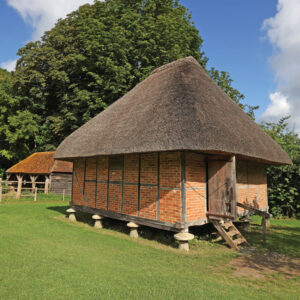
There are still preserved granaries that stand on staddle stones, but most have long since decayed or been dismantled. Thanks to the durability of stone, we do, however, find plenty of the old mushroom-shaped staddle stones, and many today are used as garden ornaments. In fact, modern concrete copies are frequently made for decorative purposes.
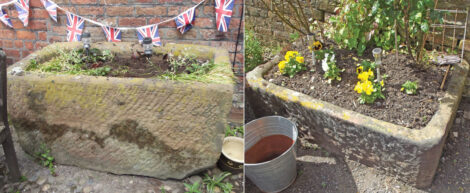
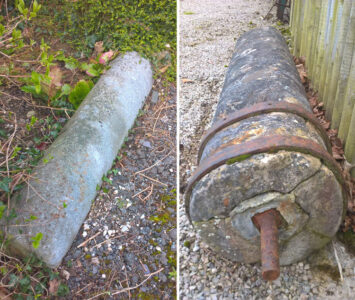
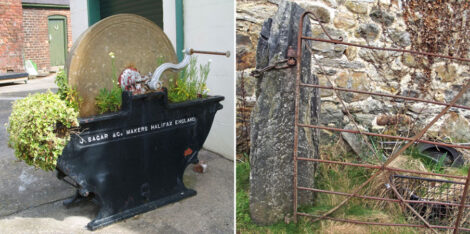
Apart from staddle stones, there are many other stone relics to be found that harken back to the older days of farming, with millstones and grinding stones being among the most commonly seen. Again, many of these now obsolete items have become popular garden features. Stone troughs, used for feeding and watering livestock, are often seen in gardens, planted with flowers, and fetch high prices when they come on the market, as buyers are well aware that no more of these durable and beautiful containers are being made today.
The Beauty of Slate
Slate is a finely grained metamorphic rock that can be split easily into slabs, and which has been used as a roofing material worldwide, with North Wales historically being one of the leading producers of slate.
Welshmen have been quarrying slate for at least 1,800 years, but the real golden era of the slate industry in Wales was during the 18th and 19th centuries when slate from Wales was used to roof almost every building in the U.K. and when slate became so popular that it was shipped worldwide. During the 19th century, the Penrhyn and Dinorwig quarries were the two largest slate quarries in the world, and the Oakley mine in Blaenau Ffestiniog was the largest slate mine in the world, although they’ve been surpassed by other quarries. All of these sites are just a short drive from where I live, so it’s safe to say that slate is a commonplace sight here. Despite the fact that there’s nothing rare about slate, it’s long held a fascination for me, as it’s a beautifully smooth material and extremely easy to shape. If you go to any old cemetery in Britain, you’ll see that all the gravestones are slate, and these slabs are often intricately carved. They’ve stood the test of time, whereas their more modern counterparts, made from glossy, foreign-produced stone with gold lettering, have a far shorter lifespan.
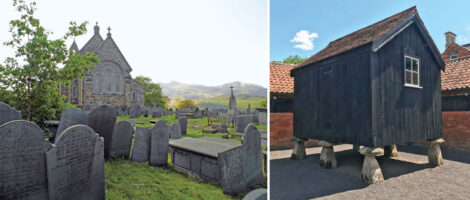
In and around the slate mining areas, it’s not unusual to see barns built with slate pillars, farm fences and gateposts made from slate, and livestock troughs made from slate, with the colors varying from shades of grey to blue and rich purple.
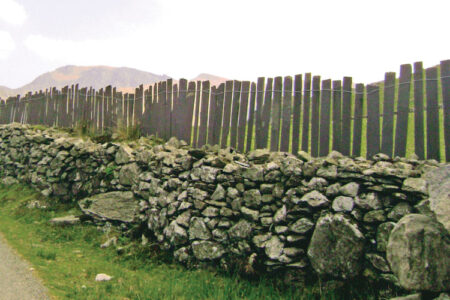
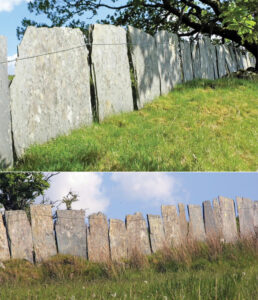
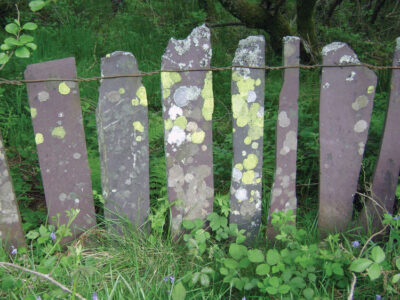
Most old slate fences that we see here in North Wales are made from long narrow strips of slate, but there are a few I’ve seen made from large slabs of slate. These stand majestically, almost like lines of gravestones, as durable monuments to past times and hard times, standing up to the harsh weather, and still, after well over a century, sheltering our Welsh Mountain sheep.
Josephine Roberts lives on an old-fashioned smallholding in Snowdonia, North Wales, and has a passion for all things vintage. Email her at josiewales2021@aol.com