
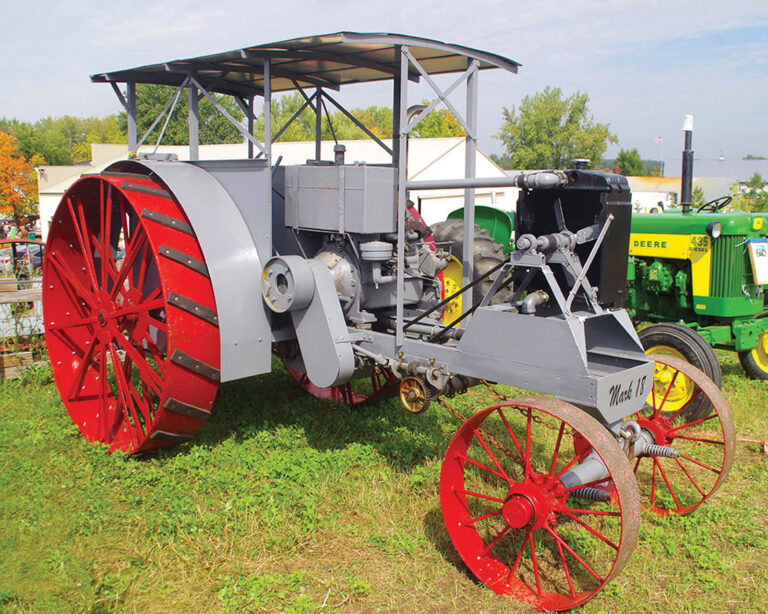
Each homemade tractor that Mark Lofgren built over the past few years was bigger than the one before, he says. “First, I built a tractor with an International Harvester model M 1/2hp flywheel engine, and the second one was an IH Model M 3hp flywheel engine. And then the Mark 18 – named after me and the year I built it, 2018.”
His fascination with the big old prairie tractors triggered his desire to build his tractor, he says. “Those monsters existed during a 20-year period after the end of the steam age; huge old tractors created especially to plow open large acreages of farm ground. I knew I could never afford to buy one – and if I did, it would need to be kept somewhere expensive. And if I wanted to move it, that would be expensive, too. That’s why I decided to build a tractor that resembled a prairie tractor, but in scale so it could be transported.”
The Planning
The Mark 18 tractor took time to develop in Mark’s brain. “I never used any tractor drawings or plans. I thought about it a year before I started working on it, trying to figure out which parts I might need and where I might find them. Maybe I’d find what I needed laying around, like on my carcass of a Farmall F-12 without an engine, but a transmission, rear end, and rear axles that would work on the Mark 18.”
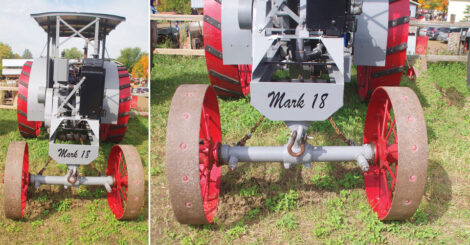
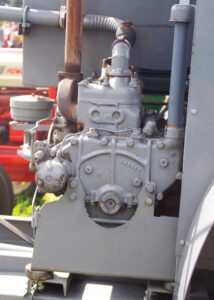
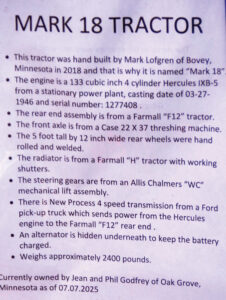
Next was the engine. Eventually, Mark found a 133 cubic inch Hercules IXB-5, cast on March 27, 1946, with a serial number of 1277408. “I used to log for a living, so I often saw that little Hercules 4-cycle motor. I knew I wanted it for the Mark 18. Well, that engine seemed common, because you see one occasionally at a tractor show, but you really don’t run across them very often. I was lucky to find one for sale. It had been a stationary power plant, with a clutch and v-belt pulley on the output shaft – perfect for what I wanted. The motor sits crosswise on the body.
“As I worked on the machine, I came across other parts I needed, such as a front axle off a Case 22-by-37 threshing machine. The steering wheel was also off that Case separator: the wheel on the back that raised up the straw tracker pipe. The steering gears were from an Allis-Chalmers WC mechanical lift assembly.”
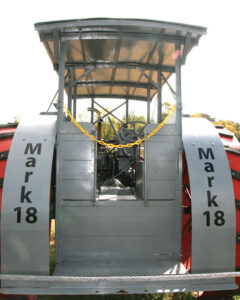
He also added a second transmission. “I have a jackshaft that goes into the auxiliary transmission that I put in there. I used a roller chain final and gearing to slow everything down. 1-1 would be too slow. 2-3 or 2-2 or something like that might work. But I had plenty of gears to pick from, walking speed and up. I didn’t want to slow the parade down.”
The radiator came from a Farmall H tractor with working shutters, he says.
Then there were the rear wheels. “They were the most difficult part of the project. Early on, I propped up the rear axles on jack stands to the height I thought it should be and built from there. Getting it on wheels was an important early step.
“I searched but couldn’t find steel wheels in the size I wanted. The Farmall F-12 rear wheels were 54 inches tall and the Fordson’s were 48 inches tall. I wanted something 60 inches tall.”
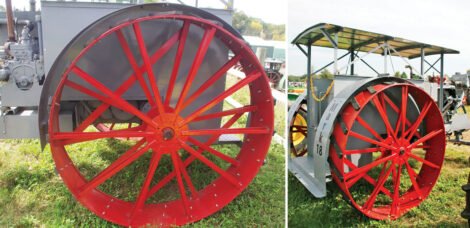
So, he made the wheels. And the roller. “I made a roller so I could roll the wheels, starting with 8-by-12 inch flatstrap, 1/8-inch thick. Then, I figured that was too thin, so I doubled the 1/8-inch to get the rear wheels 1/4-inch thick, 12 inches wide, and 60 inches high. Everything on the wheels is homemade by me in my shop.”
He adds that the wheels were the hardest on him physically. “Rolling those bands and getting that all hammered out round was difficult. Once I finished that, I welded everything together. Then, I welded the spokes in there.”
He spent all winter on it, he says. “Every day, I did something to it. I worked about 300 hours all together, I’d guess.”
Not everything went right all the time, though. “Some things you learn through trial and error. You work on it until you get it right. Like the steering, which I discovered was too slow. To get the wheels to turn, I had to rotate the steering wheel too many times. So, I got it better the second try, but maybe it could even be faster.”
Some pieces had to be made with templates, Mark says. “I used cardboard to make templates to mock up how some parts were going to connect. Anything I had trouble with, I made cardboard templates, then went straight to the plasma cutter and started cutting out plates. I cut everything I could with a plasma cutter. It does a nice job and it’s cheap.
“Finishing it was exciting,” Mark says. “I put that four speed transmission ahead of the three speed, so I’ve got all kinds of combinations of gears. When it was time to drive in a parade, I had to figure out which gears worked the best. It’s the combination of third in one transmission and second in the other – or something like that,” he laughs. “But it was fun playing with it, that’s for sure.”
Immediately after finishing the Mark 18, which weighs 2,400 pounds, he had several chances to sell it. “People said, ‘I’d sure like to buy that tractor. Would you sell it to me?’ That was years before I advertised it. I just said it wasn’t for sale yet.”
Reactions to the Mark 18 were gratifying. “Close friends and family thought it was a pretty neat little tractor. At big shows, though, people often get visual overload from all the stuff, so some people would walk right by the tractor and never look give it a second look. But people who’ve worked on something or built something themselves studied it. Some people went underneath to look at how I did it. The reaction really varied wildly from nothing at all to close examination.”
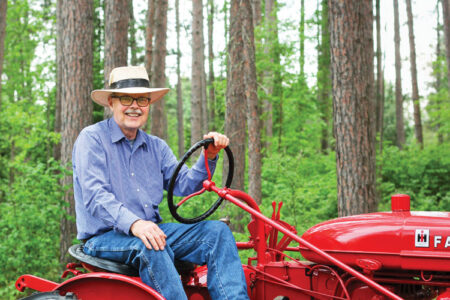
Mark says he never pulled anything with the Mark 18. “I never even hooked it up to anything. It’s just a toy and something to show. I took the Mark 18 to four different tractor shows, and one had a parade. I headed down to the end of the line to get in on it. As I was driving down a little street, suddenly a woman in her 50s started running beside me, trying to talk to me through all the noise, but I couldn’t understand her. After I parked, the guy ahead of me wanted to talk about the tractor, asking what kind of tractor it was.
“Finally, I got to talk to the woman. She said, ‘I want to know more about the tractor and write an article on it for the Park Rapids newspaper. It’s something different than you normally see.’ So, after the parade, we talked, and she wrote a piece for the newspaper.”
Selling Time
Why did he sell? “There comes a time. I’d had it since 2018 and showed it in a number of shows in Minnesota and Wisconsin. But I don’t have kids or grandkids who are interested in that stuff, so I thought I’d try to find somebody really interested in that kind of thing. So, in 2025, I decided to sell it. I’d noticed that homemade tractors at estate auctions didn’t bring in any money, so I decided on craigslist because I’d gotten good results selling other things there.”
He got a call from the state of Washington. “A guy said he was thinking of sending a driver here to pick it up. But I figured to get it from Minnesota to Washington would take a lot of money. He was an interesting guy to talk to and seemed a bit knowledgeable about prairie tractors, but maybe he wasn’t serious. Nothing came of that.”
But Mark found a buyer through his craigslist ad. “I’m very pleased with Phil Godfrey. I saw him at two shows that first summer, and saw he was enjoying the tractor. I’m just happy to see that.
“For me,” Mark says, “I think the entire story on the Mark 18 is that we can really surprise ourselves by what we can do, if we just try and do it.” FC
The New Owners, Phil and Jean Godfrey
Phil Godfrey says he was introduced to the Mark 18 by his wife, Jean. “She saw it in the farm section on craigslist and showed it to me; I’ve always liked the prairie tractors. I thought it was interesting but blew it off at first. My wife said, ‘You know you want it.’ I kept thinking about it and went back and looked at the listing a couple of more times and finally decided I should buy it with my wife’s encouragement and blessing.”
He wasn’t worried that someone else might have bought it by then, he says. “It took me a couple of calls to Mark. He told me all about the tractor, and it just seemed like something I should look into deeper. So, I made arrangements to go up to his place in Grand Rapids, Minnesota, almost a 3 hour drive from our house, and take a look at it.”
He laughs. “I had the cash in hand and the trailer hooked up to the truck, so if everything turned out the way I thought it would, we could load it up and take it home. Which we did on July 7, 2025. It fits nicely on a car trailer.
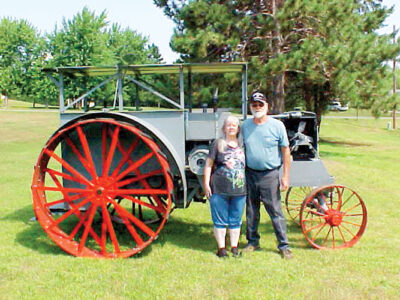
“I wanted it because I’ve always liked prairie tractors, in particular the Rumely Oil Pull 12-20 and 16-30, and the Minneapolis Threshing Machine 20-20 and 20-44. They were the smallest those two companies made. But I soon found out the price on those is ridiculous, and I could never afford one. So, this one kind of filled in that gap.”
He said he’s driven it around in his yard. “I don’t want to drive it on our blacktop road because it would probably destroy the rubber cleats on the rear wheels. We were only able to take it to two shows in 2025. It’s not a tractor that you’d use every day. I’ve got other tractors for that. It’s a show baby.” It was the feature tractor at the 39th Tractor Show in Grand Rapids in 2023.
Phil says he hasn’t done any repairs to the machine. “I just recently did an oil change and tune-up. I rebuilt the carburetor because it just didn’t seem to be running right. Now it is. It’s easy to drive once you get used to it. Not difficult at all.”
Everybody who sees it loves it, Phil says. “I have heard ‘It’s awesome’ or ‘It’s incredible,’ and other words like that. A machinist friend of mine said that the amount of engineering that went into the tractor is incredible. Truly, an amazing machine. Jean and I both think Mark needs to be thanked for building it.”
Bill Vossler is a freelance writer and author of several books on antique farm tractors and toys. Contact him at Box 372, 400 Caroline Ln., Rockville, MN 56369; email: wdvossler@outlook.com.


