
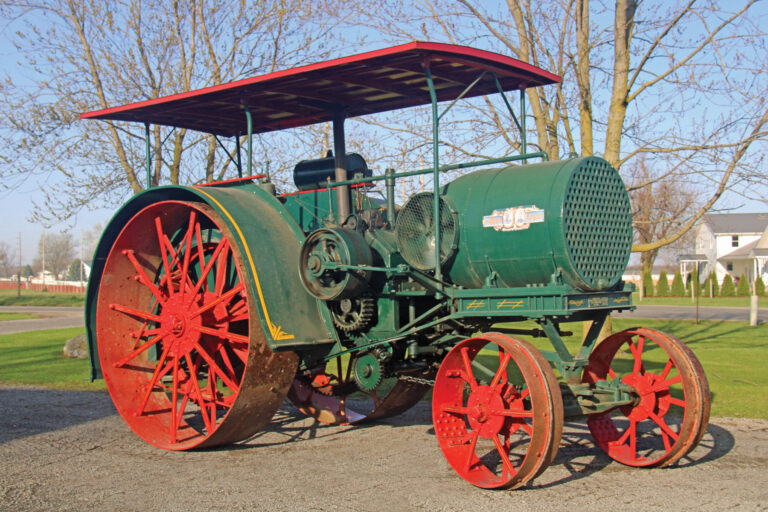
A deep-seated interest in engines is difficult to fathom, especially when you grow up working with draft horses. Delbert Helmuth explained his attraction to engines: “Growing up on an Amish farm, Dad would take the mechanical equipment to the local blacksmith shop for repair. While tagging along, I became interested in mechanics. After I took over the farm, I started fixing our equipment. I liked doing it, and it seemed to come easy for me.”
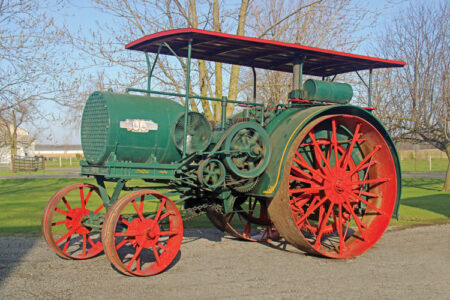
The first engine Delbert bought was a 3hp hit-and-miss Leader engine. “I enjoyed tinkering on that engine. Over the years, I have added numerous hit-and-miss engines. And I’ve added antique tractors, with 18 in the collection. The favorites include a 1914 Sawyer-Massey 22-45 steam engine and a 1917 Aultman & Taylor 30-60,” he said.
Aultman & Taylor History
The annals of early American industry reveals extensive farm equipment manufacturing based in Ohio. 12 tractor brands were built in northern Ohio alone. A leading agriculture company in that revolution was the Aultman & Taylor Machinery Co., founded in 1859 by Cornelius Aultman and Henry Taylor. The firm was noted for steam engines, threshing machines, and other agriculture products.
The company relocated out of eastern Ohio and established manufacturing in Mansfield, Ohio, in 1867. Mansfield was selected due to extensive railroad service. Three of the greatest trunk lines of the world ran through the rail yards there, providing ideal shipping facilities, with company docks only feet from all three tracks.
As a result of its innovative manufacturing, Aultman & Taylor products were in the record books as “first” in the history of American agriculture. In their early years, the company produced the first vibrator thresher. By 1878, Aultman & Taylor became the largest manufacturer of threshing machinery in the United States.
The firm also produced a variety of other equipment, including sawmills, steam engines, and steam traction engines. By 1918, steam traction engines were on the way out. Kerosene-powered traction engines created the wave of the future. They were soon replaced by gasoline-powered tractors.
In 1910, Aultman & Taylor saw the writing on the wall and introduced their gas-powered tractor known as “Old Trusty.” Old Trusty was its massive Model 30-60 that went into production in 1911. The tractor gained a well-deserved reputation for reliability and performance.
The range of gas tractors was expanded over the next years to include a Model 15-30 and Model 22-45. However, neither of these tractors had the same acceptance as the original Model 30-60.
The Rooster Trademark
When Aultman & Taylor was in full operation, travelers passing over the nearby railroads in Mansfield would see an immense image of a starving rooster covering the entire front of the manufacturing facility. The “Starved Rooster” became the trademark of Aultman & Taylor due to the stellar reputation of their thresher.
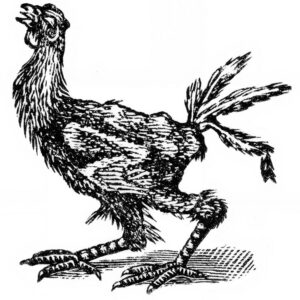
The threshing machine of the 1800s had a single job: Take the dried plant and thrash it to remove the seed. The thresher then discharged the leftover straw. If the thresher was inefficient at its job, seed would often be strewn about with the straw. A clever rooster would then scrounge through the scattered straw for the seeds left behind – And then become healthy and fat on the seeds he could find.
Aultman & Taylor claimed their thresher was so efficient there was no seed left behind. Consequently, a rooster could starve following an Aultman & Taylor threshing machine. To farmers in the 19th century, this trademark was sophisticated, yet fun. The scrawny rooster was clever and unforgettable. It, therefore, became priceless advertising in the age of homegrown agriculture.
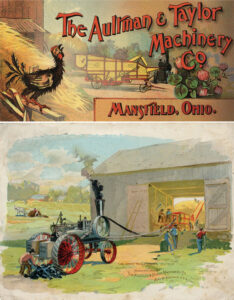
The company claimed a Nebraska farmer witnessed that exact scenario: a starving rooster pecking pathetically in search of seed in the scattered straw behind Aultman & Taylor’s Excelsior thresher. The farmer was so impressed he crated the emaciated rooster and shipped it to Mansfield by train as proof.
When the factory workers received the rooster, they adopted him as a company pet. The rooster flourished for several years with feed and special care. He eventually fluttered off to the burial grounds next to the company office.
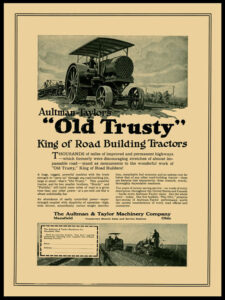
Aultman & Taylor produced numerous starving rooster promotional pieces throughout the decades. They included advertisements, newspapers, catalogs, and watch fobs. The rooster was even embossed on different parts of the tractors and equipment.
Aultman & Taylor 30-60
Delbert Helmuth’s 1917 Aultman & Taylor 30-60 is the most noteworthy. This brute of a tractor, which weighs just over 24,000 pounds, has been called by different names, such as “Old Trusty” and “Contractor Special.”
The tractor’s versatility made it useful for road construction, railroad yards, and other heavy workloads. In addition to handling an 8- or 10-bottom plow in the field, it worked well on heavy capacity threshing machines. With its dependable performances, the 30-60 was regarded as one of the best-built prairie tractors.
Delbert acquired the Model 30-60 tractor in 2014 in its original condition, which is quite good for a 100-year-old tractor. “I have not been able to verify that the engine is original. The axle and engine serial numbers do not coincide with established records. They’re both in excellent condition, however,” Delbert indicated.
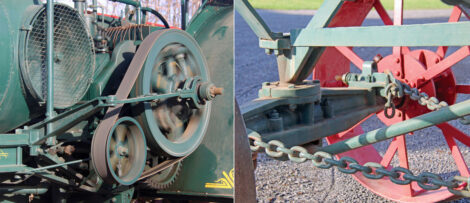
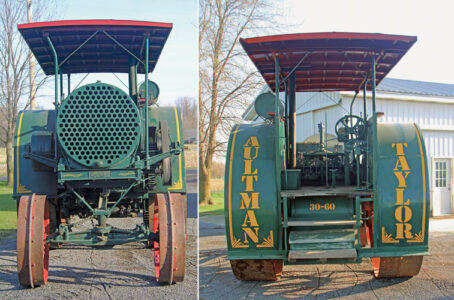
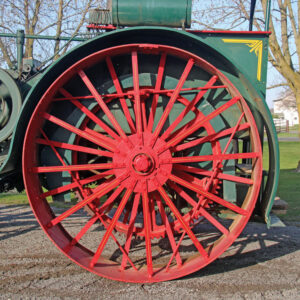
Early versions of the 30-60 had a square radiator but was replaced by a more familiar tubular radiator, as shown in the pictures. The dual fans pulled air through 196 two-inch tubes in the 120-gallon radiator. It was considered a state-of-the-art cooling system for its time.
When gas was scarce, the four-cylinder engine could be started with gas and then switched over to run on kerosene.”The engine starts easily with a couple quick cranks and runs entirely on gasoline. I removed the lugs for easier driving on solid and paved surfaces,” Delbert said.
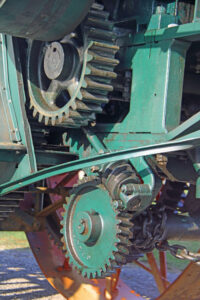
According to TractorData, the 30-60 was Nebraska tested at 58hp on the drawbar and 80hp on the belt. The fuel tank capacity is 60 gallons, whereas the auxiliary tank held 20 gallons of fuel.
The demise of the Aultman & Taylor Co. ultimately had to do with management. The company had outlived its founders and was being run by questionable management. Consequently, the company experienced financial challenges and was taken over by the Advance-Rumely Threshing Co. of LaPorte, Indiana, in 1924.
Presenting the 30-60
Delbert has exhibited his Aultman & Taylor 30-60 at several antique tractor shows throughout northern Indiana. “When I’ve displayed at various antique farm equipment shows, there are opportunities to put the tractor in the belt and operate various kinds of equipment. As fellow collectors, we enjoy working our tractors. We’re not doing it for show, but the enjoyment of operating them. The 30-60 has proven to be a good workhorse under any condition,” Delbert said.
If you’d like to learn more about Delbert Helmuth’s antique engine or tractor collection, he welcomes your contact during the evening by phone: 574-773-3300.
Freelance writer Fred Hendricks of Mansfield, Ohio, covers a vast array of subjects relating to agriculture. You may contact Fred at fwhendricks@gmail.com


