
It is intriguing how one person’s discards can be another person’s cherished collection. Daryl Yoder’s rare assemblage of discarded, early International tractors is and example of what makes collecting so fascinating.
Daryl’s collecting started under unusual circumstances as he explained: “Two of our local Amish schools support an annual fundraiser called ‘Rentown Old-Fashion Days.’ Throughout the two-day activities, we have exhibitors who demonstrate their antique tractors and steam engines. Watching that activity caught my attention. As a result, it pushed me into tractor collecting mode.”
Collection Scope
Daryl commented about his tractor assembly. “Our collection consists of five pre-1930 International Harvester tractors. We also have a 1938 Farmall Model F-12 and a 1940s or ’50s Silver King Model 42. Rounding out the group is a 1930 McCormick-Deering Model 10-20 owned by my dad that was recently restored.
“Our preference is buying antique tractors by private treaty, although some have come through public auction. We strive to have the tractors in good running order and as near original as possible.
“The tractors are stored in a heated building. This provides a working facility during the winter months and unpleasant weather conditions. Within the building is a cross-draft paint booth complete with an air makeup and filter system that we use for painting,” he said.
Collector’s Delight
Daryl’s tractor trove has grown over time and under a variety of circumstances. Detailed information about the tractors follows in chronological order of when they were built.
1913 International Harvester Mogul 15-30 – “We consider this tractor to be the most unique in our collection. Complete details are not being shared through this draft as it will be covered through a standalone story,” Daryl said.
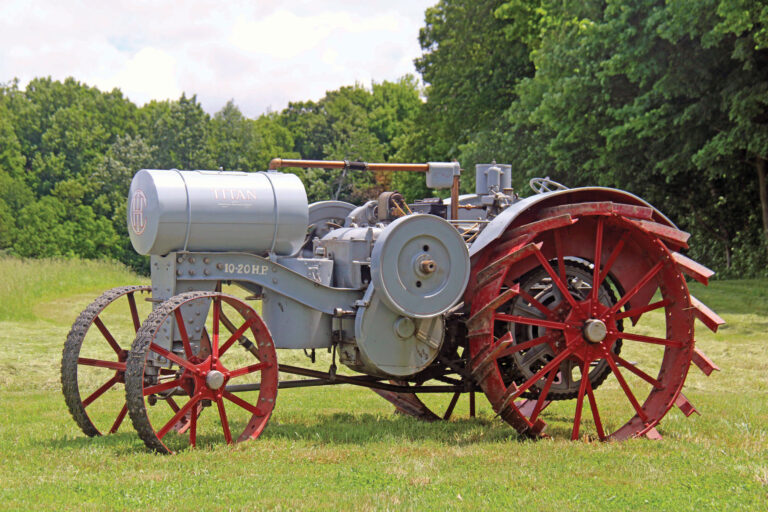
1917 International Harvester Titan 10-20 – “In 2013, we bought our first antique tractor through a private deal, the Titan 10-20. It was not in running order, but we replaced the cooling tank and pipes. And with a few minor adjustments, we had it going,” Daryl said.
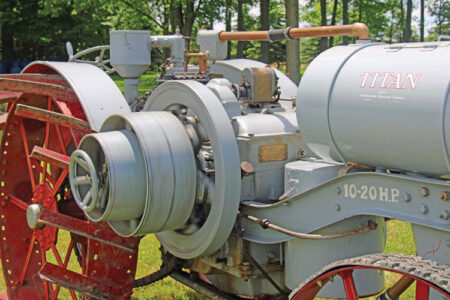
International Harvester built 78,363 Titan tractors from 1915 to 1920 at their Milwaukee, Wisconsin, plant. The most common Titan model in 1917 was the 10-20. Estimates indicate there are about 1,000 still in existence worldwide.
Powered by an 8.7L, two-cylinder kerosene engine, the Titan 10-20 has a drawbar rating of 10hp and 20hp on the belt. The Titan was considered a powerful and reliable tractor for its day. The purchase price in 1917 was estimated at $700, making it a popular farm tractor.
1919 International Harvester Mogul 10-20 – “This tractor was acquired through an auction in 2018. It was in good running condition but we replaced the brake assembly and added a belt pulley,” he said.
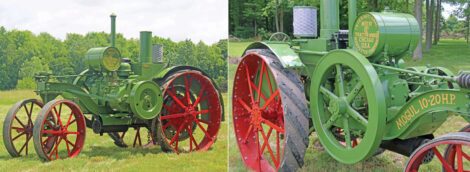
The Mogul was a pride of International’s Chicago, Illinois, facility where 8,985 were built. Weighing in at 5,500 pounds, it was powered by a 11.2L, single-cylinder International kerosene engine. The tractor had a claimed rating of 10hp at the drawbar and 20hp on the belt. The 2-speed transmission tractor was capable of drafting a three-bottom plow.
1919 International Harvester Model 8-16 Junior – “A unique tractor for our collection, the 8-16 Junior was bought through an auction in 2019,” Daryl said.
The International 8-16 Junior was manufactured in Chicago, Illinois. A total of 33,142 were built from 1917 to 1922. The tractor had a weight of 3,600 pounds, which was nimble for its time.
When the 1918 model was introduced, it was styled after the International trucks of the day. The design had a sloping hood with the radiator behind the engine, typical of early 20th-century farm machinery.
The Model 8-16 Junior was 8hp tested at the drawbar and claimed a 16hp belt rating. A two-bottom plow tractor, it was powered by a 4.1L, 4-cylinder International Harvester engine.
1919 International Harvester Model 15-30 or “Flaming Four” – “This gem was in good condition when it came through an auction in 2020. However, we replaced the fuel tank, repaired the oiler, and redid the cooling system. We also replaced the fan belt guard to its original specs,” Daryl said.
“You might wonder why it’s called a ‘Flaming Four.’ The tractor has four independent carburetors, one for each of its four cylinders. If the carburetors were not adjusted correctly, flames could shoot out through the exhaust, hence the ‘Flaming Four’ nickname,” he said.
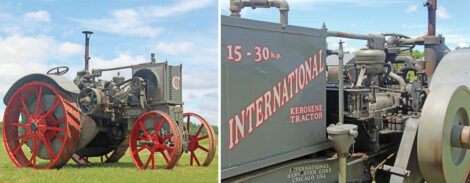
A reported 6,024 Flaming Four tractors were built from 1917 to 1921 at International’s Milwaukee, Wisconsin, facility. With its hefty International Harvester 11.4L kerosene-fueled engine, it was drawbar tested at 26hp. Its belt was tested at 37hp. The significant power on the belt pulley made it suitable for powering various farm machinery.
1930 McCormick-Deering Model 10-20 – “This is the tractor owned by my dad. We were pleased with how it came together following full restoration. With the large deep lugs on the heavy-duty iron wheels, we put protection bands on the wheels for ease of moving,” Daryl said.
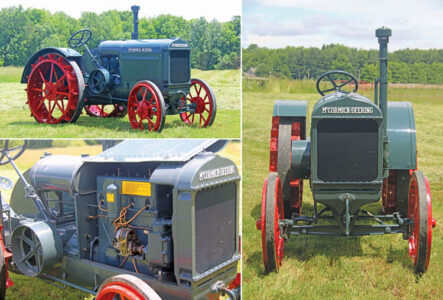
There were 215,000 McCormick-Deering Model 10-20 tractors manufactured at International’s Chicago complex from 1923 to 1939. This included the industrial version called “Model 20.” Its original cost was estimated to be $785.
With a weight of 3,000 pounds, the Model 10-20 is powered by an International Harvester 4.6L, 4-cylinder kerosene engine. It was drawbar tested at 20hp and 24hp on the belt. The tractor was suitable for medium-sized farming operations and capable of pulling a two-bottom plow.
1938 Farmall Model F-12 – “We were pleased to come by this restored tractor for our collection barn. The early F-12s were delivered with steel wheels. With ours being a later model, it has rubber tires,” Daryl noted.
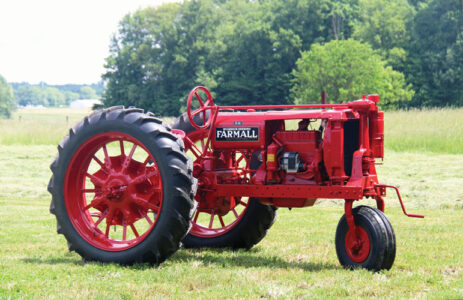
International Harvester produced this small, two-plow, row-crop tractor under the Farmall name from 1932 to 1938. The early F-12s were painted gray, like the forerunner, named Regular. Beginning with the 1936 model, the F-12 was painted bright red to increase visibility. This color soon became the trademark color for the Farmall line.
A total of 123,442 Model F-12s rolled out of International’s Chicago plant. An additional 2,848 were produced in International’s Neuss, Germany, operation. Powered by a 1.9L, four-cylinder gas engine, it has a drawbar tested 12hp, whereas the belt tested 16hp.
Rural Heritage
Daryl Yoder grew up on a small Amish farm near Nappanee, Indiana. “Dad worked the farm with a team of draft horses. Early chores for us six kids were helping clean the hog pens and gathering eggs from our flock of chickens,” Daryl said.
“With a little more responsible age, we were allowed to do the feed grinding and haul manure with a tractor. That task was done with an Allis-Chalmers Model D-17. When the farm required more power, Dad bought an International Model 560. After a few years, that tractor was traded for an International Model 706.”
Daryl’s interest in engines evolved over time. “Dad liked the old steam engines, so us boys tagged along to steam shows with him. I liked those engines so I started messing around with small engines. But the serious interest in tractors resulted from Rentown Old-Fashion Days, as mentioned before,” he said.
Collection and exhibition
“With several antique tractors on hand, we’ve exhibited at a few local shows. They include Nappanee Power from the Past Show, Shipshewana Steam & Gas Show, and the Northeast Indiana Steam & Gas show at LaGrange. Resulting from our commitment collecting antique tractors, we’re always looking for pre-1930 International versions,” Daryl said.
“Collecting tractors has been an enjoyable experience. I’ve learned a lot through meeting other collectors who share information about their tractors. Through our local Rentown Old-Fashion Days, it’s exciting to see people bring their antique tractors, and then put them to work through demonstrations. It seems like there’s always something new and different with each year’s event.”
If you would like to learn more about Daryl Yoder’s International Harvester antique tractor collection, your call is welcomed during the evening by phone: 574.248.2542.
Freelance writer Fred Hendricks of Mansfield, Ohio, covers a vast array of subjects relating to agriculture. Contact Fred at fwhendricks@gmail.com


