
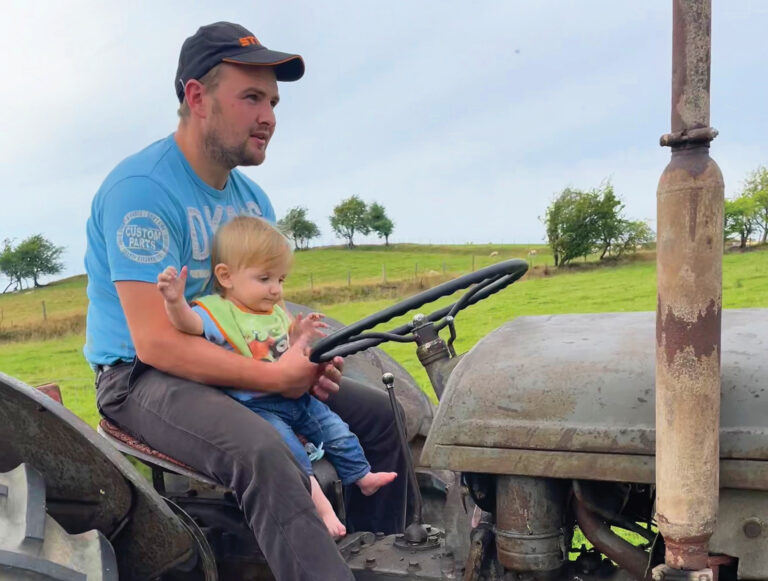
In my work as a “rural heritage journalist” (a term which is rather “bigging up” my work, as really all I do is go around chatting and listening to interesting people), I come across a lot of old tractors. Some of these old tractors are extremely unusual and very valuable, but it isn’t necessarily the case that these “wow factor” tractors will make the best stories. Often it is the more ordinary old tractors that make the best stories, and this month’s story features an old tractor that some might rightly say is quite commonplace here in the U.K., namely an antique Ferguson tractor.
The little grey Ferguson tractors were made in the hundreds of thousands, and at one time pretty much every other farmer would have owned one. There are more of these tractors on the vintage circuit than any other type of tractor … so what makes this particular Fergie worth writing about, and what makes it, to me at least, more interesting than some rarity that is worth perhaps £10,000 more?
Well, you see, so many of the extremely rare and expensive tractors have no back story. They have very often been bought at auction by a collector who knows nothing of the tractor’s past, and who has very often only driven the tractor a few meters from trailer to the show-ring. Don’t get me wrong, rare mahcines are always interesting to look at, but the older I get the more interested I am in the stories that go with these old tractors, and the less interested I am in their monetary value.
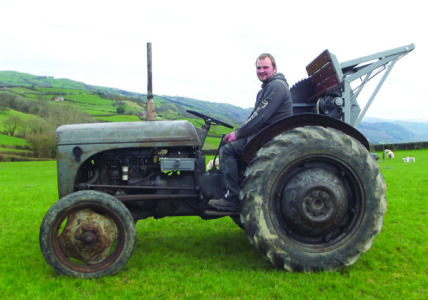
I might be a sentimental old fool but I truly believe that old things – buildings, antiques and old machines, to some extent — seem to absorb some of the stories of the people who lived with them, drove them or handled them. What really drew me to this particular Ferguson tractor is the fact that the current owner of the tractor, Aled Jones, is the fourth generation to own the tractor, and that it has always been owned, since new, by the same family, in the same little corner of North Wales.
In the Welsh language there is a saying, “dŷn ei filltir sgwâr” meaning “a man of his square mile.” It describes a person who has always stayed close to his roots, and who never strays far from the place where he was born. This saying was true about a lot of the old farmers around these parts, but it is also true of Aled Jones’ little grey Fergie. This tractor has never travelled far from the dealership in the little market town of Llanrwst, where it was bought new in 1950.
Hand-painted registration remains on antique Ferguson tractor
In 2016, Aled became the new custodian of the tractor, and like his great-uncle, who endeavoured to keep the tractor in the family, Aled too felt that it was important to ensure that the tractor remained in the family, and that it should stay here in the Conwy Valley. In these days of internet auctions and sales, it is becoming a rare thing to find a tractor that has remained in the same family and the same area for more than 70 years. It has been a blessing that not only did the tractor stay in the family, but also that it was stored indoors and was always well looked after.
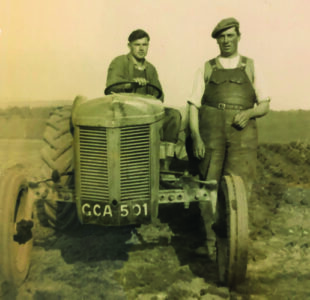
It was Aled’s grandfather’s stepfather – a man known locally as Gwilym Moelogan Bach – who bought the tractor new in 1950. A treasured family photograph shows the tractor with Aled’s grandfather, Brynle Owen Roberts, as a young man in the driving seat, and his stepfather, Gwilym Moelogan Bach, standing beside him. Maelogan Bach was not Gwilym’s born surname, but it was the name of his farm, because here in Wales people were often informally known by their family farm, rather than their born surname. It was practical to refer to people using the name of their home, because a lot of people might share the same surname, for example Jones was (and is) a popular surname in Wales, but also in a local farming community it gave a person a link to a place, as if to announce that this is where their roots are. The tradition of using the home name in place of a surname continues today, but it is mostly only seen in old farming families, however it is something that is quite touching to see in today’s world, where people move around so much.
This photograph, taken in the early 1950s, shows the tractor with the down-swept exhaust that it came out of the factory with, but at some stage the exhaust was replaced with an upright example, which is still on the tractor today. Here in the U.K., if a tractor is to be used on the roads, it is legally required to be road-registered. Cars and tractors today have a license plate consisting of a mixture of numbers and letters, but in the 1950s, this was often hand-painted onto tractors.
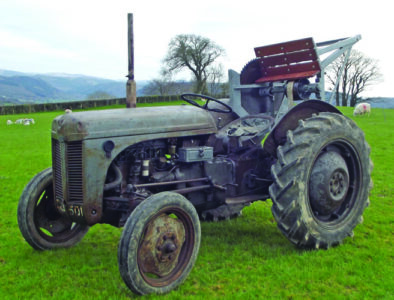
The hand-painted vehicle registration that we can see in the old photograph is still visible on the tractor today, and it is wonderful that in all these years no one has painted over this, as an over-zealous restorer could easily have done so, and something of the tractor’s unique character (as well as the original registration) might well have been lost. Aled’s great uncle recalls that it was the dealership that painted the “number plate” onto the front of the tractor, rather than the family themselves.
Ferguson tractor proves its worth on the farm
Gwilym Moelogan Bach was a horseman, and prior to the arrival of the Ferguson tractor, all of the work on the farm was done by a pair of draught horses. Tractors had of course been on the scene here in the U.K. for many decades, but in North Wales many of the smaller scale farmers continued to farm using working horses right up into the 1950s. Given that Gwilym had never owned a tractor before he bought the Ferguson, one can imagine that this shiny new tractor must have caused a great deal of excitement it when it arrived on the farm. Aled’s great-uncle Elwyn remembers the day that the Ferguson arrived on the farm. “I was about 9 years old and it was Tuesday, February 14, so it was Valentine’s Day,” he recalls, “and Market Day in Llanrwst.”
Gwilym also bought a Ferguson plough and a mowing machine to accompany his new tractor, but for other work, the horses were still used, because even though mechanisation arrived on the farm the day that the Fergie rolled up the drive, the family kept their working horses for a number of years after buying the tractor. The horses remained on the farm as a back-up. After all, there was always a chance that these new-fangled tractors could break down, and it made sense to have the reliable and familiar horses there as insurance. There were also a number of implements on the farm which were horse-drawn, and while some of these were converted to work behind a tractor, there was quite a crossover period where both horses and the tractor worked alongside each other.
After the horses left the farm, the family used the Ferguson for all of the farm work. At hay time, it was used for mowing and turning the hay. When it came to carrying the hay off the field, the tractor was fitted with a hay sweep, and the hay was carted into the barn where it was stacked loose using a pitch fork. The tractor would also be used to carry milk in churns in the transport box to the village, and it would make regular trips to the mill, carrying grain grown on the farm to be crushed and ground.
Even when larger tractors arrived on the farm, the old Fergie was still kept in work and it would be called on to row hay and for odd jobs where a smaller tractor was required. Aled’s great-uncle Elwyn recalls many happy memories of using the tractor, getting stuck here and there on the farm and driving it in the snow; “The narrow front tyres made it quite good in the snow!” he recalls. Elwyn also has memories of John Cae Coch, a local farmer and mechanic, who would come around every year to service the tractor.
Restoring the family heirloom tractor
During the 1990s, there was something of a clear-up going on at the farm, and various bits of machinery were being sold, but luckily Aled’s great-uncle Elwyn wanted to make sure that the little tractor was preserved and kept in the family, so he took the Ferguson and stored it in his garage in the little market town of Llanrwst. Occasionally Elwyn would fire up the old tractor, to make sure it was alright, but it was largely left to slumber for over two decades.
Then, in 2016, Aled became the next custodian of the tractor and extremely proud he was to be the new owner of this treasured little family heirloom. Aled explains how glad he was that the tractor had never been re-painted, for although restoration has its place in the preservation of old tractors, it would have been a real shame if this particular tractor had been unsympathetically restored, because not only would the original painted-on registration have been lost, but the lovely patina, the paintwork worn smooth down by generations of Aled’s family, would have been lost too.
It seems there’s a lot of luck in this story. It was lucky that Aled’s grandfather, Brynle, had the tractor passed onto him by his stepfather, lucky that neither of these men decided to trade the tractor in for a newer model, and it was lucky that Aled’s great-uncle Elwyn decided to preserve the tractor safely in a shed for the next generation. It was also fortuitous that by the time Aled had grown into a young man he had become something of a tractor enthusiast, and although he doesn’t work as a farmer, he was keen to become the next custodian of the family tractor.
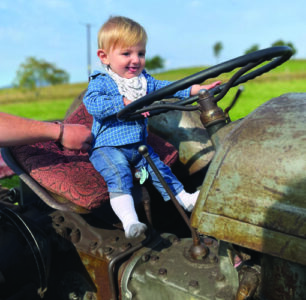
When Aled inherited the tractor, it was lurking under a pile of belongings in his great-uncle’s garage. When he unearthed the tractor, he thought he might encounter a few problems getting the Fergie going. After all, it had been standing for several years by that point, but in the end, all it took was some fresh fuel, a new battery, some air in the tyres and it was off! “I was really pleased that it fired up without any trouble,” Aled says. Since that day, Aled has become a father himself, so one day Aled’s son, Dyfan, will be the fifth generation of the family to own the Fergie.
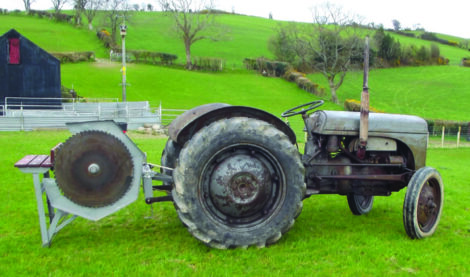
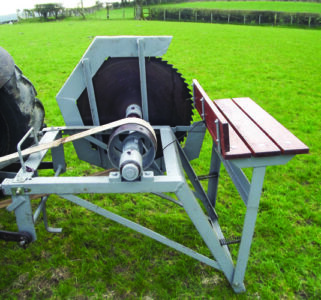
Restored tractor sawbench typical of Ferguson system
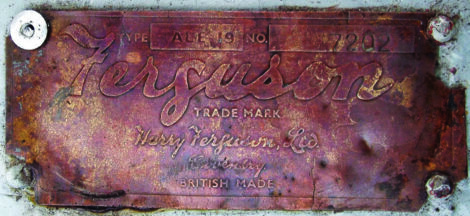
The little grey TE20 Ferguson tractor was a reliable, affordable, simple-to-use machine, but what made it stand head and shoulders above the other tractors that were available at the time was its innovative three-point linkage system. Harry Ferguson, the man behind the machine, was something of a genius when it came to business. He didn’t just design a tractor that everyone would want to own, he also built a range of implements to work with his tractor.
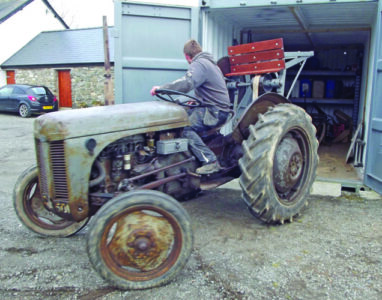
Many people who bought a new Ferguson tractor between the late 1940s and early 1950s also invested in several Ferguson implements. Ferguson’s range of implements was vast, and it included hedge cutters, plant sprayers, ploughs, harrows, drills, potato planters and diggers, a variety of loaders, rakes, hole borers, graders, earth scoops, fertiliser spreaders, muck spreaders, trailers and portable sawbenches
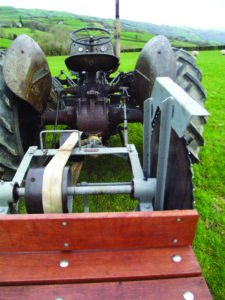
On the day I visited Aled, he had a Ferguson sawbench mounted on the tractor, and this too, he tells me, is something of a family heirloom. “My great-grandfather from the other side of the family bought the sawbench when it was new,” he says, “but by the time I found it, it was in really poor condition and I had to replace the wood, the blade, the springs and some of the nuts and bolts, as almost everything had either rusted solid or rotted away.”
Once the sort of thing that could be found covered in rust, dumped in the corner of a field, Ferguson sawbenches are now attracting interest, and good examples can fetch several hundred pounds. Gone are the days when these implements were worth nothing but scrap money. Nowadays it is well worth restoring a Ferguson implement, particularly as many are still capable of a good day’s work. Aled has worked the sawbench to cut a few bags of logs, and is pleased to see it work as it should. FC
Josephine Roberts lives on an old-fashioned smallholding in Snowdonia, North Wales, and has a passion for all things vintage. Email her at josiewales2021@aol.com.
Originally published as “The Family Fergie” in the September 2023 issue of Farm Collector magazine.


